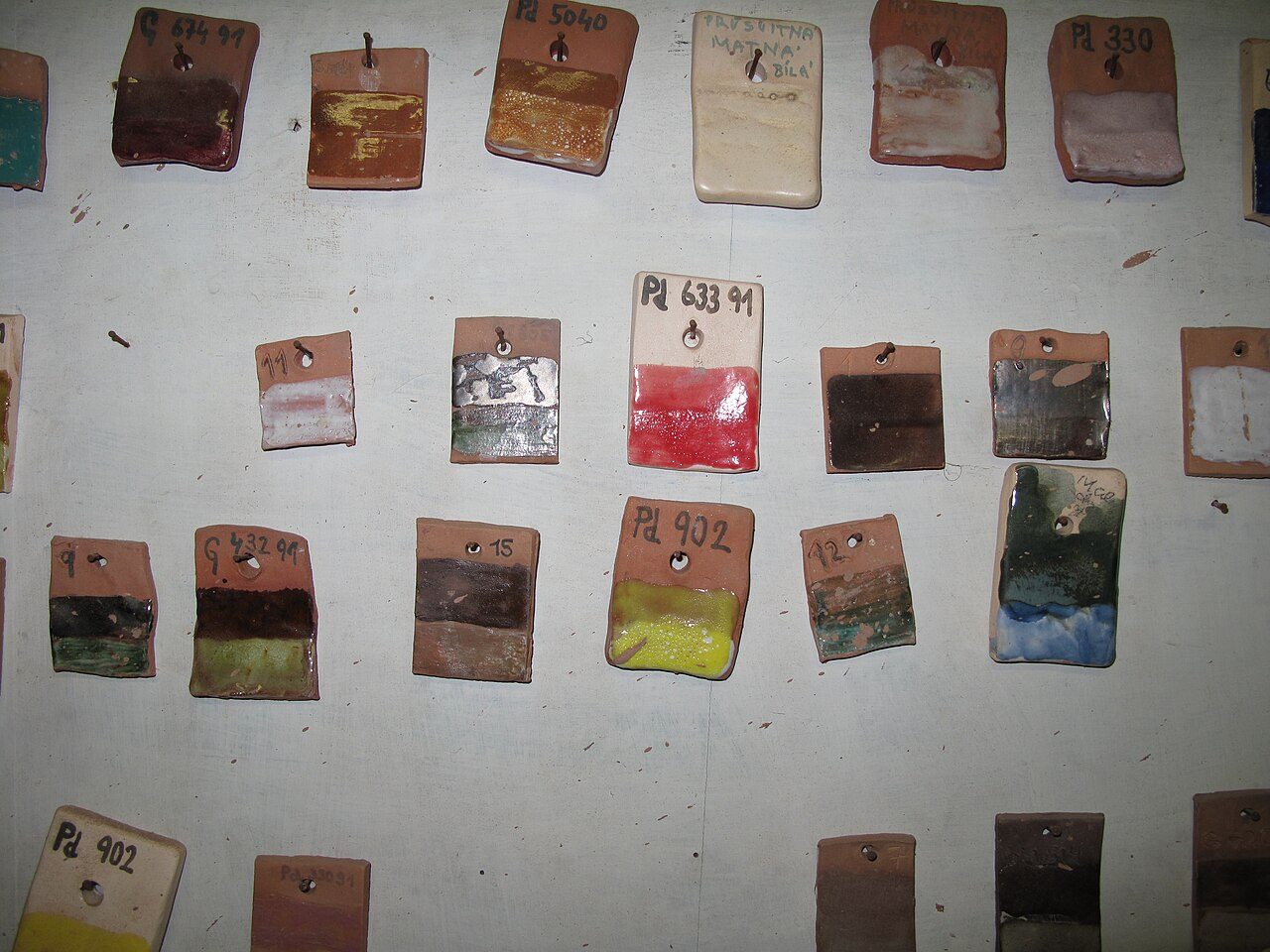
The tradition & historical record
6 min read · 2 sourcesCeramic glaze, or simply glaze, is a glassy coating on ceramics. It is used for decoration, to ensure the item is impermeable to liquids and to minimize the adherence of pollutants. Glazing renders earthenware impermeable to water, sealing the inherent porosity of earthenware. It also gives a tougher surface. Glaze is also used on stoneware and porcelain. In addition to their functionality, glazes can form a variety of surface finishes, including degrees of glossy or matte finish and color. Glazes may also enhance the underlying design or texture either unmodified or inscribed, carved or painted. Most pottery produced in recent centuries has been glazed, other than pieces in bisque porcelain. Tiles are often glazed on the surface face, and modern architectural terracotta is often glazed. Glazed brick is also common. Sanitaryware is invariably glazed, as are many ceramics used in industry, for example ceramic insulators for overhead power lines. The most important groups of traditional glazes, each named after its main ceramic fluxing agent, are: 1
Ash glaze, traditionally important in East Asia, simply made from wood or plant ash, which contains potash and lime. Feldspathic glazes of porcelain. Lead glazes, plain or coloured, are glossy and transparent after firing, which need only about 800 °C (1,470 °F). They have been used for about 2,000 years in China e.g. sancai, around the Mediterranean, and in Europe e.g. Victorian majolica. Salt-glaze, mostly European stoneware. 1
History
Historically, glazing of ceramics developed rather slowly, as appropriate materials needed to be discovered, and also firing technology able to reliably reach the necessary temperatures was needed. Glazes first appeared on stone materials in the 4th millennium BC, and Ancient Egyptian faience (fritware rather than a clay-based material) was self-glazing, as the material naturally formed a glaze-like layer during firing. Glazing of pottery followed the invention of glass around 1500 BC, in the Middle East and Egypt with alkali glazes including ash glaze, and in China, using ground feldspar. By around 100 BC lead-glazing was widespread in the Old World. Glazed brick goes back to the Elamite Temple at Chogha Zanbil, dated to the 13th century BC. The Iron Pagoda, built in 1049 in Kaifeng, China, of glazed bricks is a well-known later example. Lead glazed earthenware was probably made in China during the Warring States period (475 – 221 BC), and its production increased during the Han dynasty. High temperature proto-celadon glazed stoneware was made earlier than glazed earthenware, since the Shang dynasty (1600 – 1046 BCE). During the Kofun period of Japan, Sue ware was decorated with greenish natural ash glazes. From 552 to 794 AD, differently colored glazes were introduced. The three colored glazes of the Tang dynasty were frequently used for a period, but were gradually phased out; the precise colors and compositions of the glazes have not been recovered. Natural ash glaze, however, was commonly used throughout the country. In the 13th century, flower designs were painted with red, blue, green, yellow and black overglazes. 1
Composition
Raw materials for ceramic glazes generally include silica, which will be the main glass former. Various metal oxides, such as those of sodium, potassium and calcium, act as flux and therefore lower the melting temperature. Alumina, often derived from clay, stiffens the molten glaze to prevent it from running off the piece. Colorants, such as iron oxide, copper carbonate or cobalt carbonate, and sometimes opacifiers including tin oxide and zirconium oxide, are used to modify the visual appearance of the fired glaze. Glazes need to include a ceramic flux which functions by promoting partial liquefaction in the clay bodies and the other glaze materials. Fluxes lower the high melting point of the glass forms silica, and sometimes boron trioxide. Salt glazing is a vapor-glazing process where salt or soda ash is introduced into a high-temperature kiln. The resulting sodium vapor reacts with the alumina and silica in the clay body, forming a durable sodium-silicate glass coating. Though historically significant, the method is now largely obsolete due to the release of toxic hydrogen chloride gas and other environmental concerns. 1
Production
Preparation begins with the comminution of the raw materials by milling, such as by a ball mill, jet mill and vibro-energy mill, to achieve a specific particle size distribution; this ensures a homogeneous melt during the later firing process and a smooth surface finish. The resulting mixture is then suspended in water with the addition of electrolytes to form a stable slurry or slip that can be applied to the ceramic substrate via dipping, spraying or curtain coating. While many glazes incorporate raw minerals such as feldspar, quartz and kaolin, some formulations use frit. In the production of frit, raw materials are first melted into a glass and then rapidly quenched in water to form shattered droplets, which are then re-ground; this pre-reacts the components and renders toxic or soluble materials safe and stable for the final glaze However, many glazes do not contain frit, relying instead on a precise balance of raw un-melted minerals that react during the final kiln firing to form the protective glass layer. The choice between raw and fritted glazes is typically dictated by the required firing temperature, the solubility of the necessary chemicals and the desired thermal expansion of the finished surface. 1
Application
Glaze application methods are selected based on the desired finish and the specific geometry of the ceramic form. While many processes involve applying glaze to biscuit-fired ware to take advantage of its high porosity and structural strength, techniques are also adapted for greenware in a process known as once-firing. Dipping involves submerging a piece into a large vat for a few seconds to achieve a perfectly even, professional-grade coating. For more controlled or multi-coloured decorative work, brushing allows for the layering of different pigments, though multiple coats are necessary to ensure the finish remains opaque. Pouring is the standard technique for coating the interiors of narrow-necked vessels or creating intentional drip effects on the exterior surface. For large-scale articles or smooth gradients, spraying with an airbrush or automated spray booth provides a fine, atomised mist that builds up colour gradually. Finally, more tactile techniques like sponging and splattered application can be used to introduce organic textures and speckled patterns to the surface. In high-volume manufacturing, spraying is the dominant technique due to its superior efficiency, precision, and ease of automation. Unlike dipping or pouring, which require significant volumes of standing liquid glaze, spraying allows for a thinner, more controlled application that reduces material waste. 1
Firing
Whether whiteware is glazed after a preliminary firing or via a once-firing (raw glazi… 1
The text above is adapted from the Wikipedia article “Ceramic glaze”, available under the Creative Commons Attribution-ShareAlike 4.0 licence. 1
ceramic glaze is layer or coating of vitreous substance fused to a ceramic object, according to the structured record cited below. This entry was generated automatically from that record and has not yet been reviewed by a person familiar with the tradition. 2
The source record links this tradition to 26 external registers, which can be verified through the citation. 2