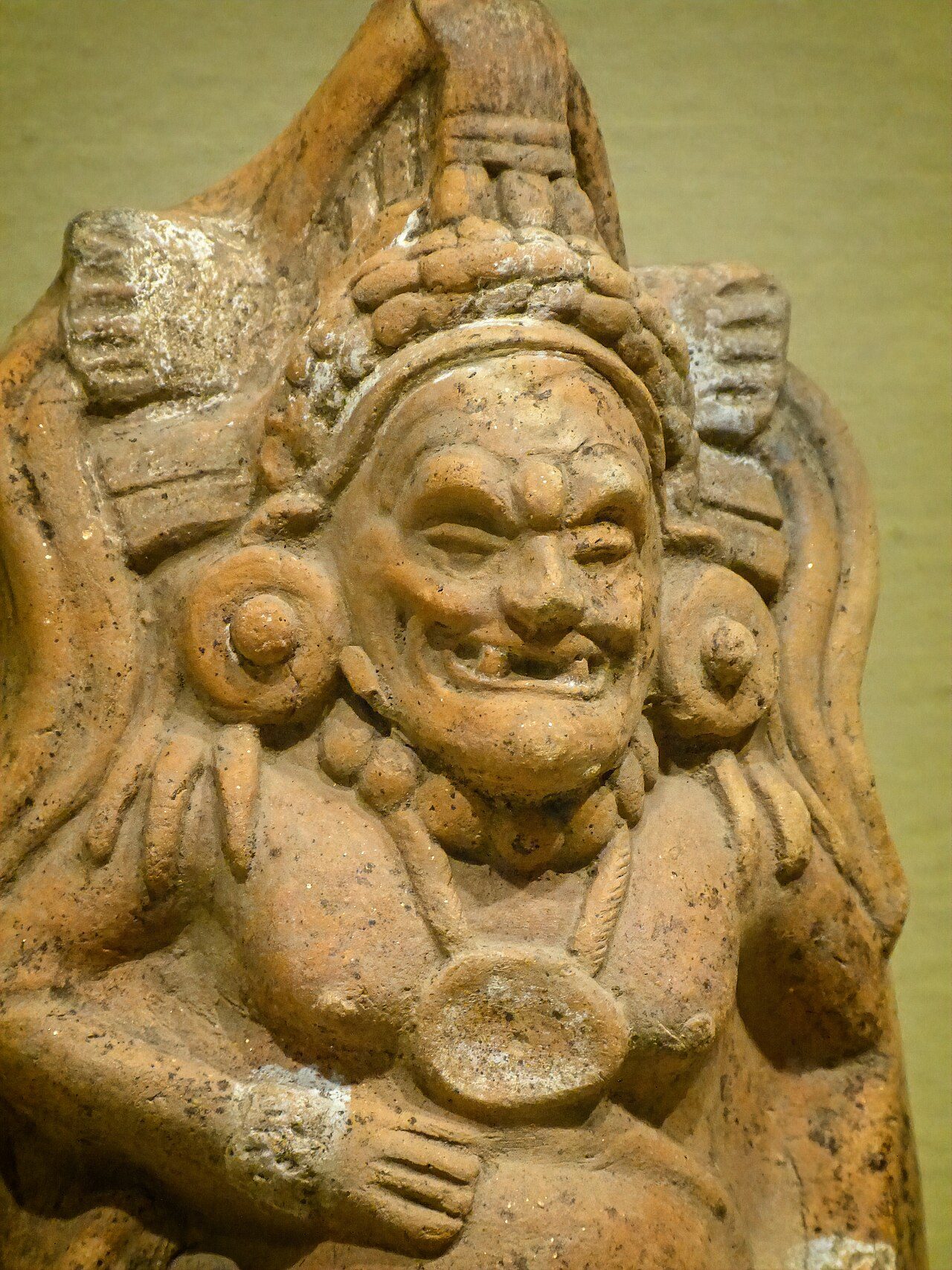
The tradition & historical record
6 min read · 2 sourcesCeramics of Indigenous peoples of the Americas is an art form with at least a 7500-year history in the Americas. Pottery is fired ceramics with clay as a component. Ceramics are used for utilitarian cooking vessels, serving and storage vessels, pipes, funerary urns, censers, musical instruments, ceremonial items, masks, toys, sculptures, and a myriad of other art forms. Due to their resilience, ceramics have been key to learning more about pre-Columbian Indigenous cultures. 1
Materials and techniques
The clay body is a necessary component of pottery. Clay must be mined and purified in an often laborious process, and certain tribes have ceremonial protocols to gathering clay. Different tribes have different processes for processing clay, which can include drying in the sun, soaking in water for days, and repeatedly running through a screen or sieve. Acoma and other Pueblo pottery traditionally pound dry clay into a powder and then remove impurities by hand, then running the dry powder through a screen, mixing it with a dry temper, and then mixing water to create a plastic paste. In preparing the clay, potters spend hours wedging it to remove air pockets and humidity that could easily cause it to explode during firing. The clay then needs to "cure" over time. Coiling is the most common means of shaping ceramics in the Americas. In coiling, the clay is rolled into a long, thin strands that are coiled upon each other to build up the shape of the pottery. While the potter builds the coils up, she also blends them together until there was no trace of the ropes of clay entwined to form the pot, no deviation in the thickness of the walls, and therefore no weaknesses. Potter's wheels were not used prior to European contact and are only used today by a limited number of Native American artists. Pinch pots and other small clay objects could be formed directly by hand. Hohokam potters and their descendants in the American Southwest employed the paddle-and-anvil technique, in which the interior clay wall of a pot was supported by an anvil, while the exterior was beaten with a paddle, smoothing the surface. In precontact South America, ceramics were mass-produced using molds. Slip is a liquid clay suspension of mineral pigments applied to the ceramics before firing. 1
Tempers
Tempers are non-plastic materials added to clay to prevent shrinkage and cracking during drying and firing of vessels made from the clay. Tempers may include: 1
Not all Indigenous American pottery requires added tempers; some Hopi potters use pure kaolin clay that does not require tempering. Some clays naturally contain enough temper that they do not required additional tempers. This includes mica or sand in clays used in some Taos Pueblo, Picuris Pueblo, and Hopi pottery, and sponge spicules in the clay used to produce the "chalky ware" of the St. Johns culture. Ceramics are often used to identify archaeological cultures. The type of temper (or mix of tempers) used helps to distinguish the ceramics produced by different cultures during particular time periods. For example, the Hohokam used schist containing silver mica as a temper in their plainware; the shiny particles of the mica gave the pottery a mystical shimmer. Grog, sand, and sandstone were all used by Ancestral Pueblo people and other Southwestern cultures. Crushed bone was used as temper in at least some ceramics at a number of sites in Texas. In the Southeastern United States, the earliest ceramics were tempered with fiber such as Spanish moss and palmetto leaves. In Louisiana, fiber as tempering was replaced first by grog and later by shell. In peninsular Florida and coastal Georgia sand replaced fiber as tempering. Still later, freshwater sponge spicules became an important temper in the "chalky ware" of the St. Johns culture in northeastern Florida. 1
Origin and spread
The earliest ceramics known from the Americas have been found in the lower Amazon Basin. Ceramics from the Caverna da Pedra Pintada, near Santarém, Brazil, have been dated to between 7,500 and 5,000 years ago. Ceramics from Taperinha, also near Santarém, have been dated to 8,000 to 7,000 years ago. Some of the sherds at Taperinho were shell-tempered, which allowed the sherds themselves to be radiocarbon dated. These first ceramics-making cultures were fishers and shellfish-gatherers. Ceramics appeared next across northern South America and then down the western side of South America and northward through Mesoamerica. Ceramics of the Alaka culture in Guyana have been dated to 6,000 to 4,500 years ago. Ceramics of the San Jacinto culture in Colombia have been dated to about 4530 BCE, and at Puerto Hormiga, also in Colombia, to about 3794 BCE. Ceramics appeared in the Valdivia culture in Ecuador around 3200 BCE, and in the Pandanche culture in Peru around 2460 BCE. The spread of ceramics in Mesoamerica came later. Ceramics from Monagrillo in Panama have been dated to around 2140 BCE, from Tronadora in Costa Rica to around 1890 BCE, and from Barra in the Soconusco of Chiapas to around 1900 BCE. Ceramics of the Purrón tradition in southcentral Mexico have been dated to around 1805 BCE, and from the Chajil tradition of northcentral Mexico, to around 1600 BCE. The appearance of ceramics in the Southeastern United States does not fit the above pattern. Ceramics from the middle Savannah River in Georgia and South Carolina (known as Stallings, Stallings Island, or St. 1
Arctic
Several Inuit groups, such as the Netsilik, Sadlermiut, Utkuhiksalingmiut, and Caribou Inuit (Qaernerimiut) created utilitarian pottery in historic times, primarily to store food. In Rankin Inlet, Nunavut, Canada, when the mine that employed much of the community closed down, the national government created the Rankin Inlet Ceramics Project, whose wares were successfully exhibited in Toronto in 1967. The project foundered but a local gallery revived interest in Inuit ceramics in the 1990s. 1
Eastern Woodlands
Hopewell pottery is the ceramic tradition of the various local cultures involved in the Hopewell tradition (ca. 200 BCE to 400 CE) and are found as artifacts in archeological sites in the American Midwest and Southeast. Mississippian culture pottery is the ceramic tradition of the Mississippian culture (800–1600 CE) found as artifacts in archaeological sites in the American Midwest and Southeast. 1
The text above is adapted from the Wikipedia article “Ceramics of Indigenous peoples of the Americas”, available under the Creative Commons Attribution-ShareAlike 4.0 licence. 1
Ceramics of indigenous peoples of the Americas is Pottery produced by the indigenous people of the Americas, according to the structured record cited below. This entry was generated automatically from that record and has not yet been reviewed by a person familiar with the tradition. 2
The source record links this tradition to 13 external registers, which can be verified through the citation. 2