The tradition & historical record
6 min read · 2 sourcesCeramics of Jalisco, Mexico has a history that extends far back in the pre Hispanic period, but modern production is the result of techniques introduced by the Spanish during the colonial period and the introduction of high-fire production in the 1950s and 1960s by Jorge Wilmot and Ken Edwards. Today various types of traditional ceramics such as bruñido, canelo and petatillo are still made, along with high fire types like stoneware, with traditional and nontraditional decorative motifs. The two main ceramics centers are Tlaquepaque and Tonalá, with a wide variety of products such as cookware, plates, bowls, piggy banks and many types of figures. 1
History
The making of ceramics in Jalisco extends far back into the pre Hispanic era. Early ceramics in the area were rough and utilitarian, for such purposes as cooking, carrying water or storing seeds. Some of these were multicolored, but the decorated faded because the pieces were not fired after painting. The Spanish introduced European techniques to the area, especially the potter's wheel to make more symmetrical containers and glazing to keep color and give a bright finish. Spanish introduced ceramics were slowly adopted by the indigenous population in most of New Spain but in Jalisco, their adoption was relatively quick. Demand was high, spurring a developed ceramics industry in the Guadalajara area. The ceramics industry was established by monks who not only evangelized the indigenous, they also taught them trades, such as European style pottery. The training allowed for indigenous traditions, such as burnishing to be combined with the use of high quality clay slips. It also allowed for a decorating styles influenced by European, indigenous and Oriental motifs. The Tonalá tradition became known as "Tonalá ware" "Polished ornamental ware" or "Guadalajara polychrome." A number of these pieces were exported Europe in the 17th and 18th centuries, mostly to Spain but examples reached Italy and other areas. However, in the later colonial period ceramics waned in Tlaquepaque, coming back in the 19th century with jars and Nativity scenes. 1
Traditional ceramic styles
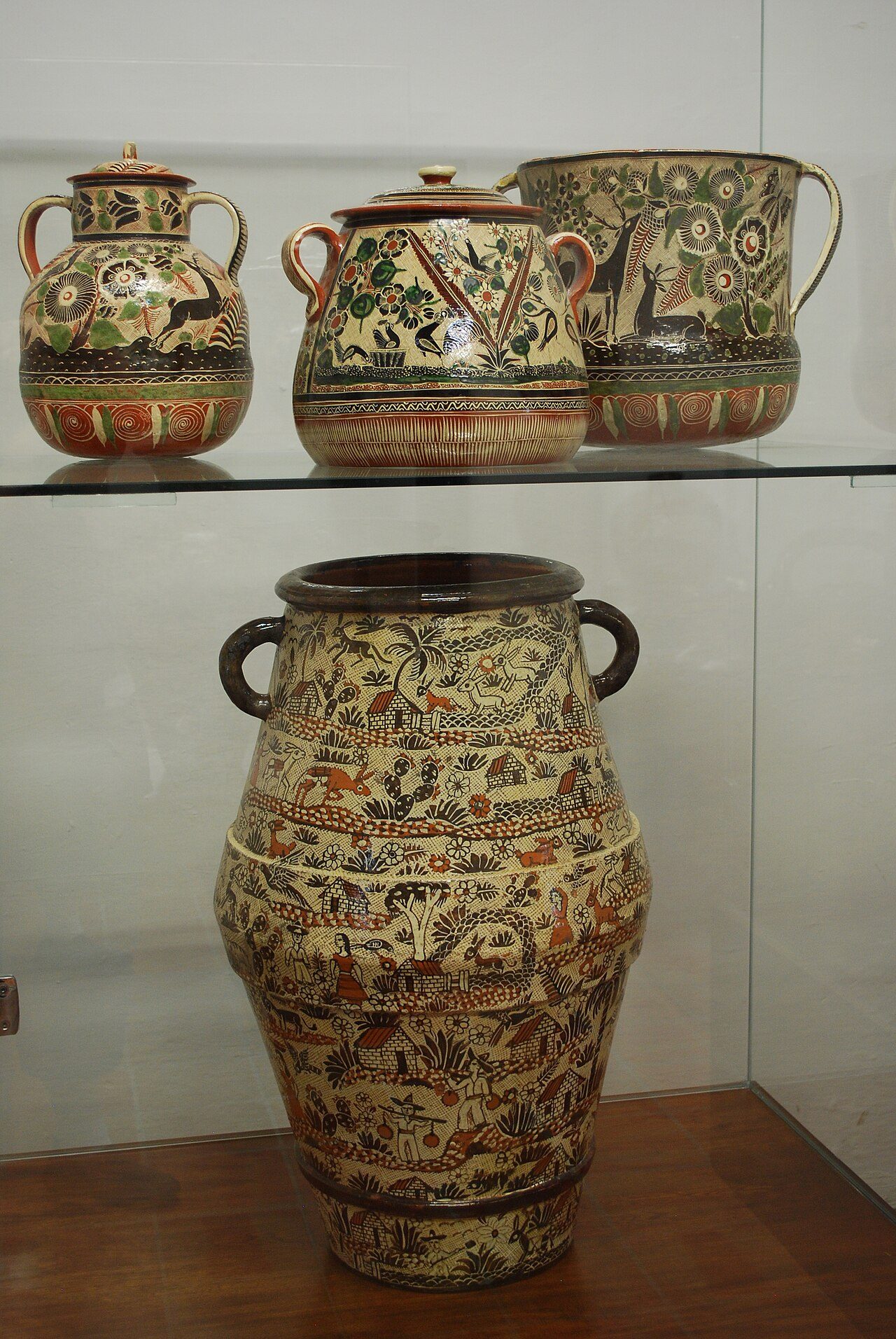
A wide variety of traditional low-fire and some high fire ceramics are made in Jalisco, ranging from cheap objects to artistic productions. The two main pottery producing municipalities are Tonalá and Tlaquepaque. Traditional ceramics styles include "bruñido", "bandera", "canelo", "petate" and "betus". The best known of these styles is bruñido, which translates to burnished. It probably descends from polychrome produced in this area en the 19th century. The name comes from the fact that these pieces are not glazed, but rather they are given a slip and then polished with a stone or pyrite. Many of these pieces are slender necked jugs or lamp bases, often decorated with animals, such as rabbits, with distorted characteristics, giving them a surreal look. The pieces are usually painted with delicate tones of rose, gray-blue and white on a background of a light coffee color, light gray and sometimes green or blue. Each piece is individually created. The attraction of this pottery is its appearance, as it is too porous to hold any liquid or food. One exception to this are thick large tubs mainly to store water or for bathing. Water stored in this kind of vessel takes on a flavor from the clay, which is actually desired by many people. Another exception is a water container with a fat body and long neck, with a ceramic cup placed upside down over the neck. These are called botellones or carafes. One town that specializes in these is El Rosario, near Tonalá. One variant of bruñido is black, which is often made into jars, flower vases, platters and skulls for Day of the Dead . Canelo is a type of bruñido is named for the color the fired clay turns out, which is various shades of cinnamon (canela in Spanish). It is burnished with lard and painted with ochre and brown tones. 1
High fire
Jalisco's high-fire ware is of the best produced in the country. High fire ceramics, including stoneware, were introduced to Jalisco by Jorge Wilmot and Ken Edwards in 1950s and 1960s, making Tonalá the first and primary production of this type of ceramic in Mexico. This production is considered between industrial and traditional handcrafted ceramic. These are fired at over 1,100 °C, causing the clay to vitrify and form a nonporous surface. The main difference between the Wilmot and Edwards styles is that Wilmot maintained the area's traditional decorative styles, focusing on images of suns, birds, eagles, lions and flowers. He also founded a new school of ceramic production which remains to this day, using a traditional green-gray background with images made of small dots, often of double headed eagles, lions and multicolored suns. Edwards' ceramics have a blue-gray background and delicate decorations with Oriental influence. Workshops from both traditions create elaborate bowls, jars, flower vases, and decorative pieces such as fish figures from miniatures to those measuring fifty centimeters. Wilmot created the Premio Nacional de la Cerámica in 1977 with two categories, traditional and contemporary ceramics. In the last twenty years, new categories have been added. In 1997, a museum dedicated to prize winners was inaugurated as the Museo del Premio Nacional de la Cerámica Pantaleón Panduro, named after a famous artisan. 1
Tonalá
Tlaquepaque and Tonalá are Jalisco's major ceramics centers with international recognition for their techniques and decorative styles, with high fire ceramics their most important production. The best clay in Jalisco is found in the Tonalá and Tlaquepaque areas, especially that in the El Rosario community. This clay is so fine, that the resulting works are similar to porcelain. Tonalá has long been recognized as a center for ceramics in Mexico. The streets are filled with artisan workshops and sidewalks stalls selling pottery and stoneware pieces. One thing that distinguishes Tonalá made ware is the decorative details. Two elements, the nahual and the "flor de Tonalá" are common. A nahual is a pre-Hispanic shape shifter or shaman, often drawn as a smiling cat. The flor de Tonalá (Tonalá flower) first appeared in pottery design in the early 20th century. Its distinctive shape is an oval center with rounded petals that form a scalloped design. These elements can appear in all of the types of pottery that is produced here. Market days, Thursday and Sunday, are a good chance to see a wide variety of ceramics of the region, all spread out on the streets of the downtown. While there are a wide variety of figures, utensils and decorative items, it is not all that is produced. Many manufacturers sell their wares through other channels. To find the best pieces, one needs to visit the workshops and factories. Tonalá is known for its "barro de olor" (lit. 1
Tlaquepaque
Tlaquepaque is from the name Tlacapan, which roughly translates to "men who make clay utensils with their hands". 1
The text above is adapted from the Wikipedia article “Ceramics of Jalisco”, available under the Creative Commons Attribution-ShareAlike 4.0 licence. 1
Ceramics of Jalisco is type of Mexican ceramics, according to the structured record cited below. This entry was generated automatically from that record and has not yet been reviewed by a person familiar with the tradition. 2
The source record links this tradition to 1 external register, which can be verified through the citation. 2