The tradition & historical record
6 min read · 2 sourcesThe term Cerreto ceramics refers to the ceramic production of the neighboring municipalities of Cerreto Sannita and San Lorenzello (Benevento). This designation combines the previous terms "Cerreto ceramics" and "Laurentina ceramics". Cerreto ceramics, recognized by the Ministry of Industry, Commerce, and Crafts as "artistic and traditional ceramics", has ancient origins, although the most flourishing period of production was after the earthquake of 5 June 1688. The reconstruction of Cerreto Sannita attracted many foreign "faenzari" (ceramists), especially from Naples, who contributed to creating the eighteenth-century shapes and decorations that still characterize Cerreto ceramics today. The father of Cerreto ceramics was the Neapolitan faenzaro (ceramist) Nicolò Russo, who moved to Cerreto Sannita in 1692. In his workshop, men were trained who gave rise to entire generations of Cerreto and Laurentina ceramists: Antonio Giustiniani, Domenico Marchitto, and Santi Festa. The decorator Lorenzo Salandra, one of the most important figures in Neapolitan majolica, also worked there. 1
14th century to the earthquake of 5 June 1688
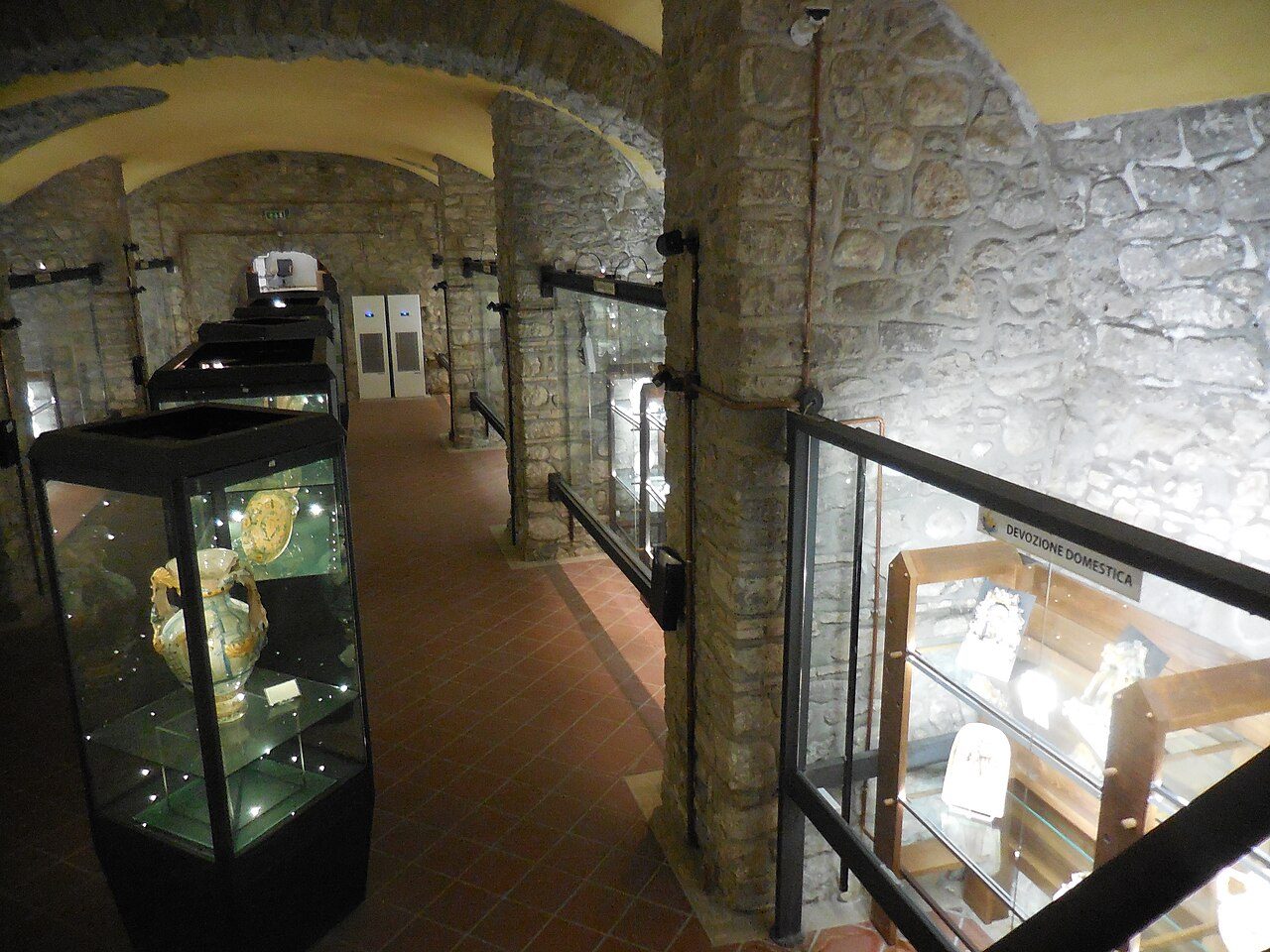
According to the scholar Salvatore Biondi, the oldest artifact of Cerreto-Laurentina ceramics would be a statuette depicting the Ecce Homo, owned by Caterina Sanframondi, the first abbess of the Monastery of the Poor Clares in Old Cerreto. The statuette, following the dispersal of Biondi’s ceramic collection, has been lost. During excavations among the ruins of Old Cerreto, destroyed by the 1688 earthquake, numerous ceramic fragments were found, now preserved in the civic museum, testifying to the existence of ceramic production even before 1688. 1
The local historian Nicola Rotondi, in a book written in the 19th century, noted that "in the new and old Cerreto, potters have always crafted vessels, even large ones, glazed and variously painted [...]" adding that "here (in Cerreto) this art, in the uncertainty of its rules and despite the many practitioners, only a few distinguished themselves for the delicacy of the colors and the shape [...]". The local historian Dr. Renato Pescitelli argues that before 1688, only minor ceramists, not classifiable as "faenzari", were present in Cerreto Sannita. In support of this thesis, Pescitelli notes the lack of documents explicitly mentioning the presence of "faenzari" in Cerreto, although he acknowledges the presence of several vasai and pignatari workshops in the 17th century, as evidenced by two documents preserved in the Cerreto Sannita Diocesan Archive. The first document mentions the existence, near the Church of San Giovanni, of a street inhabited by several pignatari, while the second states that only "three small houses of a potter" survived the destruction of the earthquake of 5 June 1688. 1
1688 to the present
The earthquake of 5 June 1688 devastated Cerreto Sannita and caused significant damage to San Lorenzello. The reconstruction of the two towns attracted numerous foreign artisans, particularly from Naples. Many ceramists settled in the two towns, contributing with their work to the creation of a new decorative repertoire more aligned with the artistic period of that era. In the "new" Cerreto, there was a true ceramists’ quarter located near the Cerreto Sannita Cathedral. During the renovation of several buildings in that area, remains of kilns for firing terracotta and ceramics were found. In this "ceramists’ insula," there were the workshops of Francesco Iadomaso, a Cerreto native, and Carlo Coluccio from Campobasso. In the same area was the workshop of Nicolò Russo, a master faenzaro who moved from Naples in 1693. Many young apprentices worked in his workshop, becoming the main figures of Cerreto ceramics in the 18th century: Domenico Marchitto, Santi Festa, Melchiorre Cerri, Nicola and Crescenzo Petruccio, Nicola Marchitto, Salvatore Paduano, and Giuseppe Paolino. 1
Ceramic production
Since 2001, the ceramic production of Cerreto Sannita and San Lorenzello has been regulated by a disciplinary approved by the Consiglio nazionale ceramico on 21 November 2001. Typical Cerreto artifacts include ceremonial plates, pharmacy jars, lobed jugs, holy water fonts, and "riggiole" (tiles) with wind rose or garland decorations. The majority of artifacts feature decorations with religious, naturalistic, or landscape motifs. Article 4 of the ceramic disciplinary meticulously lists the shapes of the Cerreto Sannita and San Lorenzello ceramic tradition: service plates have a double grooved rim with an average size of 23–24 cm; tureens, of various sizes, are adorned with raised fruit on the lid; medium and large holy water fonts feature architectural, floral, and sacred plastic elements; the shape of holy water fonts is temple-like; pharmaceutical albarelli have a rounded lower body with a flared rim and no lid; oil lamps have one or two handles. Article 5 of the ceramic disciplinary lists the stylistic features of the Cerreto Sannita and San Lorenzello ceramic tradition. In the 17th century, ivory-colored glaze prevailed, with decorations in a compendiario style (summarized and simple, with essential and sober motifs) or faunal-floral or landscape styles. In the 18th century, the glaze was "grayish-blue white," with decorations influenced by Baroque taste, predominantly floral and landscape. In the 19th century, the glaze was slightly yellowish, with prevailing geometric or compendiario decorations. The traditional colors of the 17th–18th centuries were yellow, copper green, Cerreto blue, and orange. 1
Criticism
According to Judge Vincenzo Mazzacane, a local historian and ceramic collector, the most notable figures in Cerreto ceramics were the Giustiniani and Marchitto families. However, this judgment has been surpassed over time due to subsequent studies. In particular, the ceramologist Guido Donatone highlighted the pivotal role of the ceramist Nicolò Russo and his workshop, where men were trained who gave rise to entire generations of ceramists (the Giustiniani, Marchitto, and Festa families) and where Lorenzo Salandra, a "key figure in Neapolitan majolica," worked as a decorator. The local historian Cosimo Formichella further noted that Mazzacane’s judgment does not account for the local craftsmanship "present before the 1688 earthquake," considered the "basis" and "foundation" of the more famous 18th-century Cerreto ceramic art. The art historian Mario Rotili, unlike Mazzacane, emphasizes the artistic value derived from the works of humbler ceramists, as it is precisely their spontaneity that allowed Cerreto ceramics to define themselves, avoiding mere imitations of other manufactures. Guido Piovene states that Cerreto ceramics are similar to the ceramics of Castelli in Abruzzo, though with a more decorative taste and lighter design. Umberto Tergolina-Gislanzoni-Brasco, who studied Cerreto pharmacy jars (albarelli) in particular, claims that Cerreto ceramics derive from Abruzzo ceramics. 1
The text above is adapted from the Wikipedia article “Cerreto ceramics”, available under the Creative Commons Attribution-ShareAlike 4.0 licence. 1
Cerreto ceramics is ceramic production in Cerreto Sannita and San Lorenzello, Italy, according to the structured record cited below. This entry was generated automatically from that record and has not yet been reviewed by a person familiar with the tradition. 2
The source record links this tradition to 1 external register, which can be verified through the citation. 2