The tradition & historical record
5 min read · 2 sourcesChanticleer and the Fox is a fable that dates from the Middle Ages. Though it can be compared to Aesop's fable of The Fox and the Crow, it is of more recent origin. The story became well known in Europe because of its connection with several popular literary works and was eventually recorded in collections of Aesop's Fables from the time of Heinrich Steinhowel and William Caxton onwards. It is numbered 562 in the Perry Index. 1
Story
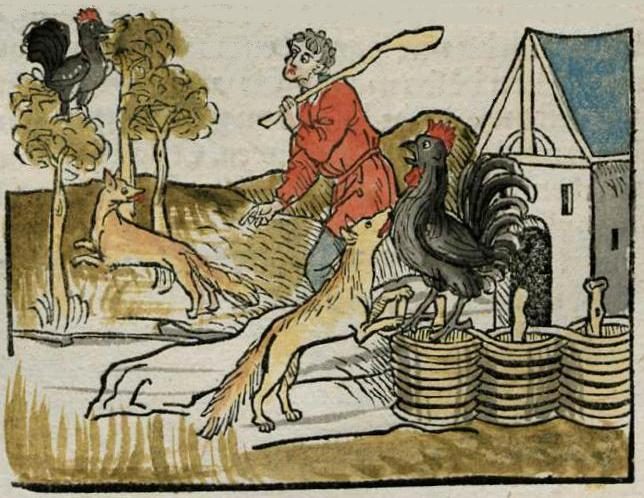
Chanticleer is a rooster who lives with his three wives in an enclosure on a rich man's farm. He is warned in a dream that he will be captured by a predator, but he ignores this warning. His favourite wife, Pinte, tells him that she has seen the fox Renart lurking in the cabbage patch. Eventually the two creatures meet, and Renart flatters Chanticleer by talking about how Chanticleer's father was a great singer. If the son is to equal his father, he explains, he must shut his eyes as he stretches his neck to crow. When Chanticleer shuts his eyes and crows, the fox seizes him and makes a run for the woods, with the farm workers and a mastiff in pursuit. Chanticleer now advises the fox to turn around and defy them, but when he opens his mouth to do so, Chanticleer flies up to safety in a tree. The rooster and the fox each blame themselves for the gullibility their pride has led them into. 1
Mediaeval background
Because the tale of Chanticleer and the Fox enters into several mediaeval narrative masterworks, there has been considerable investigation into the question of its origin. It has also been asserted that the tale has developed out of the basic situation in Aesop's fable of The Fox and the Crow. Early examples of the story are pithily fabular but towards the middle of the 12th century it appears as an extended episode of the Reynard cycle under the title "How Renart captured Chanticleer the cock" (Si comme Renart prist Chanticler le Coq). The work of which it was part was immensely popular and spread widely in translation. Both before and contemporary with this long, circumstantial narrative, shorter versions were recorded in a number of sources. One of the earliest is Ademar de Chabannes' 11th century fable in Latin prose of a fox who flatters a partridge into shutting her eyes and then seizes her; the partridge persuades the fox to pronounce her name before eating her and so escapes. In the following century Marie de France tells a fable very similar to the Renart version in Old French verse. Similar short tales had followed the long telling in the Reynard Cycle. They include the story of Renart and the Tomtit, in which the frustrated fox tries to persuade his 'cousin' to greet him with a kiss and eventually has to flee at the approach of dogs. This is obviously a variant version of The Cock, the Dog and the Fox. After another episode (in which Renart injures his paw), the fable of the Fox and the Crow is adapted to become the tale of Renart and Tiécelin. Here the fox flatters the crow into singing and so dropping the round cheese it has stolen. 1
Adaptations
The Taill of Schir Chanticleir and the Foxe is the third fable in The Morall Fabillis of Esope the Phrygian, a seminal folkloric work by Scots-language poet Robert Henryson. It was composed in Scotland during the 15th century. Continued appreciation of the kinship between the tales of the Fox and the Crow and The Cock and the Fox is indicated by the mid-18th century Chelsea tea service which has the former illustrated on the saucer and the latter on the cup. A little later the Cock and the Fox appears on a tile from a Liverpool pottery. These seem to be inspired by the 18th century collections of Aesop's fables. A 1520 misericord carved by John Wake on a choir stall of Beverley Minster, on the other hand, draws from the Chaucerian version of the story. A fox has stolen a goose and the cries of the other geese attract the attention of an old woman, who rushes out of the house (SH20). There have been several musical settings of Chaucer's story, of which the first was Gordon Jacob's The Nun's Priest's Tale for chorus and orchestra, which had its premiere in 1951 and is still performed. The largest and most important of his choral works, it is in ten movements. While the narrative is sung by all, Chanticleer's part is rendered by the tenor and bass voices, Pertolete's by soprano and alto. The words used are from the translation by Nevill Coghill, who was also responsible for the lyrics in the rock-pop musical Canterbury Tales, the original score of which included the Nun's Priest's Tale among its five episodes. 1
The text above is adapted from the Wikipedia article “Chanticleer and the Fox”, available under the Creative Commons Attribution-ShareAlike 4.0 licence. 1
Chanticleer and the Fox is fable dating from the Middle Ages, according to the structured record cited below. This entry was generated automatically from that record and has not yet been reviewed by a person familiar with the tradition. 2
The source record links this tradition to 3 external registers, which can be verified through the citation. 2