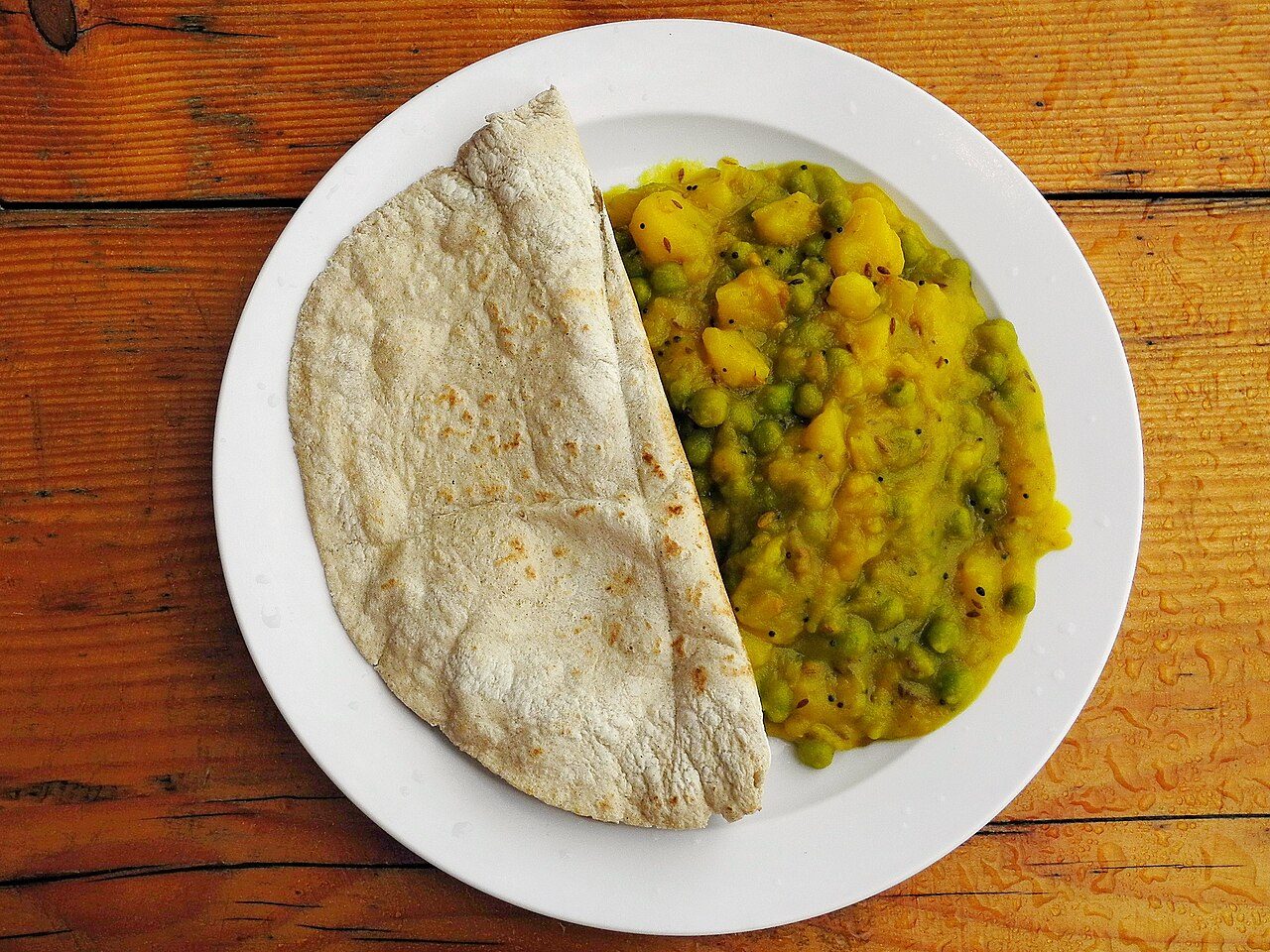
The tradition & historical record
7 min read · 2 sourcesChapati is an unleavened flatbread originating from the Indian subcontinent. Chapatis are made of atta, a type of whole-wheat flour, mixed into dough with water. It is cooked on an iron griddle known as a tava, then puffed up over direct heat. Another version, in East African cuisine, is instead fried. Chapati is a form of roti, and the two are sometimes conflated. It is common in South Asia—even in areas where rice is the typical staple—as well as in most East African countries. It is also eaten by the South Asian diaspora. Evidence of foods resembling chapati dates back to the Indus Valley Civilization, and chapati is recorded in Sanskrit and Mughal-era texts. During the British era, chapatis were consumed by South Asians throughout the British Empire. They were introduced to East Africa by trade and immigration, including by Indian indentured railway workers. In the 21st century, it is common for households to purchase chapati rather than make it. Chapati is eaten as the central component of a meal, with torn pieces used to pick up accompanying dishes such as dal or stew. Chapati may also be used for wraps, such as the Ugandan street foods rolex and kikomando. The main ingredient of chapati, wheat flour, results in its nutrition, flavour, and soft texture. Versions vary in size and may use various kinds of flour, including maize, amaranth, rice, or millet. Chapati is served hot, and it stales quickly. 1
Terminology
The word chapati entered English from the Hindi चपाती (carpatī). It is derived from the Sanskrit word चर्पटी (carpaṭī), a derivative of Sanskrit *चर्प (carpata, 'flat'). This describes the way dough is shaped by slapping it between the hands. It is also spelled chapatti or chapathi. In British India, the spellings chewpatty and chowpatty were used. The word has been used in English since the early 19th century. Chapati is also called roti. Roti is a broad term for bread in the Indian subcontinent, but the term primarily refers to chapati in some regions, including in Bengal. In East Africa, roti and chapati are identical. The term phulka, meaning 'puffed', is also used, referring to a chapati that is puffed up over a flame. In some cases, a phulka may be thinner. In the Maldives, chapati is known as roṣi (or roshi), except in the dialects of Fuvahmulah and Seenu Atoll, where it is known as foḷi. 1
Ingredients
Chapatis are made of atta, a common type of whole wheat flour that is ground using a chakki (a stone mill). The flour is mixed with water, typically 60 to 80 percent the weight of the flour, to form a smooth, soft dough. Optionally, it may have small amounts of salt—about 0.5 to 2 percent, according to taste. Oil is also optional, with about 5 millilitres per 100 grams of flour; it is kneaded into the dough after the other ingredients. The dough does not contain yeast. The atta used in chapati is typically milled to high extraction—about 70 to 100 percent extraction, commonly 90 percent in rural kitchens and 80 percent in industrial settings. It is often sifted to remove the coarsest grains. The byproduct of sifting, known as resultant atta, may also be used for chapati. In some villages, including many in Rajasthan, the flour is milled on a quern-stone. The flour typically uses the species common wheat, which results in a soft, pliable texture. Durum wheat is added in some parts of India. Wheat varieties' ability to produce good chapati is a large consideration when farming wheat or developing new varieties. Although wheat is typically sold without distinguishing between varieties, Indian consumers prefer wheat that produces better chapati, and varieties such as Sharbati wheat are priced higher due to such qualities. 1
Kneading and shaping
The dough is kneaded by hand for 10 to 15 minutes, reaching a firm consistency and developing gluten, which gives it a viscoelastic texture that enables it to be rolled out. The dough may be kneaded mechanically, using a planetary mixer or a horizontal bread mixer. It is left to rest for 30 to 120 minutes, though mechanically mixed dough may be rested for only 15 to 20 minutes. Resting enables gluten formation, and the dough becomes softer and more relaxed. If excess dough is prepared, it may then be refrigerated for one day. Portions of the dough, weighing 25 to 40 grams (0.9 to 1.4 oz), are formed into balls that are rolled into a circle about 10 to 18 centimetres (4 to 7 in) across and 2 to 3 millimetres thick. This is typically done by dusting the dough with flour and rolling it out using a long, wooden rolling pin against a wooden board. Oil may be used during rolling. The force applied to the rolling pin causes the dough to slowly rotate as it expands, and additional flour may be added. Rolling to an even thickness is necessary for uniform cooking and puffing. If chapati is too thin, it may become too dry, and if it is too thick, it may be undercooked. Mechanical shaping processes are faster and more consistent than using a rolling pin. The chapati press consists of two iron plates on a hinge, between which dough is placed; a lever connected to the lower plate is folded over the upper plate to apply pressure. These are used in both professional and home kitchens and can produce over 100 chapatis per hour. Another pressing device places the dough on a pedal-operated plate that pushes it onto a top plate; this can produce over 200 chapatis per hour. Dough sheeting machines using rollers are common in high-volume kitchens. 1
Cooking
The rolled-out dough is thrown on a hot, dry tava—a type of iron griddle—and cooked on both sides. It cooks at 200 to 220 °C (392 to 428 °F) for 1 to 2 minutes—about 45 seconds on one side and 90 seconds on the other, being flipped once bubbles start to form. This rapid cooking on a hot surface is similar to the method used for Arab breads. 1
A chapati puffs up as moisture in the dough changes into steam. Sometimes, it is only partially cooked on the skillet, and then cooked directly over a flame or hot coals for a few seconds to puff up. It is also possible to puff up the roti directly on the tava, applying pressure with a dry cloth, or in an oven at about 350 °C (662 °F). The inflation causes chapati to be soft and pliable. In the absence of leavening, the formation of steam is responsible for the separation of crust and crumb. The crust comprises almost the entire chapati, while the crumb contains starch that is highly deformed and gelatinised. Conduction is the main mode of heat transfer, forming a hard surface through starch gelatinisation. Some machines both shape and bake chapati dough. A wide range of equipment is designed for chapati due to its popularity. The roti maker is similar to a chapati press but with a heating element that cooks the dough, which inflates and lifts the upper plate. The Rotimatic is an appliance that automatically produces chapatis from jars of ingredients, sold for household use. On a commercial level, semi-automated or fully automated machines are used; the latter produces 500 to 2,000 chapatis per hour. 1
Classification and variations
Chapati is… 1
The text above is adapted from the Wikipedia article “Chapati”, available under the Creative Commons Attribution-ShareAlike 4.0 licence. 1
chapati is unleavened wheat flatbread, according to the structured record cited below. This entry was generated automatically from that record and has not yet been reviewed by a person familiar with the tradition. 2
The source record links this tradition to 9 external registers, which can be verified through the citation. 2