The tradition & historical record
5 min read · 2 sourcesCheesemaking (or caseiculture) is the art of making cheese. The production of cheese, like many other food preservation processes, allows the nutritional and economic value of a food material, in this case milk, to be preserved in concentrated form. Cheesemaking allows the production of the cheese with diverse flavors and consistencies. 1
History
Cheesemaking is documented in Egyptian tomb drawings and in ancient Greek literature. Cheesemaking may have originated from nomadic herdsmen who stored milk in vessels made from sheep's and goats' stomachs. Because their stomach linings contain a mix of lactic acid, bacteria as milk contaminants and rennet, the milk would ferment and coagulate. A product reminiscent of yogurt would have been produced, which through gentle agitation and the separation of curds from whey would have resulted in the production of cheese; the cheese being essentially a concentration of the major milk protein, casein, and milk fat. The whey proteins, other major milk proteins, and lactose are all removed in the cheese whey. Another theory is offered by David Asher, who wrote that the origins actually lie within the "sloppy milk bucket in later European culture, it having gone unwashed and containing all of the necessary bacteria to facilitate the ecology of cheese". 1
Ancient cheesemaking
One of the ancient cheesemakers' earliest tools for cheesemaking, cheese molds or strainers, can be found throughout Europe and eastern Turkey dating back to the Bronze Age. Baskets were used to separate the cheese curds, but as technology advanced, these cheese molds would be made of wood or pottery. The cheesemakers placed the cheese curds inside of the mold, secured the mold with a lid, then added pressure to separate the whey, which would drain out from the holes in the mold. The more whey that was drained, the less moisture retained in the cheese. Less moisture meant that the cheese would be firmer. In Ireland, some cheeses ranged from a dry and hard cheese (mullahawn) to a semi-liquid cheese (millsén). The designs and patterns were often used to decorate the cheeses and differentiate between them. Since many monastic establishments and abbeys owned their share of milk animals at the time, it was commonplace for the cheeses they produced to bear a cross in the middle. Although the common perception of cheese today is made from cow's milk, goat's milk was actually the preferred base of ancient cheesemakers, because goats are smaller animals than cows. This meant that goats required less food and were easier to transport and herd. Moreover, goats can breed any time of the year as opposed to sheep, who also produce milk, but mating season only came around during fall and winter. Before the age of pasteurization, cheesemakers knew that certain cheeses could cause constipation or kidney stones, so they advised their customers to supplement these side effects by eating in moderation along with other foods and consuming walnuts, almonds, or horseradish. 1
Process
The goal of cheese making is to control the spoiling of milk into cheese. The milk is traditionally from a cow, goat, sheep, or buffalo, although, in theory, cheese could be made from the milk of any mammal. Cow's milk is most commonly used worldwide. The cheesemaker's goal is a consistent product with specific characteristics (appearance, aroma, taste, texture). The process used to make a Camembert will be similar to, but not quite the same as, that used to make Cheddar. Some cheeses may be deliberately left to ferment from naturally airborne spores and bacteria; this approach generally leads to a less consistent product but one that is valuable in a niche market. 1
Culturing
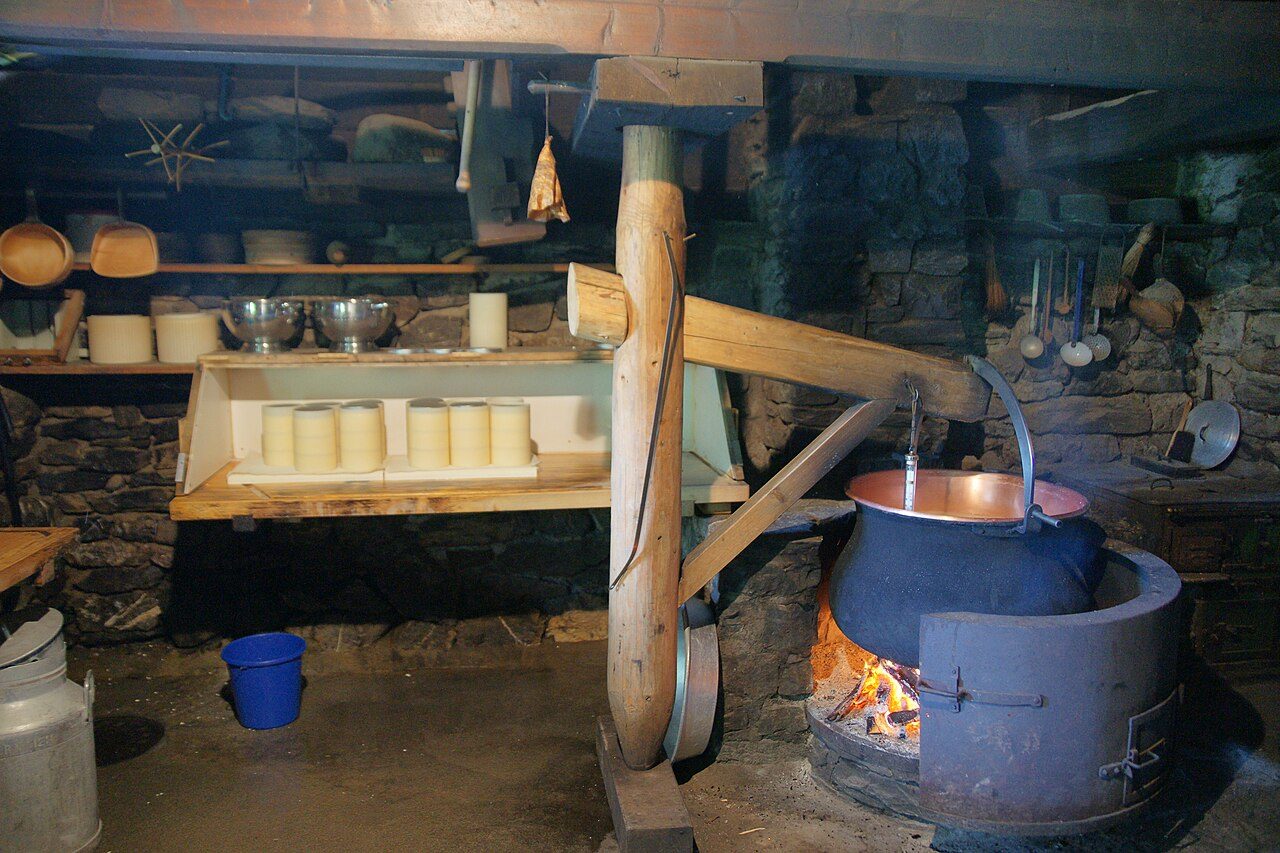
Cheese is made by bringing milk (possibly pasteurised) in the cheese vat to a temperature required to promote the growth of the bacteria that feed on lactose and thus ferment the lactose into lactic acid. These bacteria in the milk may be wild, as is the case with unpasteurised milk, added from a culture, frozen or freeze dried concentrate of starter bacteria. Bacteria which produce only lactic acid during fermentation are homofermentative; those that also produce lactic acid and other compounds such as carbon dioxide, alcohol, aldehydes and ketones are heterofermentative. Fermentation using homofermentative bacteria is important in the production of cheeses such as Cheddar, where a clean, acid flavour is required. For cheeses such as Emmental, the use of heterofermentative bacteria is necessary to produce the compounds that give its characteristic fruity flavours and, importantly, the gas that results in the formation of bubbles in the cheese ('eye holes'). Starter cultures are chosen to give a cheese its specific characteristics. In the case of mould-ripened cheese such as Stilton, Roquefort or Camembert, mould spores (fungal spores) may be added to the milk in the cheese vat or can be added later to the cheese curd. 1
Coagulation
During the fermentation process, once sufficient lactic acid has been developed, rennet is added to cause the casein to precipitate. Rennet contains the enzyme chymosin which converts κ-casein to para-κ-caseinate (the main component of cheese curd, which is a salt of one fragment of the casein) and glycomacropeptide, which is lost in the cheese whey. As the curd is formed, milk fat is trapped in a casein matrix. After adding the rennet, the cheese milk is left to form curds over a period of time. 1
The text above is adapted from the Wikipedia article “Cheesemaking”, available under the Creative Commons Attribution-ShareAlike 4.0 licence. 1
cheesemaking is activity or craft of making cheese, according to the structured record cited below. This entry was generated automatically from that record and has not yet been reviewed by a person familiar with the tradition. 2
The source record links this tradition to 21 external registers, which can be verified through the citation. 2