The tradition & historical record
6 min read · 2 sourcesChinese noodles vary widely according to the region of production, ingredients, shape or width, and manner of preparation. Noodles were invented in China, and are an essential ingredient and staple in Chinese cuisine. They are an important part of most regional cuisines within China, and other countries with sizable overseas Chinese populations. Chinese noodles can be made of wheat, buckwheat, rice, millet, maize, oats, acorns, kudzu, Siberian elm, soybeans, mung beans, seaweed, yams, cassava, potatoes, sweet potatoes, and meats such as fish and shrimp. There are over 1,200 types of noodles commonly consumed across China today, more than 2,000 different cooking methods for Chinese noodles, and tens of thousands of dish varieties prepared using these types of noodles in China. Chinese noodles have entered the cuisines of neighboring East Asian countries such as Korea, Japan, and Mongolia, as well as Southeast Asian countries such as Malaysia, Singapore, Indonesia, Vietnam, Cambodia, Myanmar, Laos, the Philippines and Thailand. 1
Nomenclature
Nomenclature for Chinese noodles can be difficult due to the vast number of noodle types available in China and the many dialects and languages used to name them. There is no single Chinese word equivalent to the Western concept of "noodles," nor is the notion of "noodles" as a unified food category recognized within Chinese cuisine. In Mandarin, miàn (simplified Chinese: 面; traditional Chinese: 麵; often transliterated as "mien" or "mein" ) refers to noodles made from wheat flour, while fěn (粉) or "fun" refers to noodles made from other starches, particularly rice flour and mung bean starch. Each noodle type can be rendered in pinyin for Mandarin, but in Hong Kong and neighboring Guangdong it will be known by its Cantonese pronunciation ("meen" or "mien" for wheat noodles, "fun" for non-wheat). Taiwan, Malaysia, Singapore and many overseas Chinese communities in Southeast Asia use Hokkien (Min Nan) (e.g. "mee" for wheat noodles, "hoon" or "hun" for non-wheat). Wheat noodles, for example, are called "mian" in Mandarin, "mein" in Cantonese, "men" in Japanese, "mee" in Thai, and "myeon" in Korean. The names of some types of noodles are based on the name of their principal ingredient (such as wheat, buckwheat, rice, potato, corn flour, bean or soybean flour, yam flour, mung-bean starch, sweet potato, or cassava). 1
History
The earliest written record of noodles is from a book dated to the Eastern Han period (25–220 AD). Noodles, often made from wheat dough, became a prominent staple of food during the Han dynasty. In the Western Han dynasty, due to demand by the military, it was necessary for the government to implement food processing technologies that would make the food storage easier and more affordable. During this time, "Laomian" emerged, it was made with starch-rich buckwheat, millet and pea flours with lower water content, making it easier to store and transport. Chinese noodles have had far reaching influences beyond China's borders. Food historian Gil Marks documented Chinese noodle-making traditions spread along the Silk Road to Central Asia and had reached Persia by the fourth or fifth century. In Persia, they were known as laksha which is the Farsi word for "slippery". The food was later spread westwards to Sicily and Spain through Arab influence, where noodles were known as itriya. From Sicily, it subsequently spread to mainland Italy sometime after the tenth century. During the Song dynasty (960–1279) noodle shops were very popular in the cities, and remained open all night. During the earlier dynastic periods Chinese wheat noodles were known as "soup cake" (Chinese: 湯餅; pinyin: tāng bǐng), as explained by the Song dynasty scholar Huáng Cháo Yīng (黃朝英) mentions in his work "A delightful mixed discussion on various scholarly topics" (Chinese: 靖康緗素雜記; pinyin: jìngkāngxiāngsùzájì, Scroll 2) that in ancient times bready foods like pasta are referred collectively as "bing" and differentiated through their cooking methods.· Up until 1992, most dried Chinese noodles in the United States could not be sold labelled as "noodles". 1
Production
Chinese noodles are generally made from either wheat flour, rice flour, or mung bean starch, with wheat noodles being more commonly produced and consumed with the ancient wooden noodles mold technology in northern China and rice noodles being more typical of southern China. Egg, lye, and cereal may also be added to noodles made from wheat flour in order to give the noodles a different color or flavor. Egg whites, arrowroot or tapioca starch are sometimes added to the flour mixture in low quantities to change the texture and tenderness of the noodles' strands. Although illegal, the practice of adding the chemical cross-linker borax to whiten noodles and improve their texture is also quite common in East Asia. In general, the Chinese noodles cooking method involves making a dough with flour, salt, and water; mixing the dough by hand to form bar shapes; bending the bars for proofing; pulling the bars into strips; dropping the strips into a pot with boiling water; and removing the noodles when finished cooking. Chinese type noodles are generally made from hard wheat flours, characterized by bright creamy white or bright yellow color and firm texture. Before the automatic noodle machine was invented in 1950s, the processing of Chinese noodles were made with four steps, including: 1
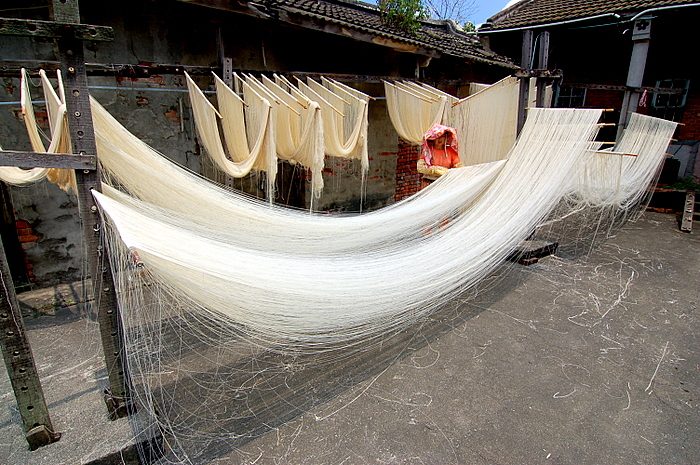
Fresh – The noodles are often consumed within 24 hours of manufacture due to quick discoloration. Their shelf life can be extended to 3–5 days if stored under refrigeration; Dried – Fresh noodle strands are dried by sunlight or in a controlled chamber; Boiled – Fresh noodle strands are either parboiled or fully cooked. 1
Cooking
Noodles may be cooked from either their fresh (moist) or dry forms. They are generally boiled, although they may also be deep-fried in oil until crispy. Boiled noodles may then be stir fried, served with sauce or other accompaniments, or served in soup, often with meat and other ingredients. Certain rice-noodles are made directly from steaming the raw rice slurry and are only consumed fresh. Unlike many Western noodles and pastas, Chinese noodles made from wheat flour are usually made from salted dough, and therefore do not require the addition of salt to the liquid in which they are boiled. Chinese noodles also cook very quickly, generally requiring less than 5 minutes to become al dente and some taking less than a minute to finish cooking, with thinner noodles requiring less time to cook. Chinese noodles made from rice or mung bean starch do not generally contain salt. 1
Wheat
These noodles are made only with wheat flour and water. If the intended product is dried noodles, salt is almost always added to the recipe. 1
The text above is adapted from the Wikipedia article “Chinese noodles”, available under the Creative Commons Attribution-ShareAlike 4.0 licence. 1
Chinese noodles is Noodles in Chinese cuisine, according to the structured record cited below. This entry was generated automatically from that record and has not yet been reviewed by a person familiar with the tradition. 2
The source record links this tradition to 5 external registers, which can be verified through the citation. 2