The tradition & historical record
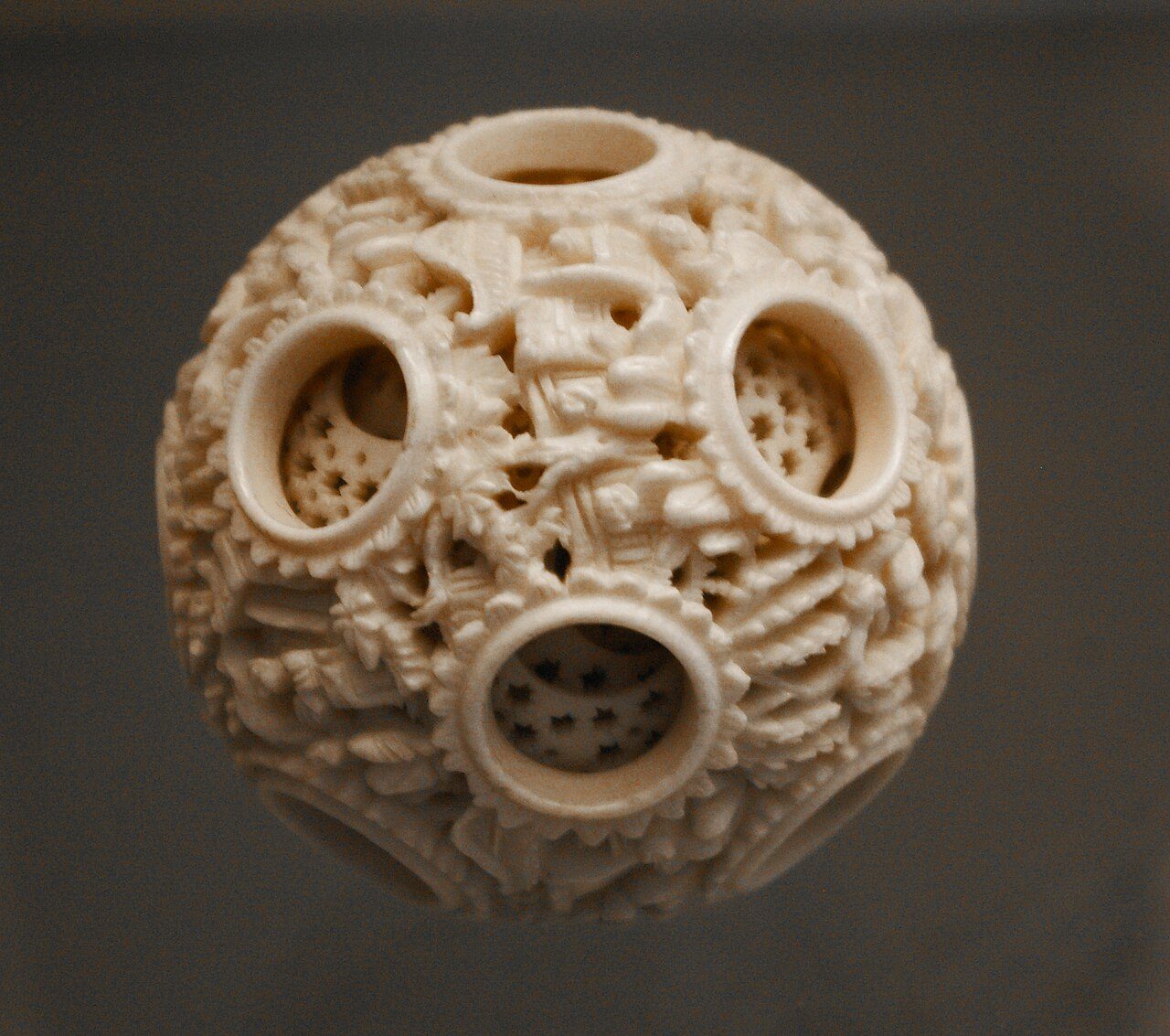
6 min read · 2 sourcesA Chinese puzzle ball, sometimes known as a devil's work ball (Chinese: 鬼工球; pinyin: guǐ gōng qiú) or the Concentric Ball (Chinese: 同心球; pinyin: tóng xīn qiú), is an artifact that consists of a number of intricately carved concentric hollow spheres carved from a single solid block that fit within one another in a way that looks impossible, often consisting of fourteen layers. They were traditionally made of ivory. Ivory carving is a traditional art and folk craft in ancient China. On May 20, 2006, it was included in the first batch of national intangible cultural heritage list approved by the State Council of the People's Republic of China. Following the international ban on the ivory trade, manufacturers of puzzle balls have tried using other materials, including bone. 3D imaging using computational tomography has been used to identify details of the manufacturing process. The name "devil's work ball" likely stems from the Chinese Daoist idiom "gui fu sheng gong" (Chinese: 鬼斧神工; pinyin: guǐ fǔ shén gōng), which translates as "the demon's axe paired with the deity's workmanship," emphasizing the craft's intricate and delicate nature with supernatural connotations. Originating from Guangdong province, particularly Guangzhou, these intricate balls were originally local tribute items and luxury export goods. 1
Historical development
Although the production of Chinese puzzle balls reached its peak in the eighteenth century during the Qing dynasty, records indicate earlier iterations of puzzle balls during the Song dynasty and Ming dynasty. The earliest mention of Chinese puzzle balls dates back to Cao Zhao's 1338 book Gegu Yaolun (Essential Criteria of Antiques), where he describes seeing an earlier, more simplistic version of the devil's work ball (Chinese: 鬼工球; pinyin: guǐ gōng qiú) he assumed was made by an artisan at the Song dynasty court: "[t]here was a hollow-cantered ivory ball, which had two/multiple concentric layers inside it, all layers can be turned." The appearance of a 14-layer puzzle ball was noted by Gao Lian in 1591, in Zunsheng bajian (Eight Discourses on the Art of Living), although the artifact he mentioned was made of stone: "Ancient people like to carve this type of stone into circular spheres which were similar to Chinese puzzle ball. I have seen one with twelve layers that from the outermost layer to the innermost one was diminishing in size and each layer could revolve. The innermost sphere was as tiny as a green bean. How it was made I do not know. It was 'true devil's work'." In 1792, Wang Qishu reported seeing thirteen-layer puzzle balls being sold in Guangzhou (Canton). Ching-fei Shih argued that Chinese puzzle balls were influenced by European geometric carved ivory balls due to similarities in craftsmanship and the use of turning lathes in modern production. The Sotheby's catalogue, 2017, tells that "The earliest known example [of contrefait] is a sphere turned by Giovanni Ambrogio Maggiore of Milan in 1582 now preserved in the Museo degli Argenti in Florence. 1
Production and trading
Chinese puzzle balls are believed to have originated in Canton, where there was a thriving artisanal sector and easy access to raw ivory, allowing artisans to show off their dexterity and technical prowess with the intricate carving required to make these items. Production of the ivory puzzle balls became more common due to the thriving artisanal export industry that emerged in Canton after 1760 when the government restricted foreign merchants to that region. From the 1730s onwards, artisans in Canton started intentionally making puzzle balls for mass tributes to the emperor. The puzzle balls of the best quality were selected by the Tribute Bureau officials to be brought to the imperial court. Those not deemed fit for the emperor’s court were then sold commercially in domestic and export arts markets. Design motifs commonly carved on puzzle balls include auspicious symbols such as Chinese dragons, floral patterns, geometric shapes, and Chinese characters. Dragon motifs were an especially common design when puzzle balls were made as tributes, as they depict the power of the Manchurian and Qing emperors, since they symbolized immortality and the emperor's travel between heaven and earth . Chinese puzzle balls held an appeal as a status symbol in China as well as in Europe. At the imperial court in China, puzzle balls were another form of decoration that conspicuously flaunted the emperor’s wealth and ability to wield the labour and talent of the populace. Chinese puzzle balls also appealed to government officials, literati scholars, and any other upper-class elites who aimed to project sociopolitical status with this purchase by showing it off in their homes . 1
Production process
Chinese puzzle balls are created through a time-consuming process of intricate carving and nesting. First the artisan must start by selecting a suitable piece of material, traditionally ivory, and then turning it into a sphere, often with a lathe. As the next step, geometric modelling on paper is typically used to map out the creation of the puzzle ball, so that the creator can ensure that all peepholes that will be drilled into the puzzle ball have the same diameter and there is consistent distance between layers. Fourteen peepholes are drilled with conical-shaped incisions, before the carver then goes in with L-shaped scalpels to separate the different layers of the ivory puzzle ball so that each can dynamically move independently of the others. The painstaking nature of this stage is conveyed by ivory puzzle-ball master Weng Rongbiao, who said in a live demonstration that it would take an experienced master at least 30 hours to separate 30 layers of a single ivory puzzle ball. Finally, open-work geometric patterns are then carved onto each layer by the artisan, before the artisan then polishes the outer layer in the final step. Artisans use lathes to turn the ivory puzzle balls as they carve them manually with hand-held tools, with lathes historically being foot-powered in China, though modern artisans use electric lathes . The geometric patterns in each layer are carved by "punching" a small knife into the ivory once for every line in a shape, meaning that small delicate tools the same width as each interior shape's side must be used. Historically, Guangdong master turners also had to be skilled ironsmiths who produced their own carving tools, with apprentices learning to forge iron tools before being taught how to create puzzle balls. 1
Artisan craftsmanship
The craft of creating Chinese puzzle balls, developed in family workshops in Guangdong, has been passed down through generations since the Qianlong period. For instance, the Weng family is famous for their master refinement of this artisanal craft. 1
Materials and modern challenges
The production and trading of Chinese puzzle ball are currently impeded by the ban on the processing and sales of ivory enacted at the end of 2017 by China's State Forestry Administration (SFA). 1
The text above is adapted from the Wikipedia article “Chinese puzzle ball”, available under the Creative Commons Attribution-ShareAlike 4.0 licence. 1
Chinese puzzle ball is concentric hollow spheres carved from a single solid block, according to the structured record cited below. This entry was generated automatically from that record and has not yet been reviewed by a person familiar with the tradition. 2
The source record links this tradition to 1 external register, which can be verified through the citation. 2