The tradition & historical record
4 min read · 2 sourcesCizhou ware or Tz'u-chou ware (Chinese: 磁州窯; pinyin: Cízhōu yáo; Wade–Giles: Tz'u-chou yao) is a wide range of Chinese ceramics from between the late Tang dynasty and the early Ming dynasty, but especially associated with the Northern Song to Yuan period in the 11–14th century. It has been increasingly realized that a very large number of sites in northern China produced these wares, and their decoration is very variable, but most characteristically uses black and white, in a variety of techniques. For this reason Cizhou-type is often preferred as a general term. All are stoneware in Western terms, and "high-fired" or porcelain in Chinese terms. They were less high-status than other types such as celadons and Jun ware, and are regarded as "popular", though many are finely and carefully decorated. Alone among major types of Song ceramics their effect largely depends on decoration in contrasting colours, usually in black on white, but sometimes polychrome. At this time, unlike later periods, ceramics for the court were "relentlessly monochrome", and Cizhou wares are not mentioned in the large quantities of "tribute wares" given from the provinces to the emperor, of which much was redistributed, or perhaps sold; "Confucian esthetics emphasized simplicity." It was named for Cizhou, a prefecture now called Ci County in Handan in southern Hebei, one of the main centres of production. 1
Description
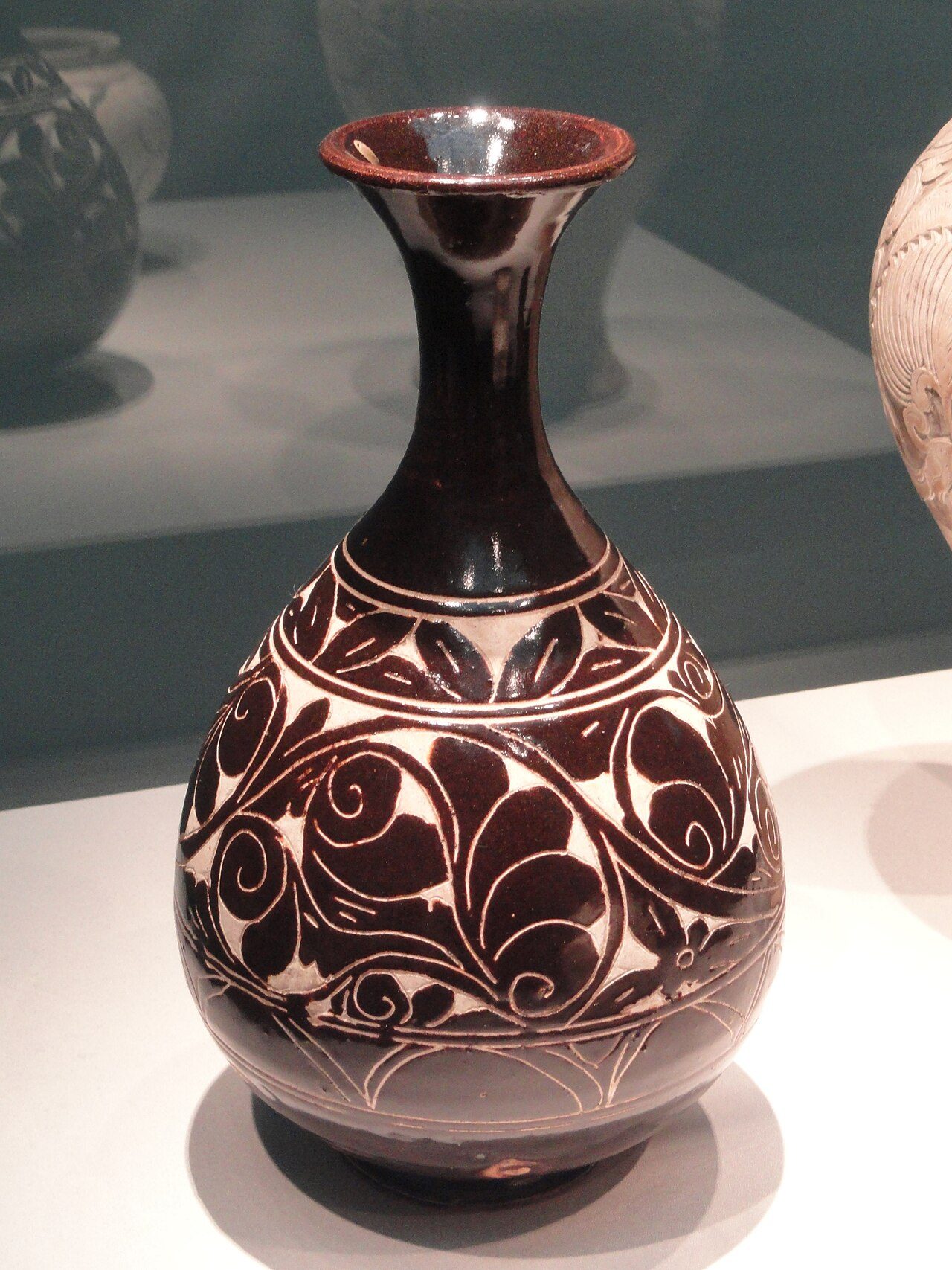
The wares are generally sturdy, and often rather large. Many shapes relate to wine-drinking, and ceramic pillows or head-rests are common. The clay bodies fire to a range of off-white, grey and brown shades, varying with location. The main methods of forming used are wheel-throwing and forming from slabs, with moulds sometimes used, mainly for head-rests. Generally a coating of white or, less often, black or brown slip was applied all over to hide this not very attractive body. After decoration a glaze was applied, normally this was transparent but, especially in later periods, green and turquoise glazes were used, including over slip-painting. Additionally, the same kilns often produced wares glazed in black and brown, and less decorated. Conventionally, and perhaps rather artificially, these are not usually classified as Cizhou wares (unless highly decorated) but by such terms as "Northern black wares", or "Northern dark wares". As well as underglaze slip-painting, overglaze enamelling was sometimes used, for the first time in China.A very wide range of decorative techniques are used, often in conjunction. The most common and characteristic technique is painting in black or brown slip on top of a layer of white slip. Designs are also formed by a variety of slip-cutting or sgraffito techniques where slip is scratched or cut away to reveal another slip or the body beneath; a vase with carved peony scrolls in Indianapolis uses this technique. Other techniques include the shallow carving common on other Song ceramics such as Ding ware and celadon or greenwares, incising, stamping, and working with a roulette or tool with a ridged wheel. 1
Influence
Although strongly based in the north, some Cizhou-type wares were produced in the south, and the products were very widely distributed across China, even if little was exported. Apparently largely free from the dictates of court or aristocratic taste, the producers were free to experiment with their great variety of techniques and subjects and motifs for decoration. They and their clientele were also less affected by political changes than their equivalents for high-status wares, allowing a development of the wares over many centuries and dynasties with relatively little disruption. In their emphasis on painted decoration, whether under or over the glaze, Cizhou ware anticipated the style that would, eventually, come to dominate Chinese ceramics, even those for the court. Eventually this would mainly use the Cizhou invention of overglaze enamelling. Another Cizhou development (if one ignores the precedent of ancient Greek vase painting) that would become part of general Chinese, and world, ceramics was decorating tall vessels in wide bands of the main decoration, surrounded by smaller bands of repetitive motifs, or in dishes similar circular borders. It has been suggested that the movement of potters from Cizhou kilns to the south, especially at the start of the Yuan dynasty, was part of this influence. This may have been either or both by the movement of artisans directly to Jingdezhen, or to kilns making Jizhou ware, which in turn influenced Jingdezhen. The Mongols often forced artists to move locations, and this period saw the beginning of underglaze painted blue and white porcelain from Jingdezhen. 1
The text above is adapted from the Wikipedia article “Cizhou ware”, available under the Creative Commons Attribution-ShareAlike 4.0 licence. 1
Cizhou ware is archaeological site, according to the structured record cited below. This entry was generated automatically from that record and has not yet been reviewed by a person familiar with the tradition. 2
The source record links this tradition to 8 external registers, which can be verified through the citation. 2