The tradition & historical record
7 min read · 2 sourcesIn Irish mythology, Clíodhna (Clídna, Clíodna, Clíona, sometimes anglicised to Cleena) is a Queen of the Banshees of the Tuatha Dé Danann. Clíodna of Carrigcleena is the potent banshee that rules as queen over the sióga (fairies) of South Munster, or Desmond. In some Irish myths, Clíodhna is a goddess of love and beauty, and the patron of County Cork. She is said to have three brightly coloured birds who eat apples from an otherworldly tree and whose sweet song heals sickness. She had her palace in the heart of a pile of rocks, 5 mi (8.0 km) from Mallow, which is still commonly known by the name of Carrig-Cleena, and numerous legends about her are told among the Munster peasantry who considered her their benefactor. 1
Associated families and legends
In general, it has been observed that Clíona is especially associated with old Irish families of Munster. Clíona has long been associated with the lands that had been the territory of the Ui-Fidgheinte (O'Donovans and O'Collins) during their period of influence (circa 373 A.D. to 977 A.D.), or were later associated with what had been the Ui-Fidghente territory (MacCarthys and FitzGeralds). Clíodhna is also associated with the MacCarthy dynasty of Desmond, who adopted her as their fairy woman, and the O'Keeffes and FitzGerald dynasty, with whom she has had amorous affairs Surviving traditions of Clíodhna in narrative and poetry associate her with the O'Keeffes (Ó Caoimh or Keefer) and O'Donovans. The latter, originally from Uí Fidgenti in North Munster with its own traditions, where their original goddess was Mongfind, later moved south to Carbery on Cuan Dor Harbour, Clíodhna's traditional abode on the South Munster coast, and she then features in poetry associated with them. The O'Keeffe narrative tradition is more extensive, and Clíodhna has other Desmond associations too. Irish revolutionary Michael Collins also had knowledge of Clíodhna. Stories were told of her in the Rosscarbery school he attended, and they took Sunday trips to Clíodhna's rock. Collins was descended from the Ó Coileáins of Uí Chonaill Gabra. Both the Ui Chonaill and the Ui Donnobhans were tribes within the Ui-Fidghente. 1
Cleena's Wave
This legend is recorded in Acallam na Senórach ("Colloquy of the Ancients"), longest-surviving work of medieval Irish literature. During the time of the Fianna lived Ciabham of the Curling Hair, son of the King of Ulster. Ciabham decided to leave Ireland by currach (boat) but encountered great white waves as big as mountains. He was saved from the sea by a rider on a dark grey horse with a golden bridle. They then reached Tír Tairngire ("the land of promise"), an otherworldly land ruled by Manannan their king. Ciabham is entertained at a feast within Manannan's city. The chief druid Gebann had a daughter named Cleena of the Fair Hair. When she saw Caibhan, she fell in love with him and agreed to leave with him the next day. Together they sailed to Teite's Strand in Ireland. Ciabhan went on shore to hunt and left Cleena in the boat. However, the people of Manannan pursued them in ships. One of them treacherously played music which caused Cleena to fall asleep. Then a great wave came and swept her away. The place was then called Tonn Chlíodhna, "Clíodhna's Wave", which is near Glandore harbour. Whether she drowns or not depends on the version being told, along with many other details of the story. 1
The Voyage of Teigue, Son of Cian
The Book of Lismore tells that Teigue was the son and heir of Cian, the king of West Munster. During a raid by an enemy from a far off land, many of their people were abducted and enslaved. Teigue and his warriors set out to rescue them. After rowing for nine weeks, they arrived in a strange land called Inis Derglocha (Red loch island). There Teigue meets a number of luminaries from Ireland's mythical past. The final person they encounter introduces herself as "Cleena Fairhead, daughter of Genann mac Treon of the tuatha dé Danann, sweetheart of Eochaid Redweapon's son Ciabhan of the curling locks; for now some time I am in this island, and from me 'Cleena's Wave' in the borders of Munster is denominated". She gives them three birds to guide them and provide music, as well as an emerald cup that transforms water into wine. She warns that if Teigue is parted from the cup, he will die soon after. Teigue and his warriors depart the island and after rescuing their kinsmen, they return home victorious. 1
The legend of O'Keeffe, the Druid and his two daughters
In the early eighth century, in Feur-magh-Feine (now Fermoy) there lived Draoi Ruadh, the last of the Druids. He had assisted the King of Munster by summoning a great storm to drive back their enemies. As a reward for his service, the king had granted the Druid the title Prince of Fermoy. The Druid had two accomplished and beautiful daughters: the elder was called Cleena who could transform creatures to any form she pleased and was titled "the queen of the fairies". The younger daughter was called Aoivil (Aibell) and was her inseparable companion. Caiov (O'Keeffe) was a prince accomplished in mind and body, who had inherited a neighboring territory. He was in the habit of visiting the Druid's palace and liked to join in the sports in which he was often victorious. This attracted the admiration of the Druid and his daughters. Both sisters fell in love with O'Keeffe. Cleena expressed her love openly and discussions began with her father for their marriage. Aoivil secretly fell in love and worked to gain his affection by her innocent arts. Caiov fell deeply in love with Aoivil but this was quickly discovered by Cleena. Because of her jealousy, Cleena called on the oldest of her nurses to curse her innocent sister. Aoivil was stricken with sickness and the loss of her beauty. Cleena pretended to help her by a powerful sleep mixture, which caused Aoivil's apparent death. Aoivil was laid in a coffin and displayed before the Druid and his wife, who were filled with profound sorrow. She was then laid to rest in a tomb under the palace. Cleena and the nurse entered the tomb by a secret entrance and moved the still unconscious Aoivil to the cave at Castlecor (5 mi (8.0 km) north-east of Kanturk). 1
The legend of Ellen O'Brien and Fiz-Gerald
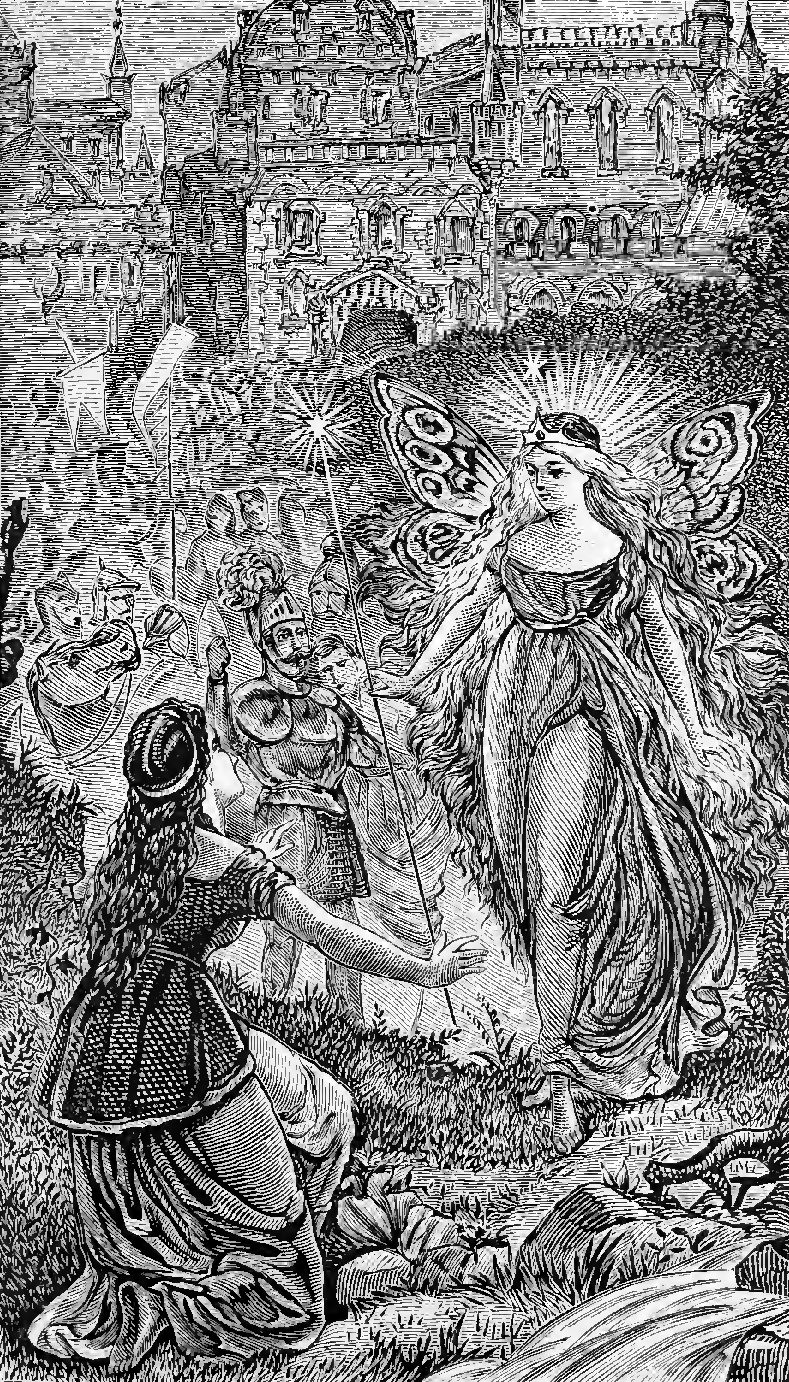
Fiz-Gerald was a youthful chieftain who lived by the banks of the Shannon, County Limerick. He was widely known to be brave, hospitable and generous, as well as an accomplished harp player. Ellen O'Brien was the only daughter from a chief whose power had crumbled under the Saxon invasion. Fitz-Gerald loved her and stole her heart with his harp playing. Cleena also desired Fiz-Gerald and resolved to bring him to her unseen hall. On a festival day, a dark cloud descended, enveloped Fiz-Gerald and carried him away. For months, no trace of him could be found and it was generally believed he was taken by enchantment. None felt greater sorry than Ellen O'Brien, who sought the help of a wizard that lived in Kerry who communed with beings from the other world. The wizard told her that Fiz-Gerald had been taken to Cleena's favorite residence at Carrigcleena. 1
The text above is adapted from the Wikipedia article “Clíodhna”, available under the Creative Commons Attribution-ShareAlike 4.0 licence. 1
Clíodhna is queen of the banshees, according to the structured record cited below. This entry was generated automatically from that record and has not yet been reviewed by a person familiar with the tradition. 2
The source record links this tradition to 2 external registers, which can be verified through the citation. 2