The tradition & historical record
6 min read · 2 sourcesCloisonné (French: [klwazɔne]) is an ancient technique for decorating metalwork objects with colored material held in place or separated by metal strips or wire, normally of gold. In recent centuries, vitreous enamel has been used, but inlays of cut gemstones, glass and other materials were also used during older periods. Cloisonné enamel was probably developed as an easier imitation of cloisonné work using gems. The resulting objects can also be called cloisonné. The decoration is formed by first adding compartments (cloisons in French) to the metal object by soldering or affixing silver or gold as wires or thin strips placed on their edges. These remain visible in the finished piece, separating the different compartments of the enamel or inlays, which are often of several colors. Cloisonné enamel objects are worked on with enamel powder made into a paste. The objects are fired in a kiln for finishing. If gemstones or colored glass are used, the pieces need to be cut or ground into the shape of each cloison. In antiquity, the cloisonné technique was mostly used for jewellery and small fittings for clothes, weapons, or similar small objects decorated with geometric or schematic designs, with thick cloison walls. In the Byzantine Empire, techniques using thinner wires were developed to allow more pictorial images to be produced. These were mostly used for religious images and jewellery, and by then always using enamel. 1
Ancient world
Cloisonné first developed in the jewellery of the ancient Near East, and the earliest works with enamel all used the cloisonné technique, placing the enamel within small cells with gold walls. This had been used as a technique to hold pieces of stone and gems tightly in place since the 3rd millennium BC, for example in Mesopotamia, and later in Egypt. Enamel seems likely to have developed as a cheaper method of achieving similar results. The earliest surviving undisputed objects known to use enamel are a group of Mycenaean rings from a tomb in Cyprus, dated to the 12th century BC, which used very thin wire. In the jewellery of ancient Egypt, including the pectoral jewels of the pharaohs, thicker strips form the cloisons, which remain small. In Egypt gemstones and enamel-like materials (sometimes called "glass-paste") were both used. Although Egyptian pieces, including jewellery from the Tomb of Tutankhamun of c. 1325 BC, are frequently described as using "enamel", many scholars doubt that the glass paste was sufficiently melted to be properly so described, and use terms such as "glass-paste". It seems possible that in Egyptian conditions the melting point of the glass and gold were too close to make enamel a viable technique. Nonetheless, there appear to be a few actual examples of enamel, perhaps from the Third Intermediate Period of Egypt (beginning 1070 BC) on. But it remained rare in both Egypt and Greece. The technique appears in the Koban culture (c. 1200 to 350 BC) of the northern and central Caucasus, and was perhaps carried by the Sarmatians to the ancient Celts, but they essentially used the champlevé technique. Subsequently, enamel was just one of the fillings used for the small, thick-walled cloisons of the Late Antique and Migration Period styles. 1
Byzantium and Europe
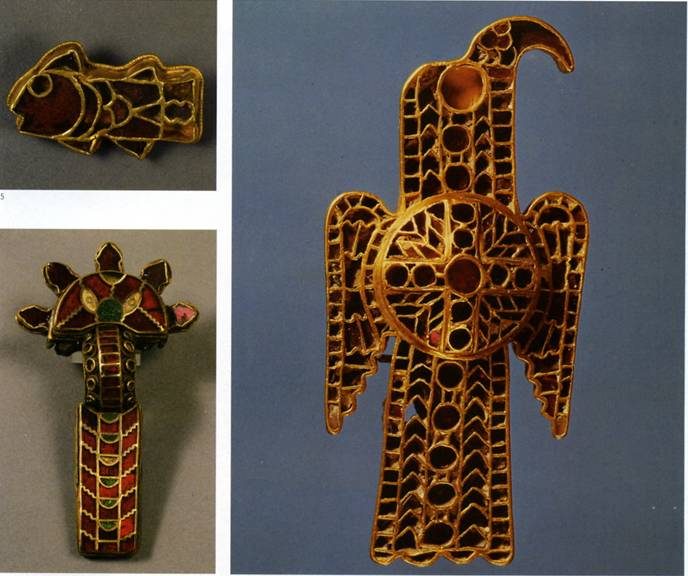
The Byzantines perfected a unique form of cloisonné icons. Byzantine enamel spread to surrounding cultures and a particular type, often known as "garnet cloisonné" is widely found in the Migration Period art of the "barbarian" peoples of Europe, who used gemstones, especially red garnets, as well as glass and enamel, with small thick-walled cloisons. Red garnets and gold made an attractive contrast of colours, and for Christians the garnet was a symbol of Christ. This type is now thought to have originated in the Late Antique Eastern Roman Empire and to have initially reached the Migration peoples as diplomatic gifts of objects probably made in Constantinople, then copied by their own goldsmiths. Glass-paste cloisonné was made in the same periods with similar results – compare the gold Anglo-Saxon fitting with garnets (right) and the Visigothic brooch with glass-paste in the gallery. Thick ribbons of gold were soldered to the base of the sunken area to be decorated to make the compartments, before adding the stones or paste. In the Byzantine world the technique was developed into the thin-wire style suitable only for enamel described below, which was imitated in Europe from about the Carolingian period onwards. 1
The dazzling technique of the Anglo-Saxon dress fittings from Sutton Hoo include much garnet cloisonné, some using remarkably thin slices, enabling the patterned gold beneath to be seen. There is also imported millefiori glass cut to fit like the gems. 1
China
From Byzantium or the Islamic world the technique reached China in the 13–14th centuries; the first written reference is in a book of 1388, where it is called "Dashi ware". No Chinese pieces clearly from the 14th century are known, the earliest datable pieces being from the reign of the Xuande Emperor (1425–35), which however show a full use of Chinese styles suggesting considerable experience in the technique. It was initially regarded with suspicion by Chinese connoisseurs, firstly as being foreign, and secondly as appealing to feminine taste. However, by the beginning of the 18th century the Kangxi Emperor had a cloisonné workshop among the many Imperial factories. The most elaborate and highly valued Chinese pieces are from the early Ming Dynasty, especially the reigns of the Xuande Emperor and Jingtai Emperor (1450–57), although 19th century or modern pieces are far more common. The Chinese industry seems to have benefited from a number of skilled Byzantine refugees fleeing the Fall of Constantinople in 1453, although based on the name alone, it is far more likely China obtained knowledge of the technique from the middle east. In much Chinese cloisonné blue is usually the predominant colour, and the Chinese name for the technique, jingtailan ("Jingtai blue ware"), refers to this, and the Jingtai Emperor. Quality began to decline in the 19th century. Initially heavy bronze or brass bodies were used, and the wires soldered, but later much lighter copper vessels were used, and the wire glued on before firing. The enamels compositions and the pigments change with time. Chinese cloisonné is sometimes confused with Canton enamel, a type of painted enamel on copper that is more closely related to overglaze enamels on Chinese porcelain, or enamelled glass. 1
Japan
The Japanese also produced large quantities from the mid-19th century, of very high technical quality. During the Meiji era, Japanese cloisonné enamel reached a technical peak, producing items more advanced than any that had existed before. The period from 1890 to 1910 was known as the "Golden age" of Japanese enamels. An early centre of cloisonné was Nagoya during the Owari Domain, with the Ando Cloisonné Company the leading producer. 1
Russia
The first Russian cloisonné developed from Byzantin… 1
The text above is adapted from the Wikipedia article “Cloisonné”, available under the Creative Commons Attribution-ShareAlike 4.0 licence. 1
cloisonné is ancient technique for decorating metalwork objects, according to the structured record cited below. This entry was generated automatically from that record and has not yet been reviewed by a person familiar with the tradition. 2
The source record links this tradition to 18 external registers, which can be verified through the citation. 2