The tradition & historical record
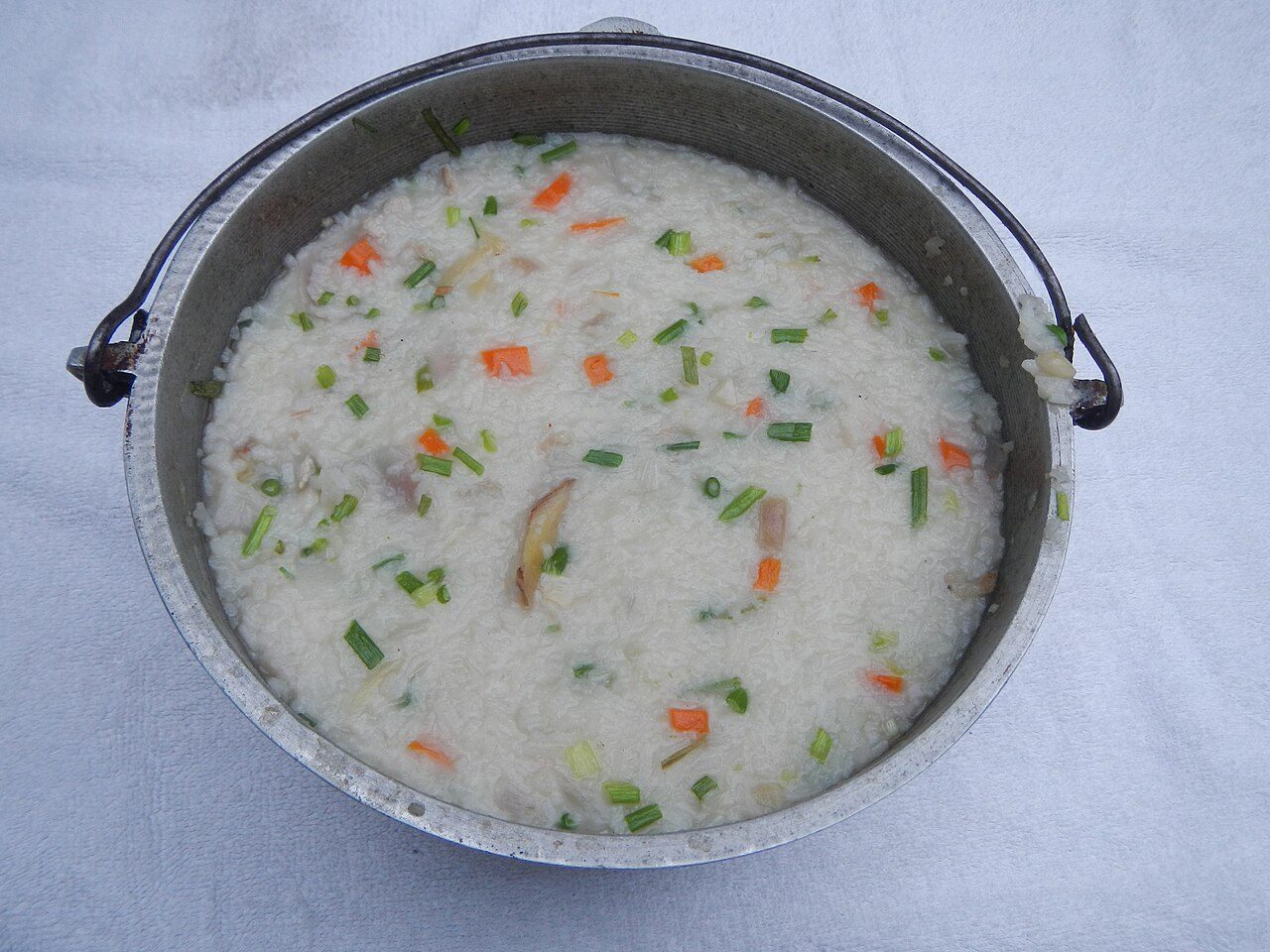
6 min read · 2 sourcesCongee ( KON-jee, derived from Tamil கஞ்சி [kaɲdʑi]) is a form of savoury porridge, primarily made by boiling rice in large amount of water until it softens or dissolves, and commonly flavored with salt or mild broth. Depending on the rice–water ratio, the thickness of congee varies from a Western oatmeal porridge to a gruel. Congee is typically served with side dishes, or it can be topped with meat, fish, and pickled vegetables. Vivid experiences of eating or delivering thin congee as wartime or famine food often feature in diaries and chronicles. In some cultures, congee is eaten primarily as a breakfast food or late supper; some may also eat it as a substitute for rice at other meals. It is often considered suitable for the sick as a mild, easily digestible food. 1
Etymology
The popular English name congee derives from the Tamil word கஞ்சி (kañci). The Portuguese adopted the name as canje, with the first document mentioning the dish and the word in 1563. The English name was adopted from the Portuguese. In China, congee is known as zhou (Chinese: 粥; pinyin: zhōu; Cantonese Yale: jūk), with the first recorded reference traced back to 1000 BC during Zhou dynasty. Across Asia, various similar dishes exist with varying names. 1
China
Porridge or congee (粥; zhōu or 稀飯; xīfàn in Standard Chinese) in southern China usually means rice congee, while in the north it may be cornmeal porridge, proso millet porridge, foxtail millet porridge, or sorghum porridge, reflecting the north–south divide of grain production. In northwest Shanxi and Inner Mongolia, fermented rice and millet porridge known as suan zhou (酸粥) is popular. Rice and millet are soaked to allow fermentation, then water is drained to obtain porridge. The water is served as a drink, suan mi tang (酸米湯). The porridge is eaten with pickles of turnips, carrots, radish or celery. When stirred-fried, the porridge is called chao suan zhou (炒酸粥). The porridge may also be steamed into solids known as suan lao fan (酸撈飯). While the traditional grain is proso millet, it is mixed with rice when available. Many folk idioms of sourness derive from this dish. In Shanghai, Suzhou and nearby, an iconic glutinous rice porridge topped by red bean paste, sweet olive syrup and brown sugar is chi dou hu tang zhou (赤豆糊糖粥, Shanghainese: tshaq deu wu daon tsoq). Street hawking of this porridge is featured in a well-known Wu Chinese nursery rhyme. Originating in Guangdong, century egg congee (皮蛋瘦肉粥; pèihdáan sauyuhk jūk in Cantonese) has become popular nationwide since the 2000s. It was first tested on the menu of KFC in Shanghai in 2002 and later rolled out to all KFCs in mainland China and Taiwan. Century egg porridge ranked in the top ten in breakfast orders in almost every Chinese major city as far north as Harbin. Additional common regional ingredients include salted duck eggs, rousong, zhacai, pickled tofu, mung beans and organ meats (especially pig liver). Youtiao is served as a side dish in some Chinese cultures. 1
Taiwan
In Taiwan, congee is known as muê (糜) in Taiwanese Hokkien or xīfàn (稀飯) in Mandarin. Sweet potato, taro root, or century egg is often added for taste. A famous congee dish in Taiwan is milkfish congee. 1
Japan
Kayu (粥), or often okayu (お粥) is the name for the type of congee eaten in Japan, which typically uses water to rice ratios of 5:1 or 7:1 and is cooked for about 30 minutes. There are recipes that use a water to rice ratio of up to 20:1. Kayu may be made with just rice and water, and is often seasoned with salt. Eggs can be beaten into it to thicken it. Toppings may be added to enhance flavour; welsh onion, salmon, roe, ginger, and umeboshi (pickled plums) are among the most common. Miso or chicken stock may be used to flavor the broth. Most Japanese electric rice cookers have a specific setting for cooking congee. In Japan, porridge – because it is soft and easily digestible – is regarded as a food particularly suitable for serving to the sick and elderly. For similar reasons, it is commonly the first solid food served to Japanese infants, being used to help with the transition from liquids to normally cooked rice, the latter being a major part of the Japanese diet. A type of kayu referred to as nanakusa-gayu (七草粥, "seven herb porridge") is traditionally eaten on 7 January with special herbs that some believe protect against evils and invite good luck and longevity in the new year. As a simple, light dish, nanakusa-gayu serves as a break from the many heavy dishes eaten over the Japanese New Year. Kayu is also used in Shinto divination rituals. Zōsui (雑炊) is a similar dish, which uses already cooked rice, rather than cooking the rice in the soup. 1
Korea
Juk (죽; 粥; [tɕuk̚]) is a Korean porridge dish made by boiling rice or other grains or legumes, such as beans, sesame, nuts, and pumpkin. Juk is often eaten warm, especially as a morning meal, but is now eaten at any time of the day. Depending on the ingredients and consistency, juk can be considered as food for recuperation, a delicacy, or famine food. It is also sold commercially by many chain stores in South Korea, and is a common takeout dish. The most basic form of juk, made from plain rice, is called ssaljuk (쌀죽; 'rice porridge') or huinjuk (흰죽; 'white porridge'). It is usually served with more flavorful side dishes, such as jeotgal (salted seafood) and various types of kimchi. There are more than forty varieties of juk mentioned in historical documents. Notable varieties include jatjuk made from finely ground pine nuts, jeonbok-juk made with abalones, yulmu-juk made from yulmu (Coix lacryma-jobi var. ma-yuen), and patjuk made from red beans. 1
The text above is adapted from the Wikipedia article “Congee”, available under the Creative Commons Attribution-ShareAlike 4.0 licence. 1
congee is type of rice, millet or grain porridge or gruel popular in many Asian countries, according to the structured record cited below. This entry was generated automatically from that record and has not yet been reviewed by a person familiar with the tradition. 2
The source record links this tradition to 8 external registers, which can be verified through the citation. 2