The tradition & historical record
5 min read · 2 sourcesCoromandel lacquer is a type of Chinese lacquerware, latterly mainly made for export, so called only in the West because it was shipped to European markets via the Coromandel coast of south-east India, where the Dutch East Indies Company (VOC) and its rivals from a number of European powers had bases in the 18th century. The most common type of object made in the style, both for Chinese domestic use and exports was the Coromandel screen, a large folding screen with as many as twelve leaves, coated in black lacquer with large pictures using the kuan cai (款彩; literally "incised colors") technique, sometimes combined with mother of pearl inlays. Other pieces made include chests and panels. But in Europe cabinet-makers often cut the screens into a number of panels, which were inserted into pieces of furniture made locally in the usual European shapes of the day, or mounted within wood panelling on walls. This was often also done with Japanese lacquer in rather different techniques, but "Coromandel" should only be used to refer to Chinese lacquer. The peak of the fashion for panelling rooms was the late 17th century. By the 18th century, Chinese wallpaper began to reach Europe, and generally replaced lacquer panels as a cover for walls. 1
At the time of the first imports in the 17th century, Coromandel lacquer was known in English as "Bantam ware" or "Bantam work" after the VOC port of Bantam on Java, modern Bantem, Indonesia. 1
Technique and iconography
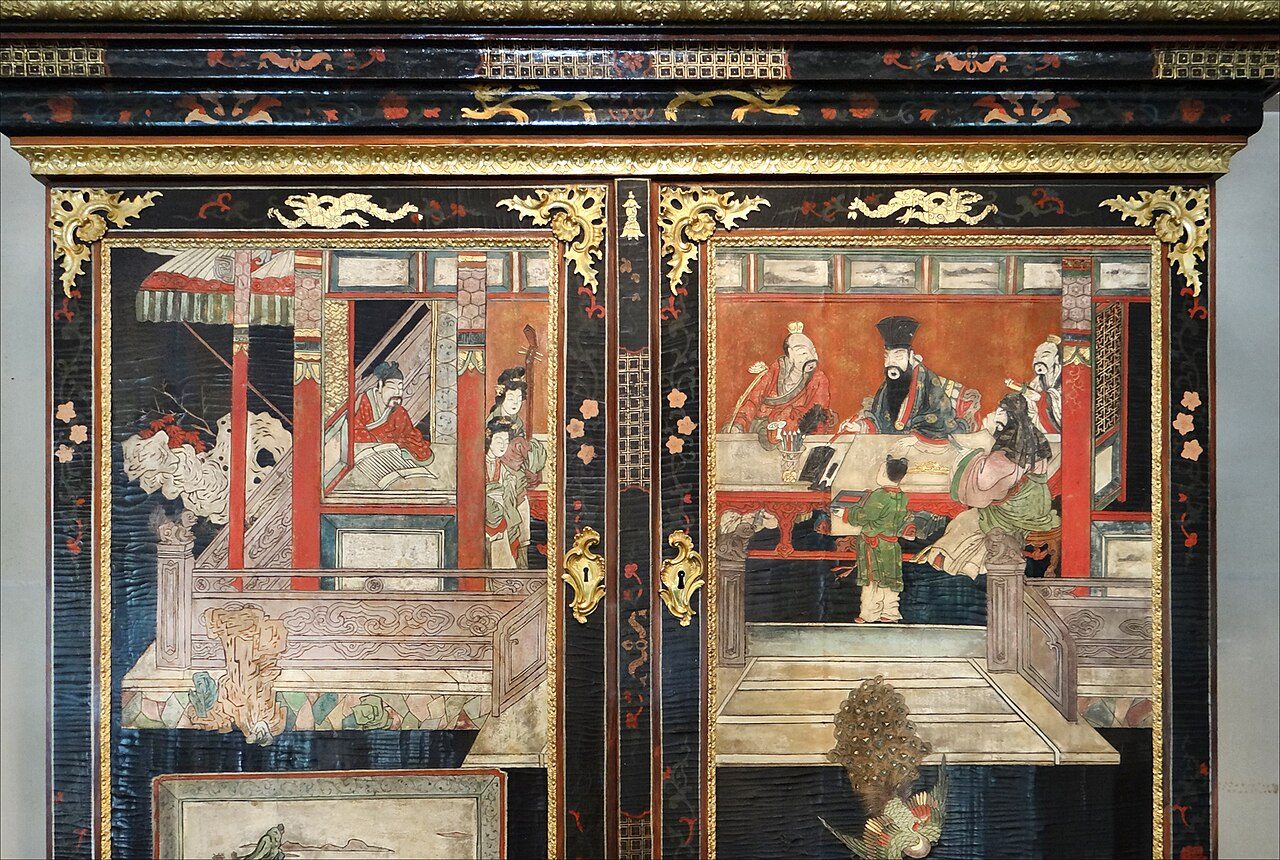
A combination of lacquer techniques are often used in Coromandel screens, but the basic one is kuan cai or "incised colors", which goes back to the Song dynasty. In this the wood base is coated with a number of thick layers of black or other dark lacquer, which are given a high polish. In theory the shapes of the pictorial elements are then cut out of the lacquer, though in screens where a high proportion of the area is taken up by the pictorial elements, some method of reserving the main elements and saving expensive lacquer was probably used. The areas for the picture elements might be treated in a variety of ways. The final surface might be painted in coloured lacquer, oil paints, or some combination, perhaps after building up the surface with putty, gesso, plaster, lacquer, or similar materials as filler, giving a shallow relief to figures and the like. A different technique was to use inlays of mother of pearl, which had been used on lacquer since at least the Song dynasty and revived in popularity in the 16th century, perhaps also using tortoiseshell, ivory, and metal, especially gold for touches. The mother of pearl was often engraved and stained with colours. The mother of pearl technique was, at least initially, more expensive and produced for the court (who also used screens painted by court artists), and the filled technique apparently developed for a wealthy clientele outside the court. The screens seem to have been mostly made in Fujian province in south China, traditionally a key area for lacquer manufacturing. Up to thirty layers of lacquer could be used. Each layer could have pictures and patterns incised, painted, and inlaid, and this created a design standing out against a dark background. 1
Treatment in Europe
At the peak period in the decades around 1700 the main customers for screens shipped by the VOC were the English. The original fashion may have been Dutch; it was brought to England after the Glorious Revolution of 1688, and to Germany by the princely marriages of the daughters of Frederick Henry, Prince of Orange and his wife Amalia of Solms-Braunfels. Small rooms panelled in lacquer, "lacquer cabinets", were built in Berlin in 1685–95, Munich in 1693 with another in 1695, and Dresden in 1701. This fashion seems to have died away rapidly after 1700, probably largely replaced in England with tapestries using similar Asiatic iconography for royalty and the top of the market (examples remain at Belton House), and then later wallpaper. None of the English or rooms panelled in lacquer have survived, but the Rijksmuseum in Amsterdam has a room from the Stadtholder's palace at Leeuwarden, which has recently been restored and placed on display (Phillips Wing). In the Netherlands the English speciality of gilded leather with impressed oriental designs was imported for grand houses around the 1720s. The Europeans were vague on the differences between Chinese, Japanese, Indian and other East Asian styles, and English tapestry-makers replicated the feel of Coromandel lacquer subjects with the individual figures adapted from Mughal miniatures they had to hand. Interest then turned to incorporating lacquer panels, whether imported as such or cut down from screens, into pieces of furniture, on a carcass of European wood in "Japanning" imitation lacquer, lavishly ornamented with ormolu mounts. 1
The text above is adapted from the Wikipedia article “Coromandel lacquer”, available under the Creative Commons Attribution-ShareAlike 4.0 licence. 1
Coromandel Screen is type of folding screen, according to the structured record cited below. This entry was generated automatically from that record and has not yet been reviewed by a person familiar with the tradition. 2
The source record links this tradition to 3 external registers, which can be verified through the citation. 2