The tradition & historical record
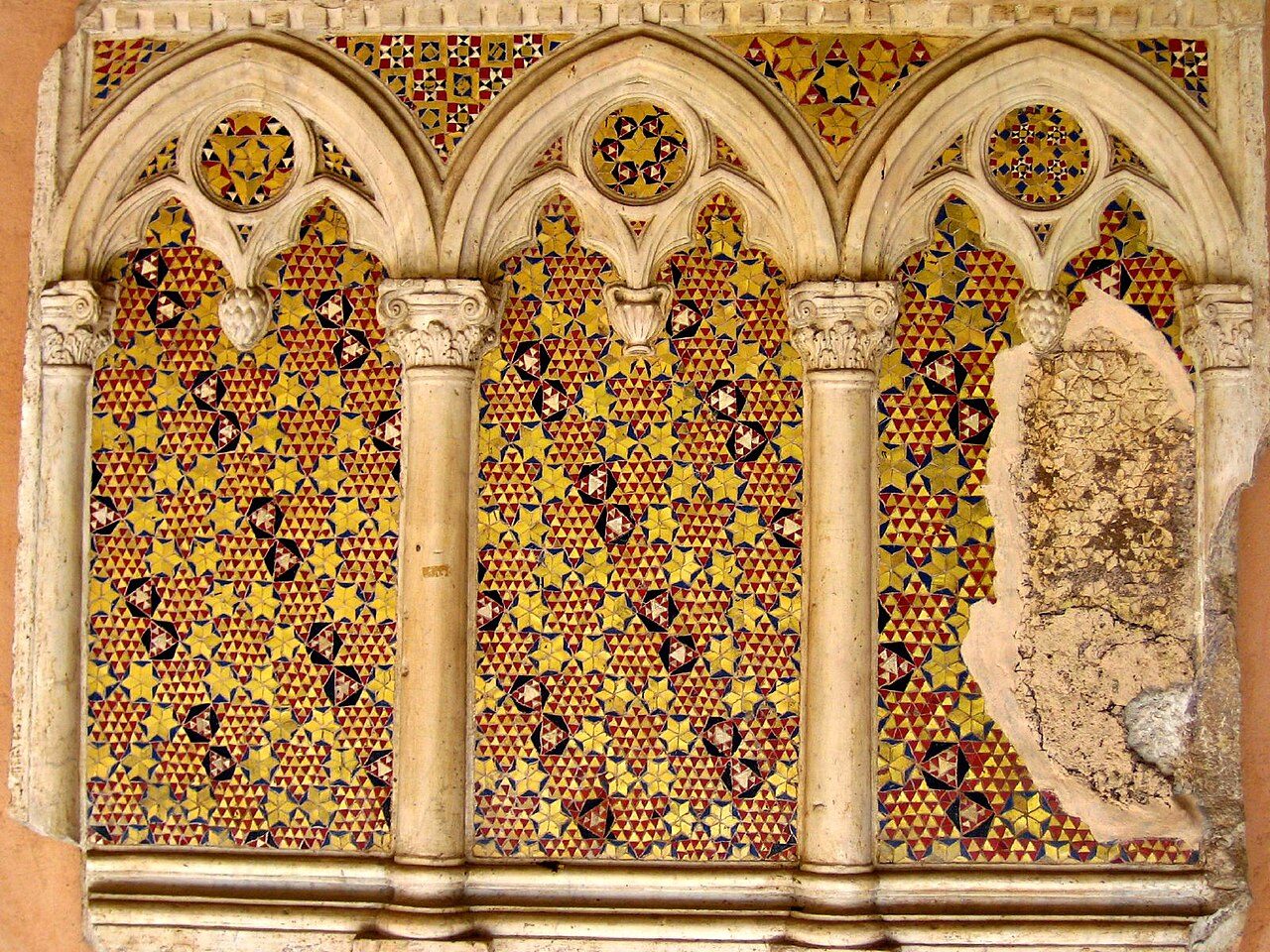
4 min read · 2 sourcesCosmatesque, or Cosmati, is a style of geometric decorative inlay stonework typical of the architecture of Medieval Italy, and especially of Rome and its surroundings. It was used most extensively for the decoration of church floors, but was also used to decorate church walls, pulpits, and bishop's thrones. The name derives from the Cosmati, the leading family workshop of craftsmen in Rome who created such geometrical marble decorations. The style spread across Europe, where it was used in the most prestigious churches; the high altar of Westminster Abbey, for example, is decorated with a Cosmatesque marble floor. 1
Description and early history
Although the Cosmati family are the eponymous craftsmen of the style, they do not seem to have been the first to develop the art. This Italian geometric style was heavily influenced by Byzantine pavements. Sometime in the first millennium AD, the Byzantine Empire moved away from the classical antique version of opus tessellatum floor mosaics, in which the patterns are made from small units that are all the same size and shape. They developed Ancinet Roman opus sectile technique and started making geometric floors using carved marble and inlays. Examples of such floors have survived in Hagia Sophia in Trabzon, the Monastery of Hosios Loukas, the "Omphalion" mosaic in Hagia Sophia, Istanbul, etc. This style may also be seen in Italy in the pavement of the Benedictine abbey of Monte Cassino (1066–1071), built using workers from Constantinople. In 12th Italians began making such floors themselves, improving the technique but retaining the basic principles. The Cosmatesque style takes its name from the family of the Cosmati, which flourished in Rome during the 12th and 13th centuries and practiced the art of mosaic. The Cosmati's work is peculiar in that it consists of glass mosaic in combination with marble. At times it is inlaid on the white marble architraves of doors, on the friezes of cloisters, the flutings of columns, and on sepulchral monuments. Again, it frames panels, of porphyry or marble, on pulpits, episcopal chairs, screens, etc., or is itself used as a panel. The colour is brilliant, gold tesserae being freely used. While more frequent in Rome than elsewhere in Italy, its use is not confined to that city. Among other locations it is found in the Cappella Palatina in Palermo. 1
Terminology
Cosmatesque work is also known as opus alexandrinum. Definitions of this term, and the distinction between it and opus sectile, vary somewhat. Some restrict opus alexandrinum to the typical large designs, especially for floors, using white guilloche patterns filled in with roundels and bands in coloured designs using small pieces. Others include any geometric design including large pieces, as in the picture from Spoleto (right side) below, whereas opus sectile also includes figurative designs made in the same technique. Opus alexandrinum is another form of opus sectile, where only a few colours are used, such as white and black, or dark green on a red ground, or vice versa. This term is particularly employed to designate a species of geometrical mosaic, found in combination with large slabs of marble, much used on the pavements of medieval Roman churches and even in Renaissance times, as, for instance, on the pavements of the Sistine Chapel and the Stanza della Segnatura. 1
Examples in Rome
Among the churches decorated in cosmatesque style in Rome, the most noteworthy are Santa Maria in Trastevere, St. John Lateran, San Lorenzo fuori le Mura, San Saba, San Paolo fuori le Mura, Santa Maria in Aracoeli, Santa Maria in Cosmedin, Santa Maria Maggiore, San Crisogono, San Clemente, Santa Prassede, Santa Croce in Gerusalemme, and the Sistine Chapel and the Stanza della Segnatura at the Vatican. Outside Rome, Tivoli, Subiaco, Anagni, Ferentino, Terracina and Tarquinia contain remarkable cosmatesque works. Also, Cosmati built innovative decoration for the Cathedral of Civita Castellana. 1
links
This article incorporates text from a publication now in the public domain: Herbermann, Charles, ed. (1913). "Cosmati Mosaic". Catholic Encyclopedia. New York: Robert Appleton Company. Cosmatesque pavement of S. Maria in Cosmedin (with photographs) The Sacred Heart and St. Catherine of Alexandria, Droitwich Spa, England - Cosmatesque Pavement floor The Cosmati pavement at Westminster Abbey Encyclopaedia Britannica article on Cosmati work 1
The text above is adapted from the Wikipedia article “Cosmatesque”, available under the Creative Commons Attribution-ShareAlike 4.0 licence. 1
Cosmatesque is intricate geometric pattern of inlayed marble, according to the structured record cited below. This entry was generated automatically from that record and has not yet been reviewed by a person familiar with the tradition. 2
The source record links this tradition to 2 external registers, which can be verified through the citation. 2