The tradition & historical record
6 min read · 2 sourcesA cotton mill is a building that houses spinning or weaving machinery for the production of yarn or cloth from cotton, an important product during the Industrial Revolution in the development of the factory system. Although some were driven by animal power, most early mills were built in rural areas at fast-flowing rivers and streams, and used water wheels for power. The development of viable steam engines by Boulton and Watt from 1781 led to the growth of larger, steam-powered mills. They were built in a concentrated way in urban mill towns, such as Manchester. Together with neighbouring Salford, it had more than 50 mills by 1802. The mechanisation of the spinning process in the early factories was instrumental in the growth of the machine tool industry, enabling the construction of larger cotton mills. Limited companies were developed to construct mills, and together with the business of the trading floors of the cotton exchange in Manchester, a vast commercial city developed. Mills generated employment demand, drawing workers from largely rural areas and expanding urban populations. They provided incomes for girls and women. Child labour was used in the mills, and the factory system led to organised labour. Poor conditions became the subject of exposés. In England, the Factory Acts were written to regulate them. The cotton mill, originally a Lancashire phenomenon, was copied in New England and New York, and later in the southern states of America. 1
History
In the mid-16th century Manchester was an important manufacturing centre for wool and Leigh and south towards Manchester, used flax and raw cotton imported along the Mersey and Irwell Navigation. 1
Key inventions
During the Industrial Revolution cotton manufacture changed from a domestic to a mechanised industry, made possible by inventions and advances in technology. The weaving process was the first to be mechanised by the invention of John Kay's flying shuttle in 1733. The manually operated spinning jenny was developed by James Hargreaves in about 1764, and speeded up the spinning process. The roller spinning principle of Paul and Bourne became the basis of Richard Arkwright's spinning frame and water frame, patented in 1769. The principles of the spinning jenny and water frame were combined by Samuel Crompton in his spinning mule of 1779, but water power was not applied to it until 1792. Many mills were built after Arkwright's patent expired in 1783 and, by 1788, there were about 210 mills in Great Britain. The development of cotton mills was linked to the development of the machinery they contained. By 1774, 30,000 people in Manchester were employed using the domestic system in cotton manufacture. Handloom weaving lingered into the mid-19th century but cotton spinning in mills relying on water power and subsequently steam power using fuel from the Lancashire Coalfield began to develop before 1800. Many more people were employed by the mills. 1
Paul-Wyatt mills
The first cotton mills were established in the 1740s to house roller spinning machinery invented by Lewis Paul and John Wyatt. The machines were the first to spin cotton mechanically "without the intervention of human fingers". They were driven by a single non-human power source which allowed the use of larger machinery and made it possible to concentrate production into organised factories. Four mills were set up to house Paul and Wyatt's machinery in the decade following its patent in 1738: the short-lived, animal-powered Upper Priory Cotton Mill in Birmingham in 1741; Marvel's Mill in Northampton operated from 1742 until 1764 and was the first to be powered by a water wheel; Pinsley Mill in Leominster probably opened in 1744 and operated until it burned down in 1754; and a second mill in Birmingham set up by Samuel Touchet in 1744, about which little is known, but which was sufficiently successful for Touchet later to seek the lease on the mill in Northampton. The Paul-Wyatt mills spun cotton for several decades but were not very profitable, becoming the ancestors of the cotton mills that followed. 1
Arkwright-type mills
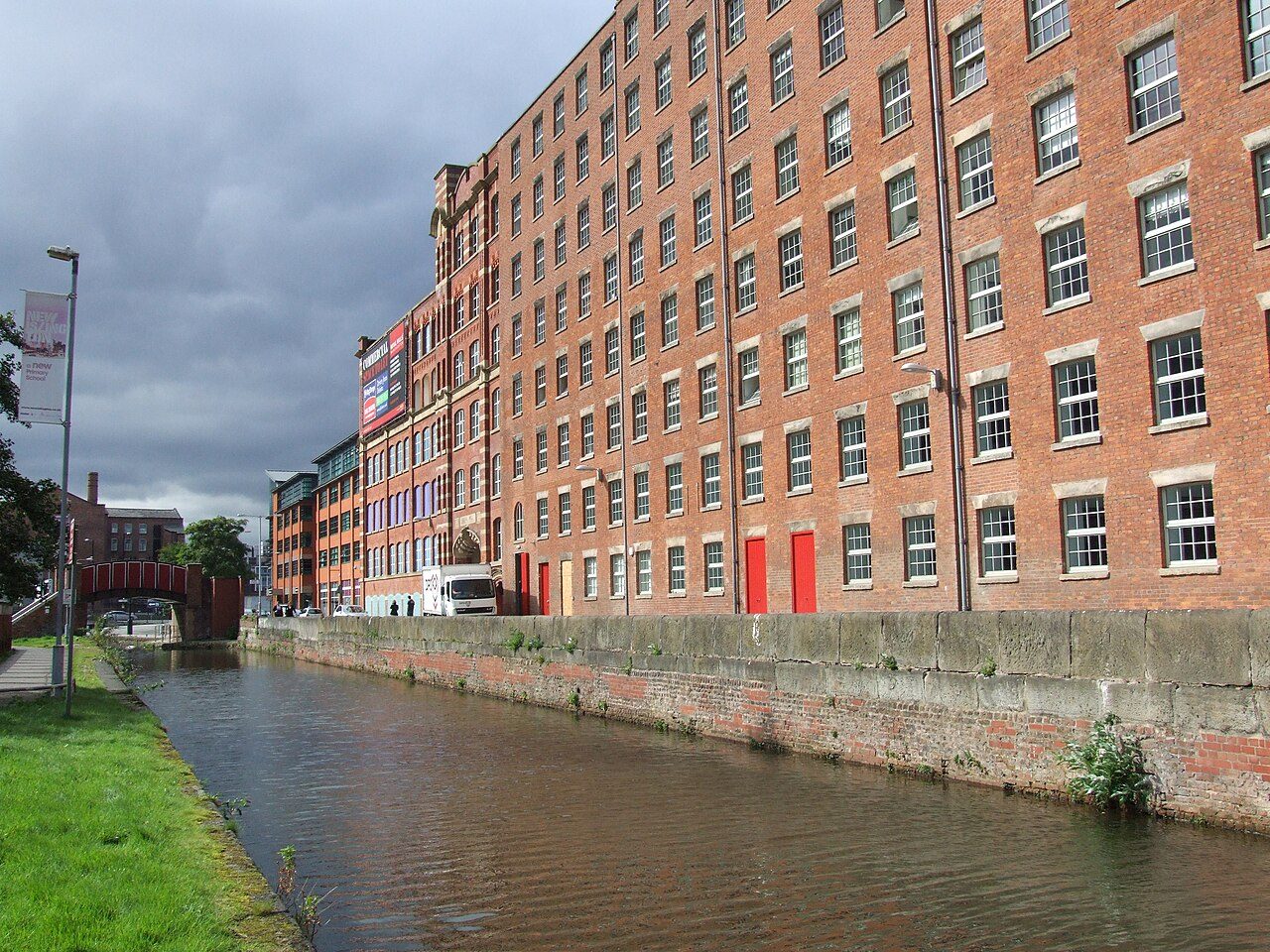
Richard Arkwright obtained a patent for his water frame spinning machinery in 1769. Although its technology was similar to that of Lewis Paul, John Wyatt, James Hargreaves and Thomas Highs, Arkwright's powers of organisation, business acumen and ambition established the cotton mill as a successful business model and revolutionary example of the factory system. Arkwright's first mill – powered by horses in Nottingham in 1768 – was similar to Paul and Wyatt's first Birmingham mill although by 1772 it had expanded to four storeys and employed 300 workers. In 1771, while the Nottingham mill was at an experimental stage, Arkwright and his partners started work on Cromford Mill in Derbyshire, which "was to prove a major turning point in the history of the factory system". It resembled the Paul-Wyatt water-powered mill at Northampton in many respects, but was built on a different scale, influenced by John Lombe's Old Silk Mill in Derby and Matthew Boulton's Soho Manufactory in Birmingham. Constructed as a five-storey masonry box; high, long and narrow, with ranges of windows along each side and large relatively unbroken internal spaces, it provided the basic architectural prototype that was followed by cotton mills and English industrial architecture through to the end of the 19th century. Arkwright recruited large, highly disciplined workforces for his mills, managed credit and supplies and cultivated mass consumer markets for his products. By 1782 his annual profits exceeded £40,000, and by 1784 he had opened 10 more mills. 1
Early steam mills
Before 1780, only water power was available to drive large mills, but they were dependent on a constant flow of water and built in rural locations, causing problems of labour supply, transportation of materials and access to urban merchants for large mill-owners. Steam engines had been used to pump water since the invention of the atmospheric engine by Thomas Newcomen in 1712 and, starting with the engine installed at Arkwright's Haarlem Mill in Wirksworth, Derbyshire in 1780, were used to supplement the supply of water to the water wheels of cotton mills. In 1781 James Watt registered a patent for the first rotative steam engine designed to "give motion to the wheels of mills or other machines". Concerns remained over the smoothness of the power supplied by a steam engine to cotton mills, where the regularity of the yarn produced was dependent on the regularity of the power supply, and it was not until 1785 at Papplewick, in Robinson's Mill near Nottingham that a steam engine was successfully used to drive a cotton mill directly. Boulton and Watt's engines enabled mills to be built in urban contexts and transformed the economy of Manchester, whose importance had previously been as a centre of pre-industrial spinning and weaving based on the domestic system. 1
The text above is adapted from the Wikipedia article “Cotton mill”, available under the Creative Commons Attribution-ShareAlike 4.0 licence. 1
cotton mill is factory housing powered spinning machinery for the production of yarn, according to the structured record cited below. This entry was generated automatically from that record and has not yet been reviewed by a person familiar with the tradition. 2
The source record links this tradition to 9 external registers, which can be verified through the citation. 2