The tradition & historical record
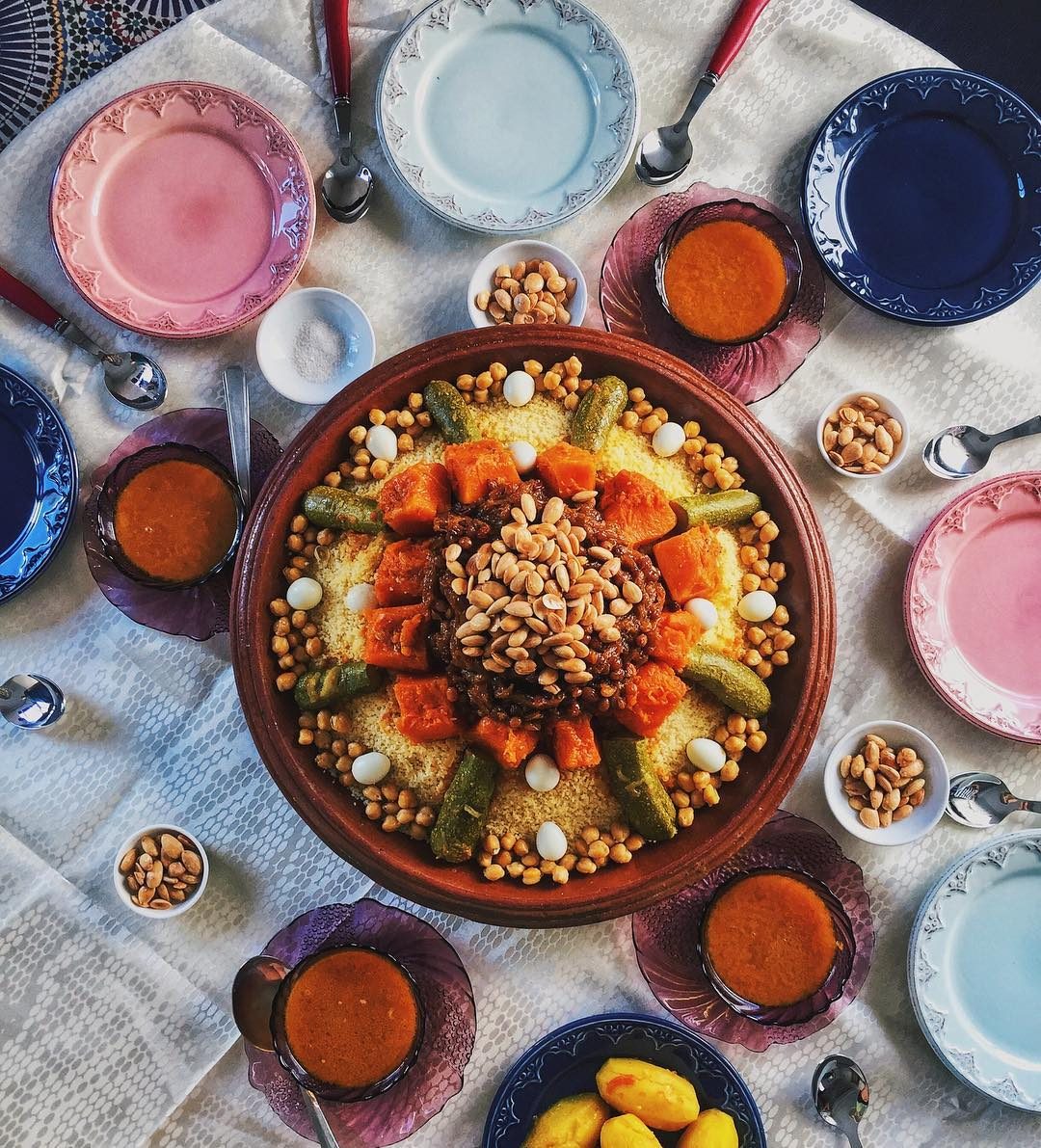
6 min read · 2 sourcesCouscous is a traditional North African dish of small steamed granules of rolled semolina that is often served with a stew spooned on top. Pearl millet, sorghum, bulgur, and other cereals are often cooked in much the same way in West Africa, and the resulting dishes are also sometimes called couscous. Couscous is a staple food throughout the Maghrebi cuisines of Algeria, Tunisia, Mauritania, Morocco, and Libya. It was integrated into French and European cuisine at the beginning of the twentieth century, through the French colonial empire and the Pieds-Noirs of Algeria. In 2020, couscous was added to UNESCO's Intangible Cultural Heritage list. 1
Etymology
The word "couscous" (alternately cuscus or kuskus) was first noted in early 17th century French, from Arabic kuskus, from kaskasa 'to pound', and is probably of Berber origin. The term seksu is attested in various Berber varieties such as Kabyle and Riffian, while Saharan Berber varieties such as Touareg and Ghadames have a slightly different form, keskesu. This widespread geographical dispersion of the term strongly suggests its local Berber origin, lending further support to its likely Berber roots as Algerian linguist Salem Chaker suggests. The Berber root *KS means "well formed, well rolled, rounded." Numerous names and pronunciations for couscous exist around the world. According to María Teresa Santamaría Hernández, the Arabic name kuskūs, first recorded in the 13th century in Al-Andalus, can be better explained from Latin adjective *coscosus. The Latin noun coscus had an ancient Mediterranean origin, and referred to small rounded or curved objects, and hence to small animals such as worms, ants, termites and woodworms. This word coscus and its variant cossus appear in Latin veterinary treatises and in glossaries, and might have been very common in North Africa, and perhaps also in southern Spain. Therefore, *coscosus meant ‘full of worms’, also in a metaphorical sense referring to this dish of granules or rolled semolina. In medieval Spanish, the word cozcucho, from Andalusi Arabic, is recorded in the 13th century, and alcuzcuzu, alcuzcuçu, cuzcuz and other variants referred since the first half of the 15th century to this dish considered typical of Moors and Moriscos. This same dish was also called formigos, hormigos and hormiguillos (‘resembling ants’) from the 15th century onwards in a metaphorical sense, since the original meaning of cuzcuz had not been lost. 1
History
It is unclear when couscous originated. Objects that may be couscoussiers have been found at Tichitt culture sites in southern Mauritania dated to 700-400 BCE, where millet was grown and perhaps made into couscous. Food historian Lucie Bolens believes couscous originated millennia ago, during the reign of Masinissa in the ancient kingdom of Numidia in present-day Algeria. Traces of cooking vessels akin to couscoussiers have been found in graves from the 3rd century BC, from the time of the Berber kings of Numidia, in Kabylia, Algeria. Cooking utensils that closely resemble couscoussiers dating back to the 9th century were found in Tiaret, Algeria. Couscoussiers dating back to the 12th century were found in the ruins of Igiliz, located in the Sous valley of Morocco. According to food writer Charles Perry, couscous originated among the Berbers of Algeria and Morocco between the end of the 11th-century Zirid dynasty, modern-day Algeria, and the rise of the 13th-century Almohad Caliphate. The historian Hady Idris noted that couscous is attested to during the Hafsid dynasty, but not the Zirid dynasty. Historian Marianne Brisville stated that couscous could be recognised in the 11th century under the word taam, the oldest mention is in Ouargla, Algeria. In the 12th century, Maghrebi cooks were preparing dishes of non-mushy grains by stirring flour with water to create light, round balls of couscous dough that could be steamed. The historian Maxime Rodinson found three recipes for couscous from the 13th century Arabic cookbook Kitab al-Wusla ila al-Habib, written by an Ayyubid author, and the anonymous Arabic cooking book Kitab al tabikh and Ibn Razin al-Tujibi's Fadalat al-khiwan also contain recipes. 1
Preparation
Couscous is traditionally made from semolina, the hardest part of the grain of durum wheat (the hardest of all forms of wheat), which resists the grinding of the millstone. The semolina is sprinkled with water and rolled with the hands to form small pellets, sprinkled with dry flour to keep them separate, and then sieved. Any pellets that are too small to be finished granules of couscous fall through the sieve and are again rolled and sprinkled with dry semolina and rolled into pellets. This labor-intensive process continues until all the semolina has been formed into tiny couscous granules. In the traditional method of preparing couscous, groups of people come together to make large batches over several days, which are then dried in the sun and used for several months. Handmade couscous may need to be rehydrated as it is prepared; this is achieved by a process of moistening and steaming over stew until the couscous reaches the desired light and fluffy consistency. In some regions, couscous is made from farina or coarsely ground barley or pearl millet. 1
In modern times, couscous production is largely mechanized, and the product is sold worldwide. This couscous can be sauteed before it is cooked in water or another liquid. Properly cooked couscous is light and fluffy, not gummy or gritty. Traditionally, North Africans use a food steamer (called a taseksut in the Berber language, a كِسْكَاس kiskas in Arabic or a couscoussier in French). The base is a tall metal pot shaped like an oil jar, where the meat and vegetables are cooked as a stew. On top of the base, a steamer sits where the couscous is cooked, absorbing the flavours from the stew. The steamer's lid has holes around its edge so steam can escape. It is also possible to use a pot with a steamer insert. 1
Recognition
In December 2020, Algeria, Mauritania, Morocco, and Tunisia obtained official recognition for the knowledge, know-how, and practices pertaining to the production and consumption of couscous on the Representative List of the Intangible Cultural Heritage of Humanity by UNESCO. The joint submission by the four countries was hailed as an "example of international cooperation." 1
Local variations
Couscous proper is about 2 mm in diameter, but there also exists a larger variety (3 mm more) known as berkoukes, as well as an ultra-fine version (around 1 mm). In Morocco, Algeria, Tunisia, and Libya, it is generally served with vegetables (carrots, potatoes, and turnips) cooked in a spicy or mild broth or stew, usually with some meat (generally, chicken, lamb, or mutton). 1
The text above is adapted from the Wikipedia article “Couscous”, available under the Creative Commons Attribution-ShareAlike 4.0 licence. 1
couscous is North african dish of steamed granul of rolled semolina, according to the structured record cited below. This entry was generated automatically from that record and has not yet been reviewed by a person familiar with the tradition. 2
The source record links this tradition to 34 external registers, which can be verified through the citation. 2