The tradition & historical record
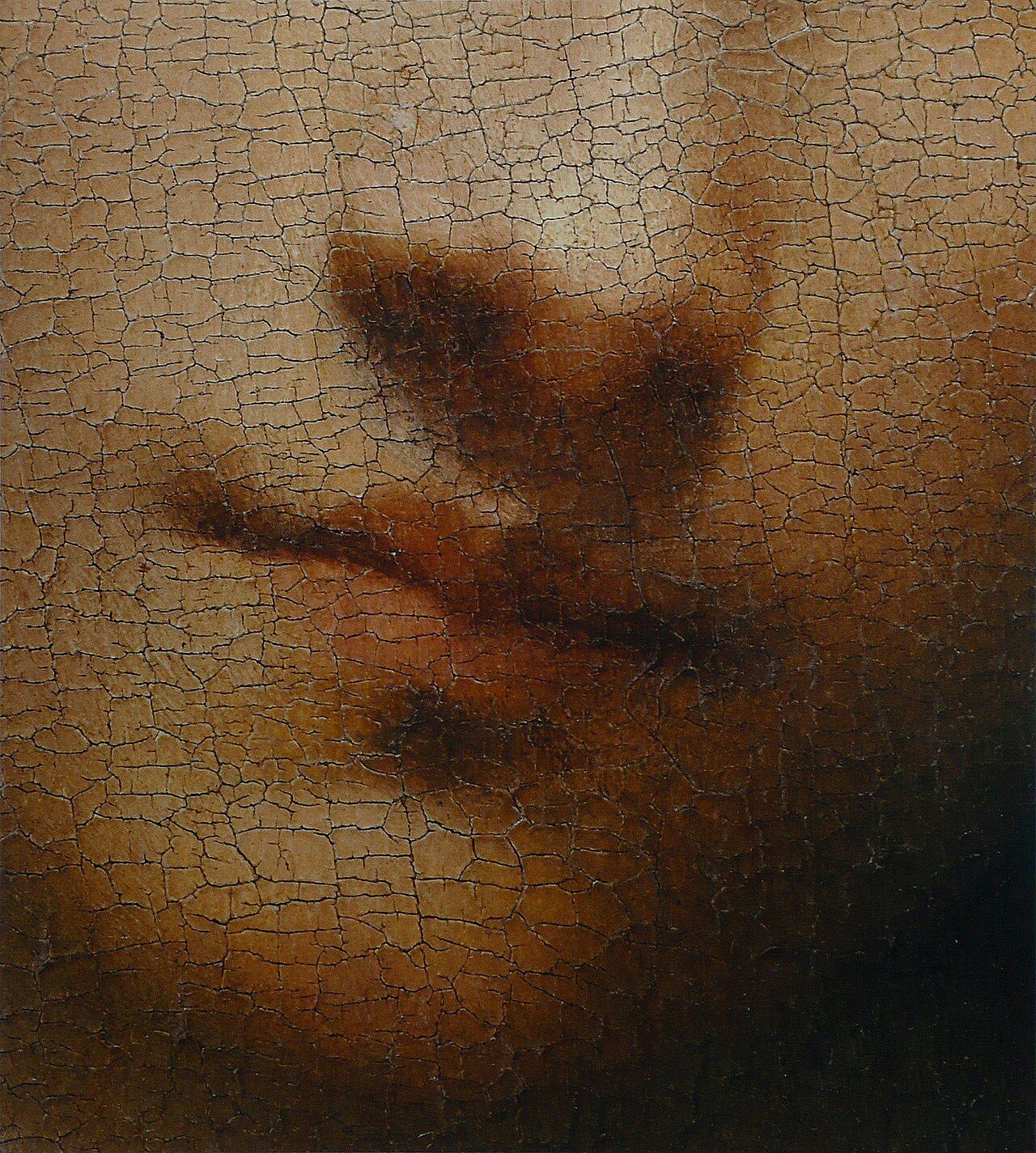
4 min read · 2 sourcesCraquelure (French: craquelure; Italian: crettatura) is a fine pattern of dense cracking formed on the surface of materials. It can be a result of drying, shock, aging, intentional patterning, or a combination of all four. The term is most often used to refer to tempera or oil paintings, but it can also develop in old ivory carvings or painted miniatures on an ivory backing. Recently, analysis of craquelure has been proposed as a way to authenticate art. In ceramics, craquelure in ceramic glazes, where it is often a desired effect, is called "crackle"; it is a characteristic of Chinese Ge ware in particular. This is usually differentiated from crazing, which is a glaze defect in firing, or the result of aging or damage. 1
In painted surfaces
Painting systems are composed of complex layers with unique mechanical properties that depend on the type of drying oil or paint medium used and the presence of paint additives, such as organic solvents, surfactants, and plasticizers. Understanding the mechanism of craquelure formation in paint and the resulting crack morphology provides information about the methods and materials used by the artists. 1
Characterization of craquelure morphology
There are seven key features used to describe craquelure morphology: 1
Local and global direction of cracks Relationship to weave or grain direction of support Crack shape Crack spacing Crack thickness Termination of cracks Organization of crack network These seven criteria have been used to identify "styles" of craquelure, which relate crack patterns to various historic schools of art. This links the crack patterns with specific time periods, locations, and painting styles. 1
Italian paintings on panel (1300–1500): cracks oriented perpendicular to wood grain with jagged lines and distinct secondary networks of thin cracks Flemish paintings on panel (1400–1600): cracks oriented parallel to wood grain with smooth, straight segments; uniform thicknesses and small, square islands observed Dutch paintings on canvas (1600s): cracks oriented perpendicular to major axis of painting with jagged lines and square junctions; cracks tend to follow weft and warp of canvas support French paintings on canvas (1700s): non-directional cracks with smooth, curved lines in random distributions; newly-developed, stiffer sublayers tended to delocalize tension from the support and remove the connection between crack direction and canvas weave 1
Distinguishing Italian and French paintings by craquelures
Paintings do not have flat surfaces but rather an uneven texture because of the wood, animal glue, ground or gesso, paint, binder used, etc. Since the elements used to create paintings vary by region, surface textures can also vary according to where they were produced. Italian painters usually used a thin ground surface, which led to their work developing skinny, thin cracks, while French painters have swirling cracks because of a much thicker ground surface. 1
Craquelure during drying
During drying, the pictorial layer tends to shrink as volatile solvents evaporate. Non-uniform shrinkage across the painting surface is caused by differential adhesion to the sublayer by different paint species and leads to large tensile stresses in the top paint layer. Crack formation during drying depends strongly on adhesion to the sublayer, paint film thickness, composition, and the mechanical properties of the sublayer. Craquelure formed during the drying process appears within days of painting and is characterized by shallow cracks that are localized to the topmost layers of paint. This localization results from capillary forces, which constrain drying stresses to the free surface of the painting. Drying cracks are usually isotropic due to the fine dispersion of pigment particles within the evaporating volatile solvents. Crack propagation at a critical strain, ϵ m {\displaystyle \epsilon _{m}} , is opposed by an unfavorable increase in surface energy as the crack elongates and promoted by a release in the elastic energy of the material near the crack. The condition for the propagation of a drying crack can be evaluated precisely using fracture mechanics. 1
Adhesion to sublayer
Crack width is heavily dependent on the ability of the top paint layer to adhere to the sublayer. If poor adhesion between these layers occurs, the pictorial layer can slide over the sublayer and create dramatic, wide cracks in response to uneven tensile strains during solvent evaporation. Unlike aging cracks, the width of drying cracks is highly varying as a result. Poor adhesion can occur if the painter mixes too much oil or other fatty substance into the sublayer material. 1
The text above is adapted from the Wikipedia article “Craquelure”, available under the Creative Commons Attribution-ShareAlike 4.0 licence. 1
craquelure is fine pattern of dense cracking formed on the surface of materials, according to the structured record cited below. This entry was generated automatically from that record and has not yet been reviewed by a person familiar with the tradition. 2
The source record links this tradition to 11 external registers, which can be verified through the citation. 2