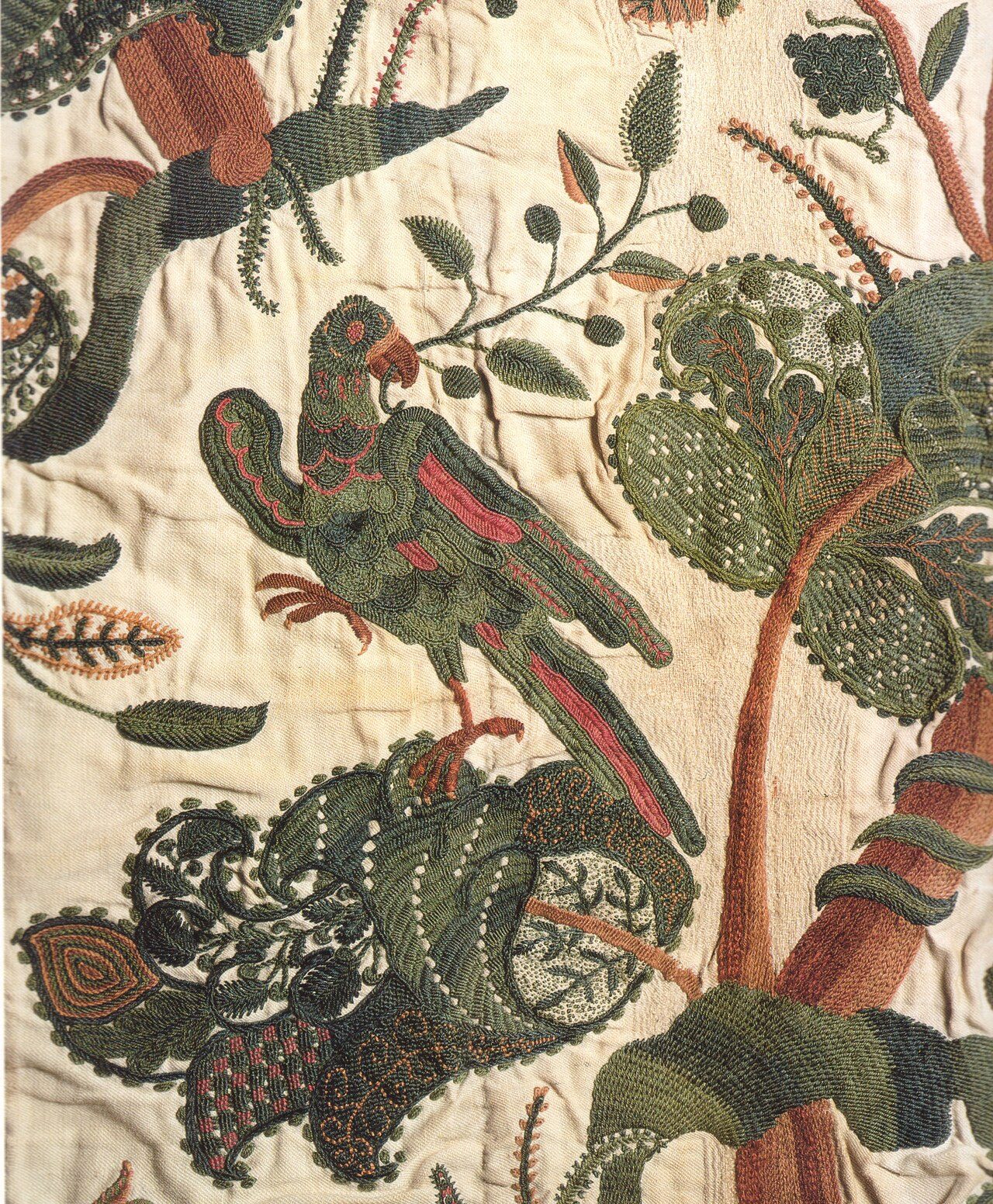
The tradition & historical record
5 min read · 2 sourcesCrewel embroidery, or crewelwork, is a type of surface embroidery worked in wool. A wide variety of different embroidery stitches are used to follow a design outline applied to the fabric. The technique became popular in the 17th century. Crewel embroidery is not identified with particular styles of designs, but simply with the use of wool thread. Modern crewel wool is a fine, two-ply or one-ply yarn available in many different colours. Crewel embroidery is often associated with England in the 17th and 18th centuries, and emigrants carried the craft from England to American colonies, where it became particularly popular in New England. The stitches and designs used in America were simpler and more economical with the scarce crewel wool. The Deerfield Society of Blue and White Needlework (1896–1926) revived interest in crewel embroidery in the United States. 1
Description of the technique
The crewel technique is not a counted-thread embroidery (like canvas work), but a style of free embroidery. Crewelwork had its heyday in Britain in the 17th century, but has come in and out of fashion several times since then. Traditionally, crewel embroidery is done on tightly woven linen twill, though more recently, other fabrics like Matka silk, cotton velvet, rayon velvet, silk organza, net fabric and also jute have been used. A firm fabric is required to support the weight of the stitching, which is done with crewel wool. This type of wool has a long staple; it is fine and can be strongly twisted. It is best to use a crewel needle to execute the stitches as a needle with a wide body, large eye and a sharp point is required. The outlines of the design to be worked are often screen printed onto the fabric or can be transferred to plain fabric using modern transfer pens containing water-soluble ink or air-soluble ink, using a lightbox and a permanent pen, or iron-on designs applied using transfer sheets. The old-fashioned "pinprick and chalk" or "prick and pounce" methods also work well. The prick and pounce method involves transferring the design outlines – printed on paper – by pricking the outline with a needle to produce perforations along the lines. Powdered chalk or pounce material is then forced through the holes onto the fabric using a felt pad or stipple brush in order to replicate the design on the material. Designs range from the traditional to more contemporary patterns. Traditional design styles are often referred to as Jacobean embroidery featuring highly stylized floral and animal designs with flowing vines and leaves. Many different embroidery stitches are used in crewelwork to create a textured and colourful effect. 1
Etymology
The origin of the word crewel is unknown but is thought to come from an ancient word describing the curl in the staple, the single hair of the wool. The word crewel in the 1700s meant worsted, a wool yarn with twist, and thus crewel embroidery was not identified with particular styles of designs, but rather was embroidery with the use of this wool thread. 1
History of crewelwork
The earliest surviving example of crewelwork is The Bayeux Tapestry, which is not actually a tapestry at all. This story of the Norman Conquest was embroidered on linen fabric with worsted wool. The creators of the Bayeux Tapestry used laid stitches for the people and the scenery, couched stitches to provide outlines, and stem stitch for detail and lettering. The worsted wool used for the embroidery may have come from the Norfolk village of Worstead. There are few other early crewel embroideries known. The Jamtlands Lans Museum in Sweden has three related items, the Overhogdals tapestries, from the 11th–12th centuries that show people, animals, and other natural and human-built items. As of 2019, the primary theory is that these works depict the downfall of the world, the Ragnarok. 1
England
Wool from Worstead in Norfolk was manufactured for weaving purposes, but also started to be used for embroidering small designs using a limited number of stitches, such as stem and seeding. These were initially often executed in a single color. However, the color and design range expanded, and embroidery using this crewel wool began to be used in larger projects and designs, such as bed hangings. Rich embroidery had been used extensively in ecclesiastical vestments and altar drapings, but after the Protestant Reformation, the emphasis moved to embroidery, including crewel work, for use in homes and other secular settings. 1
Elizabethan Period
Embroidery for household furnishings during the Elizabethan era was often worked using silk and wool on canvas or linen canvas. Garment embroidery more often used silk or silk and silver threads. Many different stitches were used for the embroidery, including "back, basket, braid, pleated braid, brick, buttonhole, chain, coral, cross, long-armed cross, French knot, herringbone, link, long and short, running, double running, satin, seed, split, stem, tent as well as laid work and couching." Motifs frequently used in crewel embroidery of the period included coiling stems, branches, and detached flower designs. Some embroideries from the Elizabethan period used garden motifs for their design, as gardens themselves were enjoying a heyday. These embroideries were worked in silk or wool (crewel), and were used in the home to brighten the surroundings. Embroidered wall hangings, table carpets, and various forms of bed-hangings might all sport embroidered images. The length of valences made them ideal for embroidery that told a story of a number of episodes. 1
The text above is adapted from the Wikipedia article “Crewel embroidery”, available under the Creative Commons Attribution-ShareAlike 4.0 licence. 1
crewelwork is creative work made using embroidery techniques and wool thread, according to the structured record cited below. This entry was generated automatically from that record and has not yet been reviewed by a person familiar with the tradition. 2
The source record links this tradition to 4 external registers, which can be verified through the citation. 2