The tradition & historical record
7 min read · 2 sourcesCroatian national costume, also called as Croatian traditional clothing or Croatian dress (Croatian: hrvatska narodna nošnja, plural: hrvatske narodne nošnje), refers to the traditional clothing worn by Croats living in Croatia, Bosnia and Herzegovina, Serbia, with smaller communities in Hungary, Austria, Montenegro, and Romania. Since today Croats wear Western-style clothing on a daily basis, the national costumes are most often worn with connection to special events and celebrations, mostly at ethnic festivals, religious holidays, weddings, and by dancing groups who dance the traditional Croatian kolo, or circle dance. Each cultural and geographical region has its own specific variety of costume that vary in style, material, color, shape, and form. Much of these regional costumes were influenced by the Austrian, Hungarian, German, Italian, or Ottoman presence, due to whichever power ruled the region. 1
Main attire
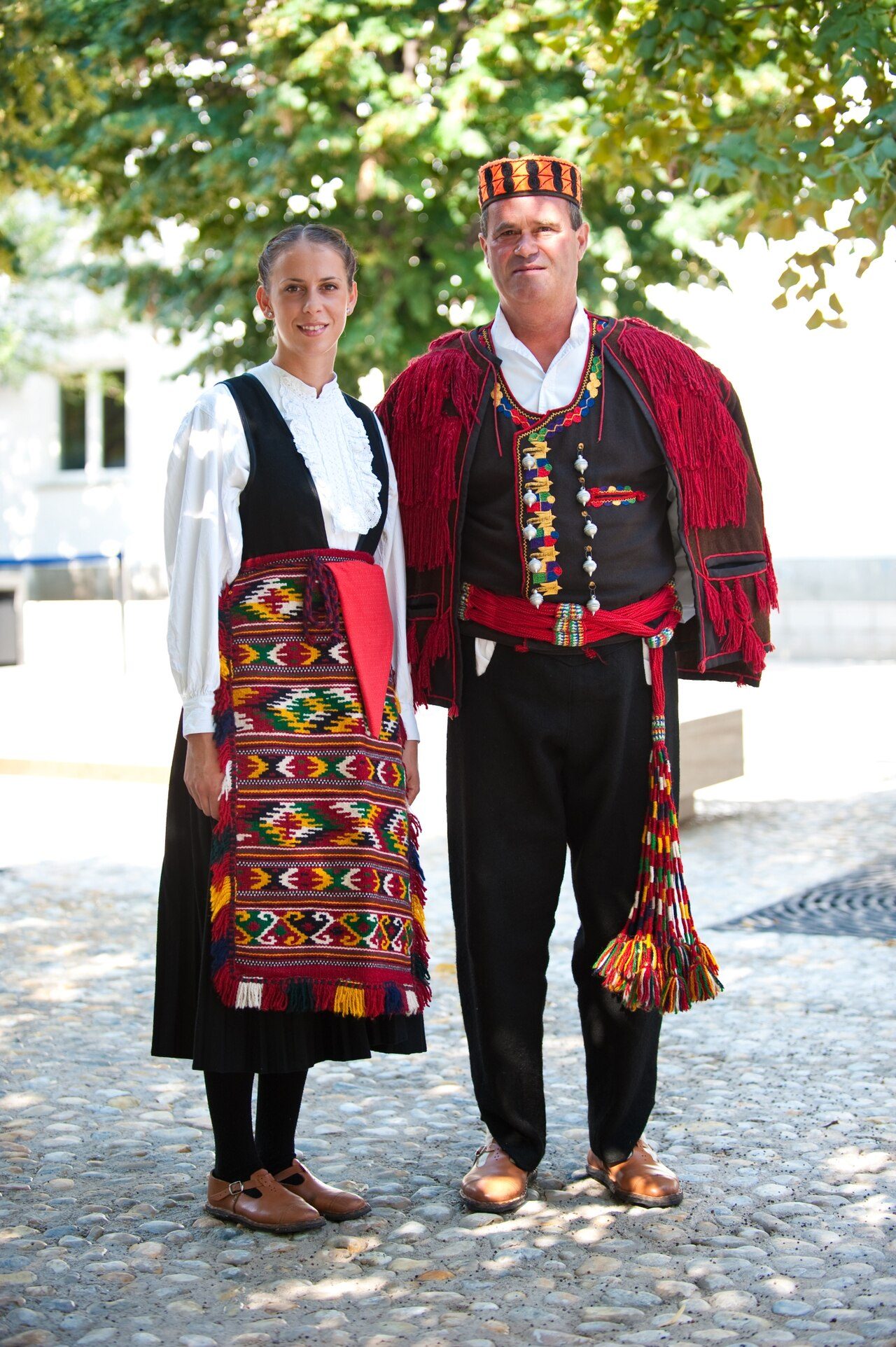
For the female dress, attire consists of a plain white dress or blouse (košulja) or underskirt (skutići), which is usually the basic form of the costume. It is then added with other clothing and decorations, which may include another overdress or skirt (kotula), a decorative jacket (djaketa, paletun or koret), apron (ogrnjač or pregjača), scarf (ubrsac), kerchief or shawl which are usually decorated with a floral or animal motif. The embroidery is very intricate and is usually red, white, blue, gold, or black. Her jewellery, ranging from necklaces, earrings, bracelets, and rings could consist of gold, silver, beads, pearls, or even coral from the Adriatic. Hair is interwoven into one or two braids and decorated with red ribbons for girls or women that are unmarried, while married women wear woven or silk kerchiefs on their heads. Costumes of brides consists of a crown or wreath often made of flowers (vijenac) and large amounts of jewelry. The woman's head could be adorned by a kerchief, cap, or a headdress, the most famous being the headdresses worn by the women from the island of Pag. The amount of paraphernalia a woman is adorned with, either very much or rarely any at all, depends on the region. Completing the costume are stockings (bječve) or knee-high socks, and boots or a special kind of sandal called opanci. For the males, the national dress usually consists on loose, wide slacks (gaće / širkoke) and a shirt, and both are usually either black or white, or both. The man may wear a decorative or plain vest (fermen or jačerma), over his shirt, and possibly a waistcoat. The man almost always wears a cap, varying in shape and design depending on the region. The most famous cap is perhaps the Lika cap, worn in the Lika region for centuries by the people. 1
Slavonia and Baranya
Both Slavonia and Baranya are located in the east, and are associated with the Pannonian style of dress and the Šokci. In Slavonia, the costumes tend to be very elaborate, with floral designs and clothing with silk or wool, fancy embroidery, decorative silk ribbons and bows, lace work, gold or silver jewelry, corals, amber necklaces and pearls for the women. The colors of the dresses tend to be bright and numerous, with colors ranging from gold, red, blue, white, and black all in one costume. The top shirt, or odnjica, of the costume has fringed-wing sleeves, which is generally associated with the Pannonian style. For the men, they tend to wear not as many colors for the shirt and pants, but often wear thick coats or vests with designs and patterns stitched on and fancy embroidery like the women. Their sleeves might have a slight ruffle at the end, but not as much as the women's. In Baranya, a part of the men's costume is a small apron that is worn over the trousers that ranges in color and design. 1
Posavina and Podravina
Posavina and Podravina are both in the north, north-east part of Croatia. Unlike the Slavonians, the costumes from Posavina do not focus on too much elaborate designs and patterns, and instead consists of simple black and white blouses, trousers, and skirts. The men wear black vests and black hats while the women wear beautiful silk shawls, usually blue or red in color with flower motifs. A thick apron with embroidered designs could be worn as well, and their color and detailed patterns are often the main focus of the costume. Although the clothing may be plain, the shawls and/or aprons worn over the blouses and skirts make up for the plain attire in Podravina, and they are sometimes so colorful and richly garnished with patterns that they completely cover up the main dress. The women in Podravina style their own kerchiefs with a unique embroidery from the region, and they wear aprons over their dresses which are colorful and geometric in design and attached with a multi-colored fringe. The men's vests are usually red or black and color and are garnished with intricate patterns and embroidery as well. 1
Međimurje, Zagorje and Zagreb region
Međimurje, Zagorje and Zagreb are all located in the north, and are therefore influenced by the continental style. White garments are typical for the continental region, but each has its own decorative scarves, shawls, aprons, and jewellery. Red is the most popular color, especially in Zagorje, and the aprons and vests worn by the men and women are red with elaborate stitching and embroidery, mostly with gold thread. Women wear colorful shawls and kerchiefs which are usually red with flower designs. The second most popular color is black, which could have gold or white embroidery, or none at all. Very often, the men and women would not wear any aprons or shawls, and their costumes would mostly consist of their white garments, which they may stitch a border of color at the ends, or add a sash (tkanica) for some color. Hats are an important part of a male's costume, and can come in two forms: the traditional Pannonian hat (škrlak) is black and dome-shaped, with a red wool band embroidered with multi-colored thread and white and gold dots attached, or the black felt box-hat (šešir) folded into a flat bow at the back with a grosgrain ribbon tied around the body. Over the grosgrain ribbon, red, white and blue strings are often tied around the hat (e.g. the Croatian tri-color). 1
Istria
The costumes from Istria are influenced by the Adriatic style of the coast. The men's costumes are typically blue or brown or white, and consist of white, ankle length trousers that are tighter than the Slavonian style, shirts, and leather vests. Coats worn over them are generally short and long-sleeved or long, sleeveless ones. Accessories include wide silk belts, red or black caps, and cotton socks worn over their footwear called opanci (strapped soft soled sandals). Women on the coast wear broad-sleeved white blouses that are embroidered in silk or lace, as well as pleated skirts or dresses varying in color, and stockings under their opanci. They also cover their shoulders with colorful shawls called oplece, which cover the shoulders and tie around the neck, hanging over their arms and upper-chest. 1
The text above is adapted from the Wikipedia article “Croatian national costume”, available under the Creative Commons Attribution-ShareAlike 4.0 licence. 1
Croatian folk costume is traditional dress of the various regions of Croatia, according to the structured record cited below. This entry was generated automatically from that record and has not yet been reviewed by a person familiar with the tradition. 2
The source record links this tradition to 2 external registers, which can be verified through the citation. 2