The tradition & historical record
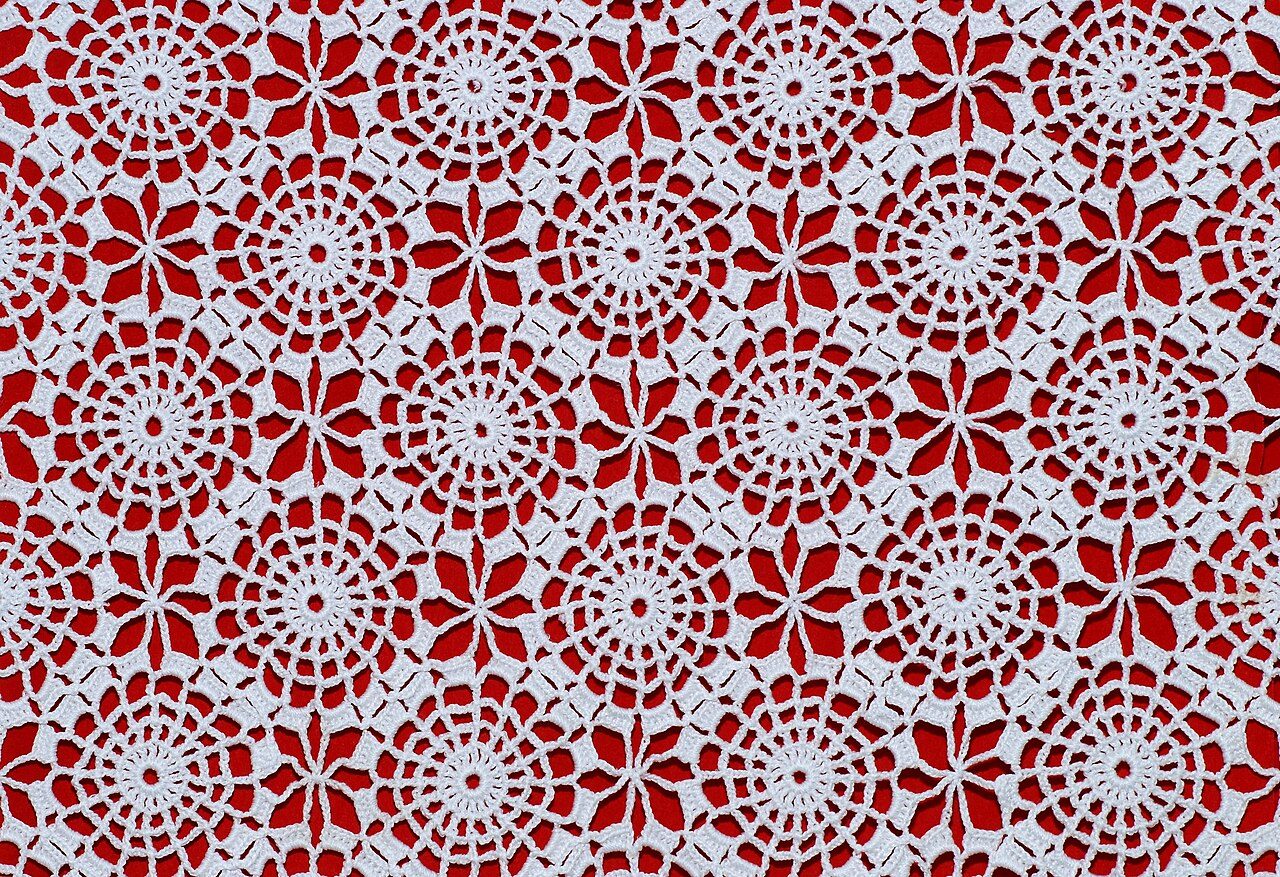
6 min read · 2 sourcesCrochet (English: ; French: [kʁɔʃɛ]) is a process of creating textiles by using a crochet hook to interlock loops of yarn, thread, or strands of other materials. The name is derived from the French term crochet, which means 'hook'. Hooks can be made from different materials (aluminum, steel, metal, wood, bamboo, bone, etc.), sizes, and types (in-line, tapered, ergonomic, etc.). The key difference between crochet and knitting, beyond the implements used, is that each stitch in crochet is completed before the next one, while knitting keeps many stitches open at a time. Some variant forms of crochet however, such as Tunisian crochet and broomstick lace, do keep multiple crochet stitches open at a time. 1
Etymology
The word crochet is derived from the French word crochet, a diminutive of croche, in turn from the Germanic croc, both meaning "hook". It was used in 17th-century French lace-making, where the term crochetage designated a stitch used to join separate pieces of lace. The word crochet subsequently came to describe both the specific type of textile and the hooked needle used to produce it. In 1567, the tailor of Mary, Queen of Scots, Jehan de Compiegne, supplied her with silk thread for sewing and crochet, "soye à coudre et crochetz". 1
Origins
Knitted textiles survive from as early as the 11th century CE, but the first substantive evidence of crocheted fabric emerges in Europe during the 19th century. Prior to the 19th century, classifications often failed to distinguish between crochet and knitting. Earlier work identified as crochet was commonly made by nålebinding, a different looped yarn technique. There are three main theories for the origin of crochet. Some believe that its beginnings can be traced to the Arab trade route, originating in Arabia and spreading to Tibet and then Spain as well as other Mediterranean countries. The second theory places crochet in South America, where it was used as adornment in a tribe's puberty ritual. The third notes the use of crochet in China where early examples of dolls were worked entirely in crochet. 1
The first known published instructions for crochet explicitly using that term to describe the craft in its present sense appeared in the Dutch magazine Penélopé in 1823. This includes a color plate showing five styles of purse, of which three were intended to be crocheted with silk thread. The first is "simple open crochet" (crochet simple ajour), a mesh of chain-stitch arches. The second (illustrated here) starts in a semi-open form (demi jour), where chain-stitch arches alternate with equally long segments of slip-stitch crochet, and closes with a star made with "double-crochet stitches" (dubbelde hekelsteek: double-crochet in international terminology; single-crochet in US). The third purse is made entirely in double-crochet. 1
Irish crochet
In the 19th century, as Ireland was facing the Great Irish Famine (1845–1849), crochet lace work was introduced as a form of famine relief; the production of crocheted lace was an alternative way of making money for impoverished Irish workers. Men, women, and children joined a co-operative in order to crochet and produce products to help with famine relief during the famine. Schools to teach crocheting were started, and teachers were trained and sent across Ireland to teach this craft. When the Irish immigrated to the Americas, they were able to take crocheting with them. Mademoiselle Riego de la Branchardiere is generally credited with the invention of Irish crochet lace, publishing the first book of patterns in 1846. Irish lace became popular in Europe and America, and was made in quantity until the first World War. 1
Modern practice and culture
Fashions in crochet changed with the end of the Victorian era in the 1890s. 1
The strong Victorian colors disappeared, and new publications called for white or pale threads, except for fancy purses, which were often crocheted of brightly colored silk and elaborately beaded. After World War I, far fewer crochet patterns were published, and most of them were simplified versions of the early 20th-century patterns. After World War II, from the late 1940s until the early 1960s, there was a resurgence in interest in home crafts, particularly in the United States, with many new and imaginative crochet designs published for colorful doilies, potholders, and other home items, along with updates of earlier publications. These commercial pattern books, such as the Kentucky Rug Yarns series, published by the January and Wood company, provided simplified instructions for practical household items. These patterns called for thicker threads and yarns than in earlier patterns and included variegated colors. The craft remained primarily a homemaker's art until the late 1960s and early 1970s, when the new generation picked up on crochet and popularized granny squares, a motif worked in the round and incorporating bright colors. 1
Although crochet underwent a subsequent decline in popularity, the early 21st century has seen a revival of interest in handcrafts and DIY, as well as an improvement in the quality and varieties of yarn. As well as books and classes, there are YouTube tutorials and TikTok videos to help people who may need a clearer explanation to learn how to crochet. Crochet has been used as a medium to explore identity and self-expression in educational programs, bridging the gap between art and technology. 1
Sustainability and crochet in fashion
Sustainability can be a key pillar of crochet, as it may use upcycled and environmentally friendly materials in yarn to create sustainable fabrics such as bamboo, hemp, cotton, linen, and wool. Since crochet is typically made by hand, although there are crochet machines in the process of being developed, crochet contributes to ethical production by adhering to the slow production of garments and accessories rather than the fast-paced and mechanized garments that are produced on a mass scale by the fast fashion industry. Slow fashion is part of the "slow movement". The slow movement's objective in clothing and garment manufacturing is to promote respect for people, animals and the environment. Slow fashion supports local artists, the use of eco-friendly materials, and preserves craftsmanship. Since slow fashion promotes the skill of being able to crochet, it's able to provide jobs with a fair income for unemployed youths in Nigeria. Money created from selling the crochet products is a method to improve their standard of living and meet sustainable development goal 8 (SDG). Slow fashion emphasizes the importance of providing high quality products over quantity, resulting in consumers being more aware of the ethics and process of material production and labor. A project called 'Mini Fashion Statement' was created in order to outline the condition of the factories/provide their opinions on the 'true cost' of fashion. Then these scrolls were placed in garments of fast fashion brands. 1
The text above is adapted from the Wikipedia article “Crochet”, available under the Creative Commons Attribution-ShareAlike 4.0 licence. 1
crocheting is technique of creating lace or fabric from thread using a hook, according to the structured record cited below. This entry was generated automatically from that record and has not yet been reviewed by a person familiar with the tradition. 2
The source record links this tradition to 32 external registers, which can be verified through the citation. 2