The tradition & historical record
5 min read · 2 sourcesCross-stitch is a form of sewing and a popular form of counted-thread embroidery in which X-shaped stitches (called cross stitches) in a tiled, raster-like pattern are used to form a picture. The stitcher counts the threads on a piece of evenweave fabric (such as linen) in each direction so that the stitches are of uniform size and appearance. This form of cross-stitch is also called counted cross-stitch in order to distinguish it from other forms of cross-stitch. Sometimes cross-stitch is done on designs printed on the fabric (stamped cross-stitch); the stitcher simply stitches over the printed pattern. Cross-stitch is often executed on easily countable fabric called aida cloth, whose weave creates a plainly visible grid of squares with holes for the needle at each corner. Fabrics used in cross-stitch include linen, aida cloth, and mixed-content fabrics called 'evenweave' such as jobelan and lugana. All cross-stitch fabrics are technically "evenweave" as the term refers to the fact that the fabric is woven to make sure that there are the same number of threads per inch in both the warp and the weft (i.e. vertically and horizontally). Fabrics are categorized by threads per inch (referred to as 'count'), which can range from 11 to 40 count. Counted cross-stitch projects are worked from a gridded pattern called a chart and can be used on any count fabric; the count of the fabric and the number of threads per stitch determine the size of the finished stitching. 1
History
Cross-stitch can be found all over the world since the Middle Ages. Many folk museums show examples of clothing decorated with cross-stitch, especially from continental Europe and Asia. 1
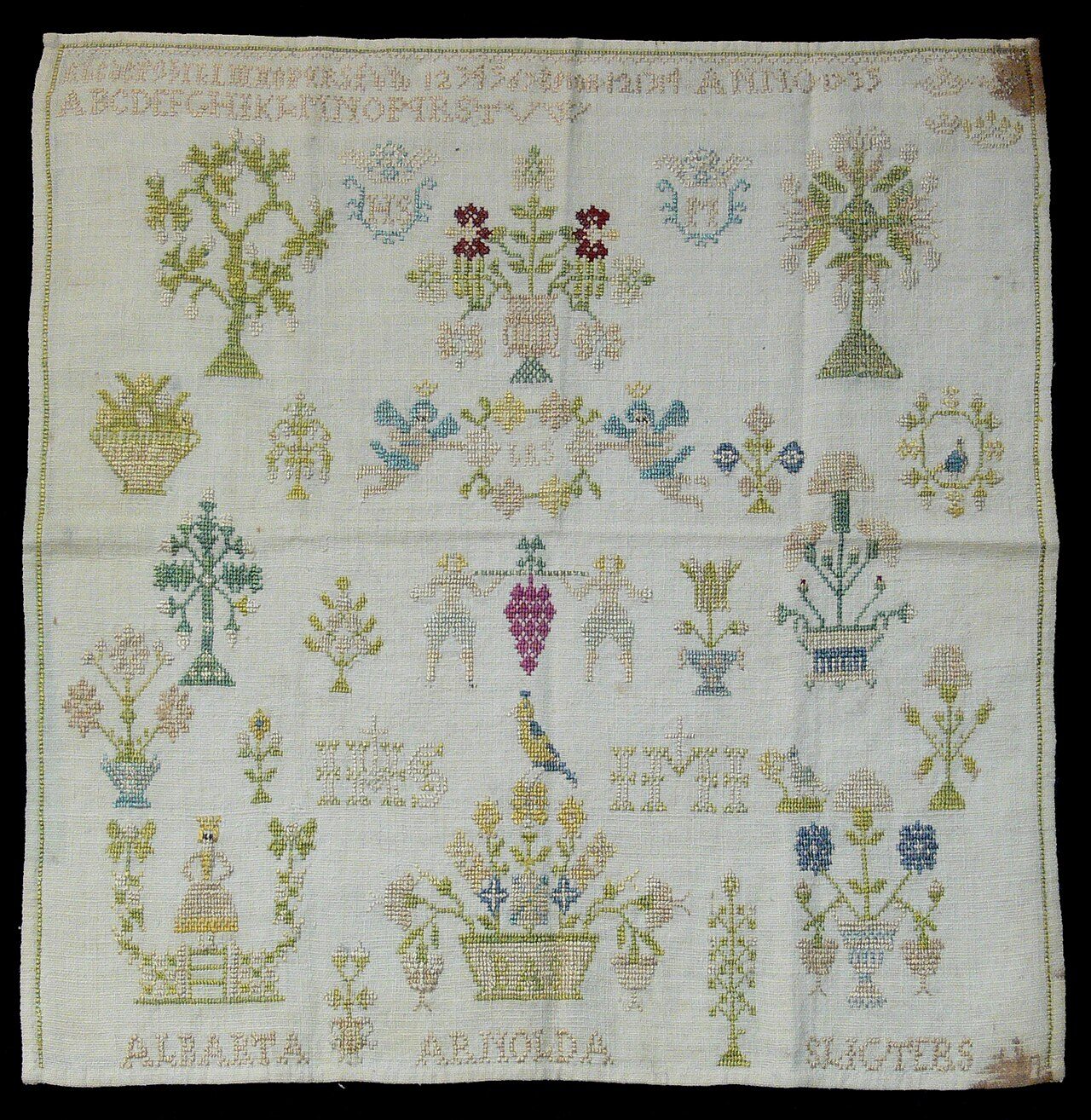
The cross-stitch sampler is called that because it was generally stitched by a young girl to learn how to stitch and to record alphabet and other patterns to be used in her household sewing. She could then refer back to these samples of her stitching over the years. Often, motifs and initials were stitched on household items to identify their owner, or simply to decorate the otherwise-plain cloth. The earliest known cross stitch sampler made in the United States is currently housed at Pilgrim Hall in Plymouth, Massachusetts. The sampler was created by Loara Standish, daughter of Captain Myles Standish and pioneer of the Leviathan stitch, circa 1653. Traditionally, cross-stitch was used to embellish items like household linens, tablecloths, dishcloths, and doilies (only a small portion of which would actually be embroidered, such as a border). Although there are many cross-stitchers who still employ it in this fashion, it is now increasingly popular to work the pattern on pieces of fabric and hang them on the wall for decoration. Cross-stitch is also often used to make greeting cards or pillow tops, or as inserts for box tops, coasters and trivets. 1
Multicoloured, shaded, painting-like patterns as we know them today are a fairly modern development, deriving from similar shaded patterns of Berlin wool work of the mid-nineteenth century. Besides designs created expressly for cross-stitch, there are software programs that convert a photograph or a fine art image into a chart suitable for stitching. 1
Related stitches and forms of embroidery
The cross-stitch can be executed partially such as in quarter-, half-, and three-quarter-stitches. A single straight stitch, done in the form of backstitching, is often used as an outline, to add detail or definition. There are many stitches which are related structurally to cross-stitch. The best known are Italian cross-stitch (as seen in Assisi embroidery), long-armed cross-stitch, and Montenegrin stitch. Italian cross-stitch and Montenegrin stitch are reversible, meaning the work looks the same on both sides. These styles have a slightly different look than ordinary cross-stitch. These more difficult stitches are rarely used in mainstream embroidery, but they are still used to recreate historical pieces of embroidery or by the creative and adventurous stitcher. The double cross-stitch, also known as a Leviathan stitch or Smyrna cross-stitch, combines a cross-stitch with an upright cross-stitch. Berlin wool work and similar petit point stitchery resembles the heavily shaded, opulent styles of cross-stitch, and sometimes also used charted patterns on paper. Cross-stitch is often combined with other popular forms of embroidery, such as Hardanger embroidery or blackwork embroidery. Cross-stitch may also be combined with other work, such as canvaswork or drawn thread work. Beadwork and other embellishments such as paillettes, charms, small buttons and specialty threads of various kinds may also be used. Cross stitch can often be used in needlepoint. 1
Cross-stitch and feminism
In the 21st century, an emphasis on feminist design has emerged within cross-stitch communities. Some cross-stitchers have commented on the way that the practice of embroidery makes them feel connected to the women who practised it before them. There is a push for all embroidery, including cross-stitch, to be respected as a significant art form. 1
Cross-stitch and computers
The development of computer technology has also affected such a seemingly traditional craft as cross-stitch. With the help of computer visualization algorithms, it is now possible to create embroidery designs using a photograph or any other picture. Visualisation uses a drawing on a graphical grid, representing colors and / or symbols, which gives the user an indication of the possible use of colors, the position of those colors, and the type of stitch used, such as full cross or quarter stitch. 1
Flosstube
An increasingly popular activity for cross-stitchers is to watch and make YouTube videos detailing their hobby. Flosstubers, as they are known, typically cover WIPs (Works in Progress), FOs (Finished Objects), and Hauls (new patterns, thread, and fabric, as well as cross-stitching accessories, such as needle minders). Other accessories include but are not limited to: Floss organizers, thread conditioner, pin cushions, aida cloth or plastic canvas, and embroidery needles. 1
The text above is adapted from the Wikipedia article “Cross-stitch”, available under the Creative Commons Attribution-ShareAlike 4.0 licence. 1
cross stitch is form of counted-thread embroidery., according to the structured record cited below. This entry was generated automatically from that record and has not yet been reviewed by a person familiar with the tradition. 2
The source record links this tradition to 21 external registers, which can be verified through the citation. 2