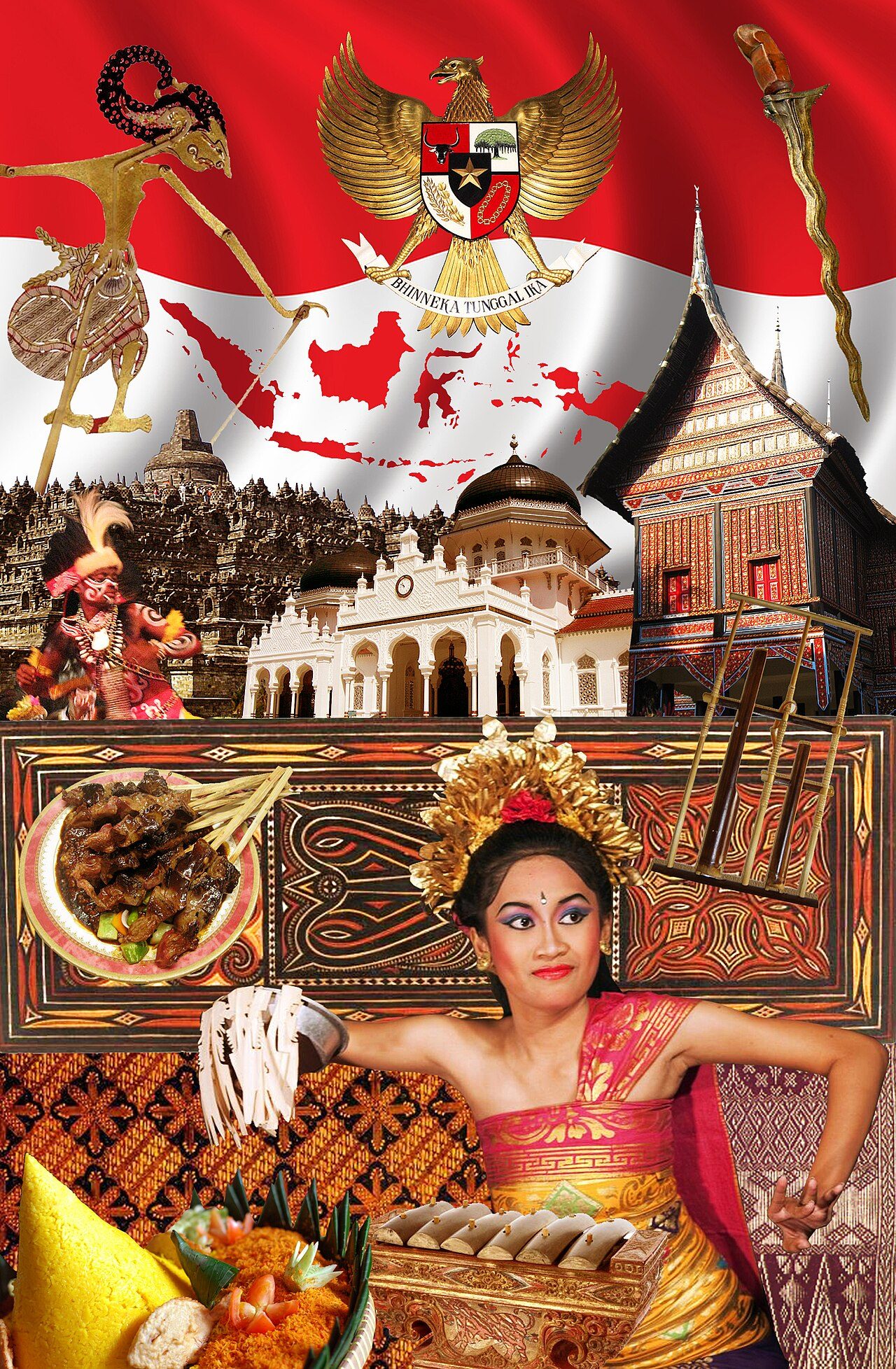
The tradition & historical record
6 min read · 2 sourcesThe culture of Indonesia (Indonesian: Budaya Indonesia) has been shaped by the interplay of indigenous customs and diverse foreign influences. As the world's largest archipelagic country, it is home to over 600 ethnic groups, including Austronesian and Melanesian cultures, contributing to its rich traditions, languages, and customs. Indonesia is a melting pot of diversity. Positioned along ancient trade routes between the Far East, South Asia, and the Middle East, the country has absorbed cultural practices influenced by Hinduism, Buddhism, Confucianism, Islam, and Christianity. These influences have created a complex cultural tapestry that often differs from the original indigenous cultures. Examples of the fusion of Islam with Hinduism include Javanese Abangan belief. Balinese dances have stories about ancient Buddhist and Hindu kingdoms, while Islamic art forms and architecture are present in Sumatra, especially in the Minangkabau and Aceh regions. Traditional art, music and sport are combined in a martial art form called Pencak Silat. The Western world has influenced Indonesia in science, technology and modern entertainment such as television shows, film and music, as well as political system and issues. India has notably influenced Indonesian songs and movies. 1
Music
Gamelan is a traditional Indonesian musical ensemble, primarily associated with Java and Bali. It consists of various percussion instruments, including metallophones such as gambang and bonang, as well as gongs like kenong and gong ageng. Gamelan plays a vital role in cultural and religious ceremonies, shadow puppet performances (wayang), and traditional dance. Its layered melodies and interlocking rhythms create a distinctive sound that has influenced both Indonesian and international music. Beyond its artistic value, gamelan is deeply embedded in local traditions and community gatherings. Recognized by UNESCO in 2021 as a Masterpiece of the Oral and Intangible Heritage of Humanity, gamelan remains an essential part of Indonesia's musical heritage. 1
In West Sumatra, the Minangkabau people play talempong, a set of small knobbed gongs used in dance and ceremonies. Another key instrument is the saluang, a four-holed bamboo flute played with circular breathing, traditionally accompanying folk tales. In North Sumatra, the Batak people's music centres around gondang, a percussion ensemble of drums and gongs used in rituals. A notable variation is gordang sambilan, a set of nine large drums historically linked to royal ceremonies. The hasapi, a two-stringed wooden lute, is often played alongside singing in traditional Batak music. In Sulawesi, the Toraja people use pa’pompang, a bamboo instrument resembling a large flute ensemble with deep tones. The Bugis and Makassar people play the kacaping, a small plucked string instrument used in solo performances or to accompany storytelling. In Kalimantan, the Dayak people are known for the sape, a long-necked lute with intricate carvings, originally played in healing rituals and warrior dances but now popular in modern Dayak music. 1
Dance
Indonesian dance reflects the rich diversity of culture from the many ethnic groups that compose the nation of Indonesia. The dances showcase Austronesian roots, Melanesian tribal dance forms, and influences from foreign countries such as Indian subcontinent, Mainland China, and the Middle East, as well as European styles introduced during colonization. With over 3,000 distinct dances, each ethnic group contributes its own unique styles and traditions. Indonesian dances can be categorized into three historical eras: the Prehistoric Era, the Hindu-Buddhist Era, and the Islamic Era, and they fall into two main genres: court dance and folk dance. 1
In West Sumatra, Tari Piring (plate dance) is performed with dancers balancing plates while executing fast, precise movements. In Aceh, the Saman dance is known for its rapid, synchronized hand and body motions and was recognized by UNESCO in 2011 as an Intangible Cultural Heritage in Need of Urgent Safeguarding. The Batak people's Tor-tor dance involves rhythmic footwork and deliberate gestures, often performed in rituals and celebrations. In Riau, the Melayu dance is characterized by fluid, elegant gestures, commonly seen in formal ceremonies. Zapin, performed in Jambi and Bangka Belitung, blends Arabic and local influences with lively footwork. In South Sumatra, Gending Sriwijaya reflects the legacy of the Srivijaya Empire, featuring graceful choreography set to rhythmic melodies. In Java, Bedhaya and Serimpi are performed in the royal courts of Yogyakarta and Surakarta. Bedhaya, a sacred dance, is characterized by slow, deliberate movements that reflect spiritual harmony. 1
Drama and theatre
Wayang is a traditional shadow puppet theatre from the Javanese, Sundanese, and Balinese cultures, depicting stories from the Ramayana, Mahabharata, and local folklore. Wayang kulit, the most well-known form, uses intricately carved leather puppets mounted on bamboo sticks, manipulated behind a lit screen to cast moving shadows. The performances, led by a dalang (puppet master), serve as both entertainment and a medium for conveying moral and philosophical teachings. Recognized by UNESCO as a Masterpiece of the Oral and Intangible Heritage of Humanity, wayang remains an integral part of Indonesian cultural heritage. Wayang wong, or "human wayang", is a form of Javanese theatre that adapts wayang stories into live dance dramas performed by actors. This tradition incorporates elaborate costumes, stylized movements, and traditional music to portray mythological tales and convey moral teachings. Performances are accompanied by a gamelan orchestra, which enhances the storytelling through rhythmic melodies. The dalang (puppet master) plays a central role, narrating the story, voicing characters, and guiding the overall performance Ludruk, a theatrical tradition from East Java, blends comedy, drama, and audience interaction through improvised dialogue and local humour. Ketoprak, another Javanese theatre form, incorporates music, dance, and historical or folkloric storytelling. In West Java, Sundanese Sandiwara portrays historical and mythological tales through music and drama, while Lenong from Betawi features humorous storytelling, often with social satire. 1
Martial arts
Pencak Silat originated and was first developed on the islands of Java and Sumatra. Initially an art of survival, it spread across the Indonesian archipelago and became an integral part of local cultures. Centuries of tribal wars shaped silat into a combat skill used by warriors in ancient Indonesian kingdoms, where it also played a role in determining rank and status. Over time, influences from Indian and Chinese martial arts further enriched silat. 1
Painting
The oldest known cave painting in the world, dated to at least 51,200 years ago, was discovered in Karampuang cave, Sulawesi, Indonesia. 1
The text above is adapted from the Wikipedia article “Culture of Indonesia”, available under the Creative Commons Attribution-ShareAlike 4.0 licence. 1
culture of Indonesia is overview of the culture of Indonesia, according to the structured record cited below. This entry was generated automatically from that record and has not yet been reviewed by a person familiar with the tradition. 2
The source record links this tradition to 4 external registers, which can be verified through the citation. 2