The tradition & historical record
5 min read · 2 sourcesThe Curupira, Currupira or Korupira (Portuguese pronunciation: [kuɾuˈpiɾɐ]) is a forest spirit in the myth of the Tupí-Guaraní speaking areas in the Brazil, Paraguay and Guyanas. It is a guardian of the forests that punishes humans for overcutting. It looks like a backwards-footed, short-statured tapuio or caboclo (civilized indigene or one of mixed race), or like a bald but otherwise shaggy man (though the women have flowing hair). Some say it has blue or green teeth. The red-haired image has become fixture, perhaps due to conflation with the caipora. The Curupira according to early Jesuits in São Paulo was a feared being known to leave gruesomely scarred bodies, to be appeased by offerings. But it underwent a mutation via European influence, and was recast into more of a mischievous trickster type spirit, often bungling and letting humans outsmart it, though it could still cause misfortune and death. 1
Origins
The first attested mention of Curupira was in May 30th, 1560 in São Vicente, São Paulo, Brazil by Joseph of Anchieta. The legend also appears in Venezuela, Guyana, Peru and Paraguay, and could have been passed from Karaib-speakers to Guarani-speaking populace. 1
Nomenclature
The lore of the Curupira is not only found in Brazil, but also in Paraguay and Guiana coinciding with the distribution of the Tupi–Guarani languages. The name Curupira means "covered in wounds or blisters", and derives from an agglutination of Nheengatu: kuru "grain, rough", etc. and piré "skin" (cog. Guarani/Tupi: pí), thus "rough or pimply skin". This kurupire may have been passed on perhaps from Nheengatu-speakers in Brazil to the Tupinambá speakers, then to the Guaraní-speaking population in the south. The name is normally styled "Curupira" (in Pará) and spelt "Currupira" in the south. It is also argued that curupira goes by other names depending on region, namely Çacy tapereré (Saci Pererê) in the south, Caipora in the central region ), and Maty-taperé in the North. Sometimes transcribed "Korupira". Some commentators have argued the Curupira and Caipora to be the same, others say they are different. The usage is regional, for example, from Maranhão south to Espírito Santo, its persistent nickname is Caipora (cf. § Conflation with Caipora). 1
Legend
The Curupira is a "hominoid spirit" or god, perhaps a "wild man", considered the guardian of the forest. It punishes humans who wantonly harvest lumber by making him lose his way, wander timelessly in the forest, so he becomes unable to reach his home. The Curupira is described as a small-statured tapuio ("brown man"), or a "caboclinho" (diminutive of caboclo), of similar meaning. Notably, the Curupira has his feet turned backwards, to mislead trackers with footprints proceeding in the opposite direction, so that one trying to flee the Curupira actually pursues it. The Curupira allegedly has family, a wife and children living in the hollow of dead trees. The women have long hair. Sometimes they trespass upon a human roça (crop field) to steal the mandioca (manioc). Or else it is said that the wife is some old, ugly evil tapuya woman who plays accomplice to his misdeeds, and among their children, the youngest is the Saci Note that Caipora (Kaapora) has been discussed as a variant of Curupira, and its wife is identified as Tatácy (in Amazonas) and Tatámanha (in Pará). Curupira was blamed for causing bad thoughts and nightmares. It is also said to have been a "mischievous wood-sprite" that engages in conversation with humans, foments distrust and dissent among individuals, and enjoy watching them fall into misfortune, but this description, taken to mean a "comical spirit" has been viewed unfavorably. The Curupira is attested as being regarded as a "god of thinking" or of "lies and deception" (cf. § History for further details), which may have to do with it being seen as playing with one's mind in general. The Curupira is fond of tobacco, and rewards hunters for offering it, but they must keep it secret from their wives. 1
Physical description
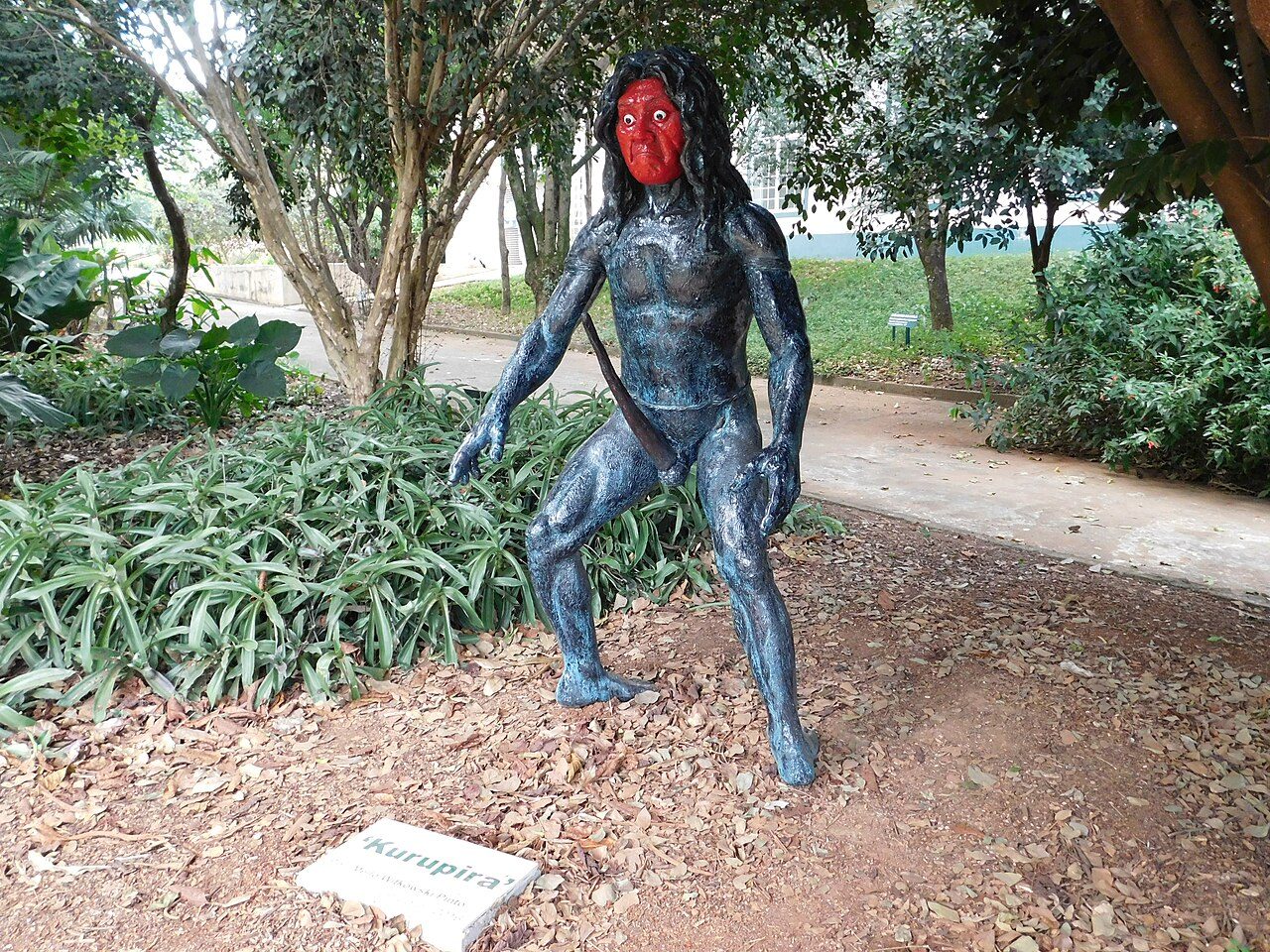
The physical appearance is described variously. He is said to have enormous ears and blue or green teeth (in the Solimões River basin). It is also said to be balding or bald-headed (Tupinambá: piroka) but hairy-bodied with long body hair (in the Rio Negro basin). Naturalist Bates remarked that it was like an orangutan with shaggy hair, living in trees, so that in later commentary the curupira was generally attributed with red/orange hair. Others have said it has a bright red face and cloven feet. Other regions held that it was one-eyed (Rio Tapajós basin), or that it has no anus hence becomes solidly or massively built (according to Pará lore). 1
Conflation with Caipora
While Bates considered the Curupira and Caipora as distinguishable, they were considered to be the same by German naturalist Martius. Long red body hair seems to have been ascribed originally to the Caipora, said to be similar to Curupira. The Caipora is said to ride a collared peccary (taitetú), and the Curupira has come to be commonly portrayed riding one also. 1
The text above is adapted from the Wikipedia article “Curupira”, available under the Creative Commons Attribution-ShareAlike 4.0 licence. 1
Curupira is mythological creature of Brazilian folklore, according to the structured record cited below. This entry was generated automatically from that record and has not yet been reviewed by a person familiar with the tradition. 2
The source record links this tradition to 1 external register, which can be verified through the citation. 2