The tradition & historical record
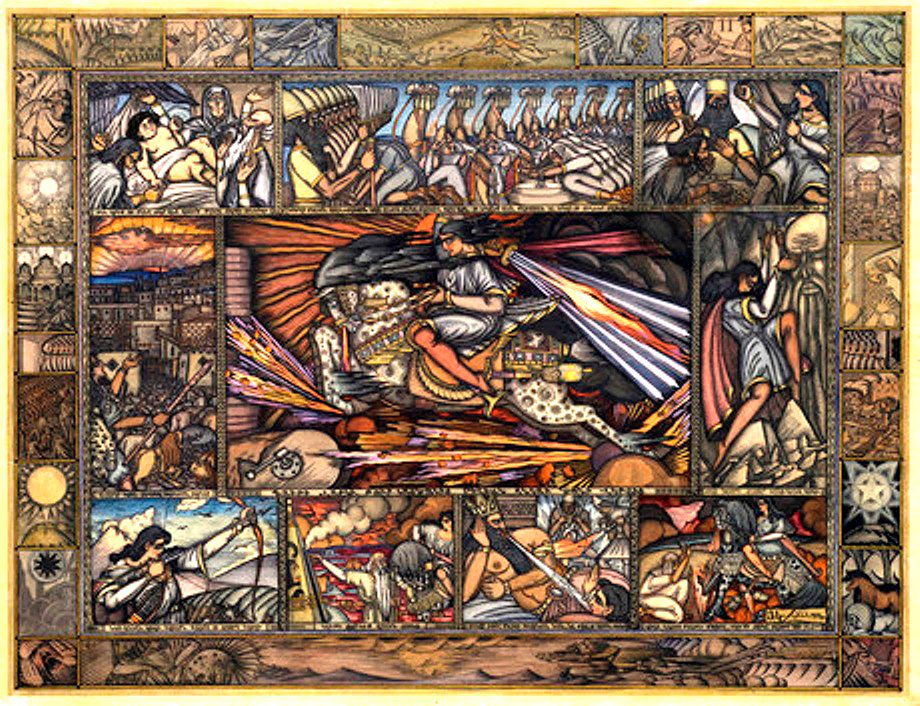
6 min read · 2 sourcesDaredevils of Sassoun (Armenian: Սասնա ծռեր Sasna cṙer, also spelled Daredevils of Sasun) is an Armenian heroic epic poem in four cycles (parts), with its main hero and story better known as David of Sassoun, which is the story of one of the four parts. In the initial decades following the discovery of the epic in the late nineteenth century a general consensus emerged attributing its theme to the struggle of four generations of Sassoun's warriors against Muslim rule in the 8th to 10th centuries. The pioneers of this interpretation of the epic were the philologist Manuk Abeghian in Armenia and academic Joseph Orbeli at the Hermitage Museum in Leningrad, who argued that there are no characters in the epic that could be attributed to a historical person from before the 10th century. The historicist school held its sway until the Armenian philologist Grigor Grigoryan first in an article (1981), then in a book (1989) argued following an incisive analysis of the epic, "it is indisputable that the roots of the epic go back deep into the centuries, and they reach not only the cuneiform times when monarchy was underway in Armenia, but even the prehistoric era." Grigoryan identified various episodes in the epic as of patently matriarchal origin, prompting various scholars both in Soviet Armenia and elsewhere to probe deeper into the proto-layers of the epic. The Daredevils of Sassoun is commonly cited as one of the most important works of Armenian folklore. 1
Background
Sasna is a genitive form of Sasun, a region located in Western Armenia in the rugged mountain country southwest of Lake Van in what is currently Batman Province, eastern Turkey. Tsur’ 'crooked' traditionally connotes an animus of rebelliousness. The most accurate and complete title of this epic is Sasna Tsr’er 'Daredevlis of Sasun'. It has however been published under various titles such as Sasunts’i Davit’ (David of Sasun), Sanasar yev Baghdasar (Sanasar and Balthazar), Sasunts’i Davit’ kam Mheri dur’ (David of Sasun or Mher's door) and many others. All these titles correspond to one of four cycles of the epic. The written literature of Armenia goes back to the fifth century, its Golden Age, when the Bible was translated into Classical Armenian directly from Koine Greek and Syriac language manuscripts. Plato and Aristotle were studied in Armenian schools and many original works of great interest to the modern specialist were produced by native historians, philosophers and poets. While its oral literature is much older, recorded folk poetry had existed in Armenian for at least two thousand years. According to the early Armenian historian Movses Khorenatsi, in his time Armenians still loved the pagan "songs" which the minstrels sang on festive occasions and quotes from them. Only the fragments of Armenian pagan songs that he quotes have survived to this day. Songs celebrating memorable events have retained their hold in the popular imagination and it could be said that Armenians are a nation whose cultural identity has been formed from both the written and oral traditions, though little has survived of the latter due to its perishable nature and fluctuation of Armenia's historical borders. 1
Discovery of the story
The story of Sasun was "discovered" in 1873 by a bishop of the Armenian Apostolic Church, Garegin Srvandztiants, who had exceptionally close contacts with the peasantry in the more remote inaccessible parts of Western Armenia. He says: 1
For three years I tried to find somebody who knew the entire story, but nobody seemed to know all of it until I met Gurbo from a village on the Moush plain. I learned that his master had two pupils who also knew the tale by heart, singing verses in it, although Gurbo himself had not recited it for so long that he had forgotten a good deal of it. Nevertheless, I kept him with me for three days, I begged him, cajoled him, honored him, rewarded him, and when he felt better and was in the proper mood, he recited the tale for me in his own village dialect, and I wrote it all down in his own words. The tale told by Gurbo was published in Constantinople (Istanbul) in 1874 under the title David of Sasun or Meherr's Sword. The bishop wrote in the introduction: 1
The life of David and his exploits belong in the Middle Ages... The entire story is a record of courage, of domestic virtue, of piety, and of simple, open-hearted relations with his beloved woman as well as with his enemies. Despite its irregularities and anachronisms it has some fine stylistic qualities and narrative devices in it... The publication of this tale would be of interest to the understanding reader, but I suppose there will also be those who will express their contempt for it and abuse both the story and my own person. These readers will not understand it. But it does not matter. I shall consider myself encouraged if I find twenty sympathetic readers. 1
Language
Though the language abounds in poetic pictures, the physical sensory details are often missing. This is because an oral tale is necessarily different from that of a written story. The reciter would get on with his action and act out most parts of the story to hold interest of his audience, plot is the main thing, and the reciter suits the words of action. It's written in a beautifully controlled language and hyperbole is a characteristic device of this epic style. 1
Publications and translations
In 1881 "Daredevils of Sasun" was translated into Russian. In 1902, the prominent Armenian poet and writer Hovhannes Tumanyan penned a poem telling the story of the David of Sassoun in a more modern language. Later the tale was translated into the languages of all fifteen republics of the Soviet Union, and then into French and Chinese. For translating the epic into Russian poet Valery Bryusov was designated People's Poet of Armenia in 1923. The poet and writer Konstantine Lortkipanidze translated several chapters of the epic into the Georgian language. Other variants of this folk epic have been published since 1874, and there are some fifty of them altogether. Bishop Garegin Srvandztiants saved the Armenian epic from oblivion. Six decades later a scholar of Armenian literature and folklore Manuk Abeghian and his co-workers collected nearly all of these variants in three scholarly volumes published in Yerevan in 1936, 1944 (part l) and 1951 (part ll), under the general title Daredevils of Sasun. All three volumes contain over 2,500 pages of text. In 1939 a collated text weaving most of the important episodes together was published for popular reading under the title "David of Sasun". As village texts are in various dialects, which presents many difficulties to the modern reader, the story was reworded and a fairly uniform style comprehensible to Eastern Armenian dialects was adopted. 1
Synopsis
Divisions of the book per Surmelian: 1
The text above is adapted from the Wikipedia article “Daredevils of Sassoun”, available under the Creative Commons Attribution-ShareAlike 4.0 licence. 1
Daredevils of Sassoun is Armenian folk epic, according to the structured record cited below. This entry was generated automatically from that record and has not yet been reviewed by a person familiar with the tradition. 2
The source record links this tradition to 19 external registers, which can be verified through the citation. 2