The tradition & historical record
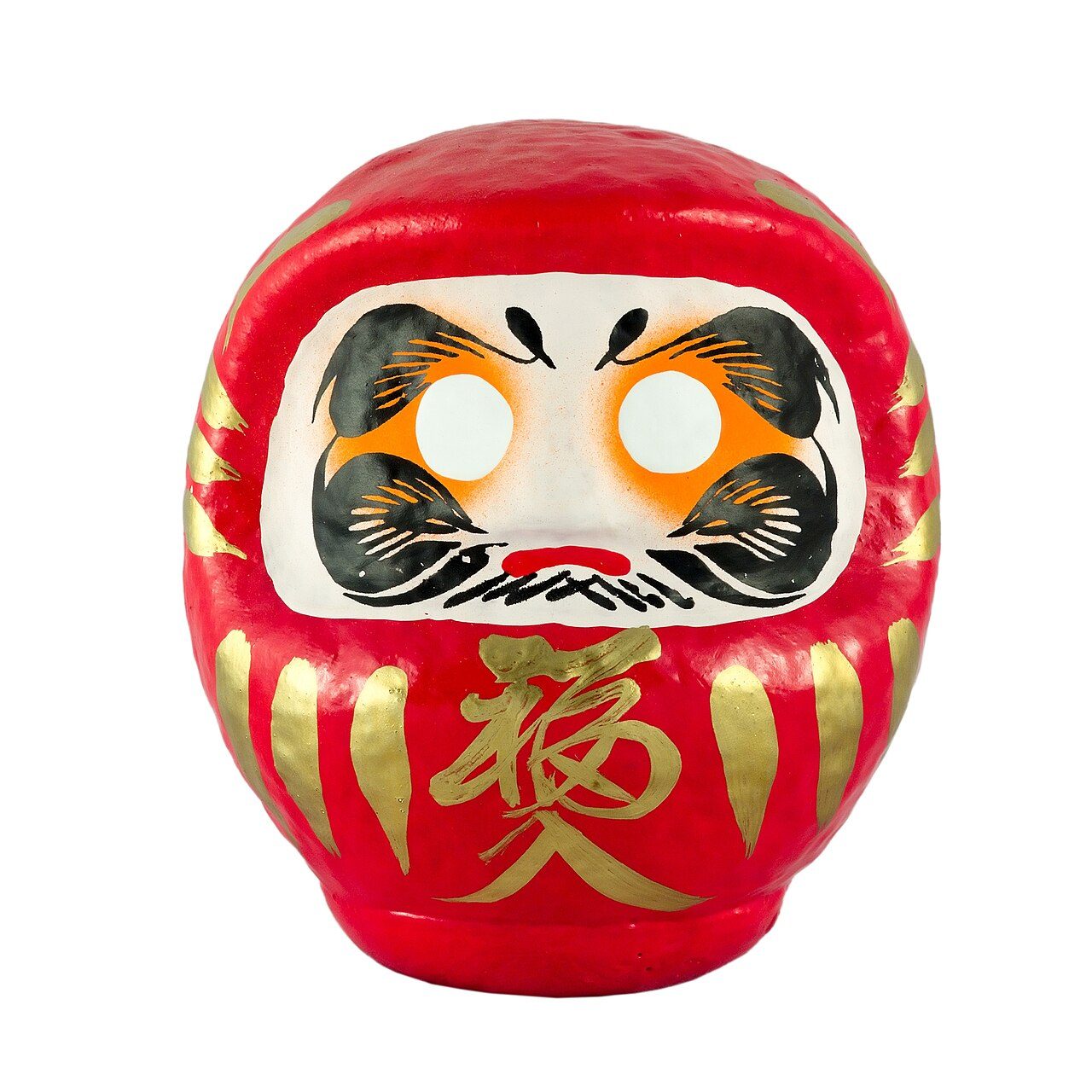
5 min read · 2 sourcesA Daruma doll (Japanese: 達磨, romanized: daruma; IPA: [da̠ɾɯ̟ma̠]) is a hollow, round, Japanese traditional doll modeled after Bodhidharma, the founder of the Zen tradition of Buddhism. These dolls, though typically red and depicting the Indian monk, Bodhidharma, vary greatly in color and design depending on region and artist. Though considered a toy by some, Daruma has a design that is rich in symbolism and is regarded more as a talisman of good luck to the Japanese. Daruma dolls are seen as a symbol of perseverance and good luck, making them a popular gift of encouragement. The doll has also been commercialized by many Buddhist temples to use alongside the setting of goals. 1
Use
When purchased, the figure's eyes are both blank white. The owner selects a goal or wish and paints in the left eye of the figure's two eyes with Chinese or Japanese ink. Once the goal is achieved, the right eye is filled in. 1
Bodhidharma
Bodhidharma was a Buddhist monk who lived during the 5th/6th century CE. He is traditionally credited as the transmitter of Ch'an (Zen) to China. Little contemporary biographical information on Bodhidharma is available, and subsequent accounts have become layered with legend. According to one tradition, Bodhidharma gained a reputation for, among other things, his practice of wall-gazing. Legend claims that he sat facing a wall in meditation for a period of nine years without moving, which caused his legs and arms to fall off from atrophy. Another popular legend is that after falling asleep during his nine-year meditation he became angry with himself and cut off his eyelids to avoid ever falling asleep again. According to the principal Chinese sources, Bodhidharma came from the Western Regions, which refers to Central Asia but may also include the Indian subcontinent, and was either a "Persian Central Asian" or a "South Indian ... the third son of a great Indian king." Throughout Buddhist art, Bodhidharma is depicted as an ill-tempered, bearded, wide-eyed non-Chinese person. He is referred as "The Blue-Eyed Barbarian" (Chinese: 碧眼胡; pinyin: Bìyǎnhú) in Chan texts, although note that while the translation "barbarian" is derogatory, in Chinese it is simply descriptive of non-Chinese origin. 1
History and commercialization
The current popular symbolism associated with Daruma as a good luck charm in part originated at Shorinzan Daruma Temple, in the city of Takasaki (Gunma Prefecture, north of Tokyo). Josef Kyburz, author of "Omocha": Things to Play (Or Not to Play) with, explained that the founder of Daruma-Dera would draw New Year's charms depicting Bodhidharma. The parishioners would keep these charms to "bring happiness and prosperity and ward off accidents and misfortune". 1
It is believed that the Daruma figurine then originated from this region when the ninth priest, Togaku, found a solution to handle the constant requests of the parishioners for new charms. The charms were always given with an effectiveness of one year, so the people required new ones every year. He solved this by entrusting them with the making of their own Daruma charms near the beginning of the Meiwa period (1764–72). The temple made wooden block molds for the people to use. The peasants then used these molds to make three-dimensional papier-mâché charms. Kyburz notes that though it is unknown when the Daruma figurine combined with the tumbler doll; the two were well recognized as synonymous by the mid-19th century. The doll quickly grew in popularity, becoming a mascot of the region. This was due greatly in part to fact that the majority of the families were silk farmers, a crop which requires a great deal of luck for success. There is an annual Daruma Doll Festival (達磨市, daruma-ichi) held by the city of Takasaki in celebration of being the proclaimed birthplace of the Daruma doll. The celebration is held at the Shorinzan, the name of Takasaki's "Daruma-Dera". According to the Takasaki city website, "Over 400,000 people from all over the Kanto Plain come to buy new good-luck dolls for the year. 1
Physical features and symbolism
Daruma's design, particularly the shape, color, eyes and facial hair, each have its own history and symbolic meaning. 1
Shape
Darumas are still usually made of papier-mâché, have a round shape, are hollow and weighted at the bottom so that they will always return to an upright position when tilted over. In Japanese, a roly-poly toy is called okiagari, meaning to get up (oki) and arise (agari). This characteristic has come to symbolize the ability to have success, overcome adversity, and recover from misfortune. In Japanese popular culture on cards, banners and books, Daruma is often illustrated alongside the phrase "fall over seven times, get up eight" (七転び八起き, nanakorobi yaoki). While some traditional Daruma dolls have flat bases, the "triangle" Daruma (三角だるま, sankaku Daruma) is constructed from a rolled cardboard cone attached to a rounded clay base so that it always stands straight when tilted. Bodhidharma is said to have meditated for nine years at Shaolin Temple facing a wall until his legs atrophied from lack of use, which was the inspiration for its limbless form. The tumbler doll style is similar to an earlier toy called the okiagari-kobōshi, a little self-righting monk which was popular in the Kinki region during the mid-17th century. The original okiagari toy, however, is said to have been introduced from Ming China. 1
The text above is adapted from the Wikipedia article “Daruma doll”, available under the Creative Commons Attribution-ShareAlike 4.0 licence. 1
Daruma doll is traditional Japanese doll modeled after Bodhidharma, the founder of the Zen sect of Buddhism, according to the structured record cited below. This entry was generated automatically from that record and has not yet been reviewed by a person familiar with the tradition. 2
The source record links this tradition to 15 external registers, which can be verified through the citation. 2