The tradition & historical record
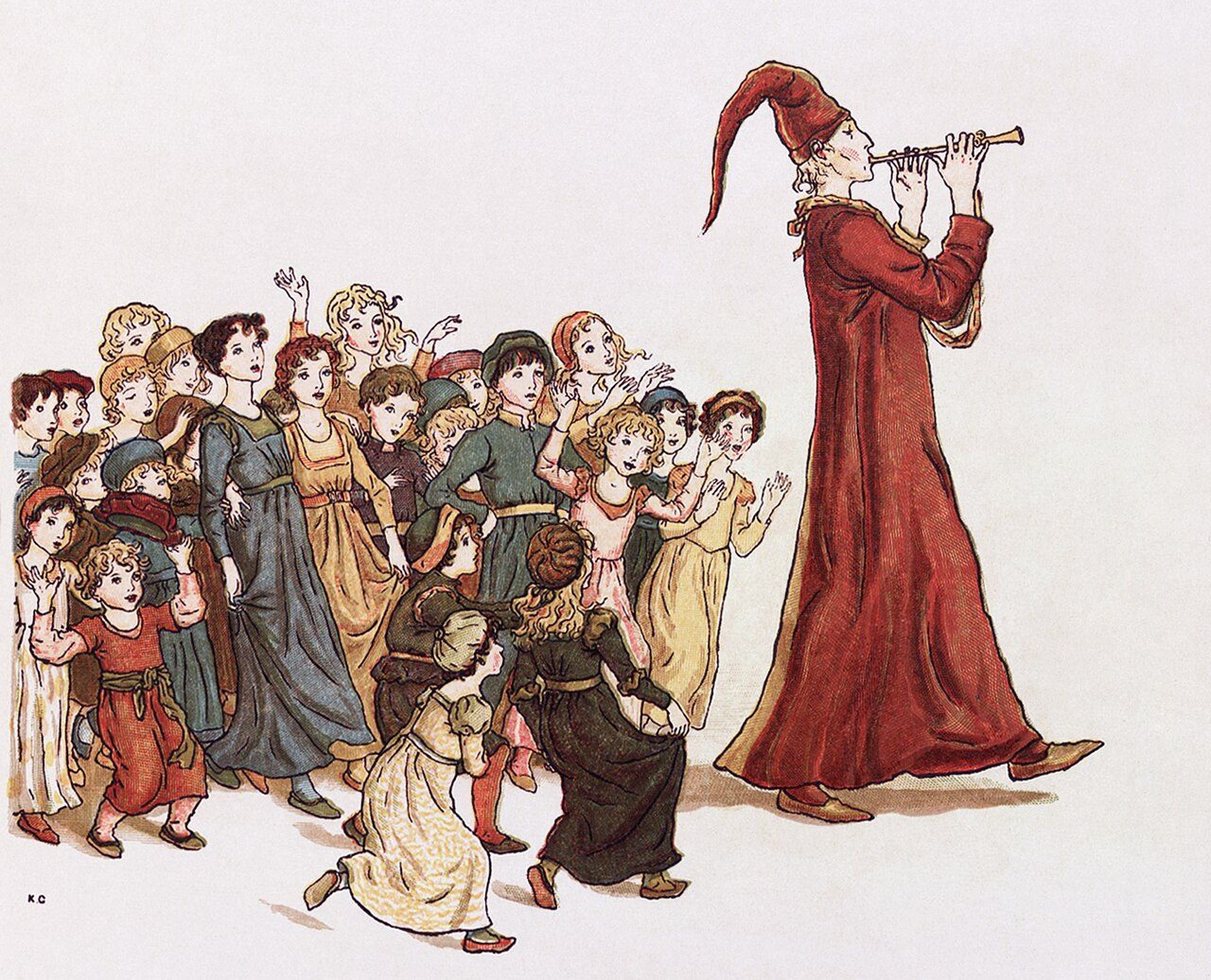
6 min read · 2 sourcesThe Pied Piper of Hamelin (German: der Rattenfänger von Hameln), also known as the Pan Piper or the Rat-Catcher of Hamelin, is the title character of a legend from the town of Hamelin (Hameln), Lower Saxony, Germany. The legend dates back to the Middle Ages. The earliest references describe a piper, dressed in multicoloured ("pied") clothing, who was a rat catcher hired by the town to lure rats away with his magic pipe. When the citizens refused to pay for this service as promised, he retaliated by using his instrument's magical power on their children, leading them away as he had the rats. This version of the story spread as folklore and has appeared in the writings of Johann Wolfgang von Goethe, the Brothers Grimm, and Robert Browning, among others. The phrase "pied piper" has become a metaphor for a person who attracts a following through charisma or false promises. Various theories have arisen about the origin and symbolism of the Pied Piper. Some suggest he was a symbol of hope to the people of Hamelin, which had been subjected to plague; he drew the rats from Hamelin, saving the people from the epidemic. 1
Plot
As the town Hamelin is suffering from a rat infestation, a piper dressed in multicoloured ("pied") clothing appears, claiming to be a rat-catcher. He promises the burgermeister a solution to their problem with the rats. The burgermeister, in turn, promises to pay him 1,000 guilders for the removal of the rats. The piper accepts and plays his pipe to lure the rats into the Weser River, where all the rats drown. Despite the piper's success, the burgermeister reneges on his promise and refuses to pay him the full sum (reputedly reduced to 50 guilders), even going so far as to blame the piper for bringing the rats himself in an extortion attempt. Enraged, the piper storms out of the town, vowing to return later to take revenge. On Saint John and Paul's day, while the adults are in church, the piper returns, dressed in green like a hunter and playing his pipe. In doing so, he attracts the town's children. 130 children follow him out of town and into a mountain cave, after which they are never seen again. Depending on the version, at most three children remained behind; one is lame and could not follow quickly enough, the second is deaf, so could not hear the music, and the last is blind, so unable to see where he was going. These three inform the townsfolk of what had happened when they came out from church. Other versions depict the Pied Piper leading the children to the top of Koppelberg Hill, where he takes them to a beautiful land, or a place called Koppenberg Mountain, or Transylvania. In yet other versions, he makes them walk into the Weser River as he did with the rats, and they all drown. 1
Background
The earliest mention of the story seems to have been on a stained-glass window placed in the Church of Hamelin c. 1300. The window was described in several accounts between the 14th and 17th centuries. It was destroyed in 1660. Based on the surviving descriptions, a modern reconstruction of the window has been created by historian Hans Dobbertin. It features the colourful figure of the Pied Piper and several figures of children dressed in white. The window is generally considered to have been created in memory of a tragic historical event for the town. According to multiple secondary discussions of Hamelin’s town records, an entry dated 1384 stated: "It is 100 years since our children left." Although research has been conducted for centuries, no explanation for the historical event is universally accepted as true. In any case, the rats were first added to the story in a version from c. 1559 and are absent from earlier accounts. 1
14th-century Decan Lude chorus book
Decan Lude of Hamelin was reported c. 1384 to have in his possession a chorus book containing a Latin verse giving an eyewitness account of the event. 1
15th-century Lüneburg manuscript
The Lüneburg manuscript (c. 1440–50) gives an early German account of the event. An article by James P. O'Donnell in The Saturday Evening Post (24 December 1955) tells how an elderly German researcher, Heinrich Spanuth, discovered the earliest version of the story in the Lüneburg city archives in 1936. 1
On the back of the last page of a chronicle called The Golden Chain, written in Latin in 1370 by the monk Heinrich of Herford, a written version in a different handwriting has the following account:Here follows a marvellous wonder, which transpired in the town of Hamelin in the diocese of Minden, in this Year of Our Lord, 1284, on the Feast of Saints John and Paul. A certain young man thirty years of age, handsome and well-dressed, so that all who saw him admired him because of his appearance, crossed the bridges and entered the town by the West Gate. He then began to play all through the town a silver pipe of the most magnificent sort. All the children who heard his pipe, in the number of 130, followed him to the East Gate and out of the town to the so-called execution place or Calvary. There they proceeded to vanish, so that no trace of them could be found. The mothers of the children ran from town to town, but they found nothing. It is written: A voice was heard from on high, and a mother was bewailing her son. And as one counts the years according to the Year of Our Lord or according to the first, second or third year of an anniversary, so do the people in Hamelin reckon the years after the departure and disappearance of their children. This report I found in an old book. And the mother of the Dean Johann von Lüde saw the children depart. 1
Rattenfängerhaus
It is rendered in the following form in an inscription on a house known as Rattenfängerhaus (English: "Rat Catcher's House" or Pied Piper's House) in Hamelin: 1
According to author Fanny Rostek-Lühmann, this is the oldest surviving account. Koppen (High German Kuppe, meaning a knoll or domed hill) seems to be a reference to one of several hills surrounding Hamelin. Which of them was intended by the manuscript's author remains uncertain. 1
The text above is adapted from the Wikipedia article “Pied Piper of Hamelin”, available under the Creative Commons Attribution-ShareAlike 4.0 licence. 1
Dealing with the Pied Piper of Hameln is German legend, according to the structured record cited below. This entry was generated automatically from that record and has not yet been reviewed by a person familiar with the tradition. 2
The source record links this tradition to 21 external registers, which can be verified through the citation. 2