The tradition & historical record
4 min read · 2 sourcesDeirdre ( DEER-drə, -dree, Irish: [ˈdʲɛɾˠdʲɾʲə]; Old Irish: Derdriu [ˈd̠ʲerʲd̠ʲɾʲu]) is a tragic heroine in the Ulster Cycle of Irish mythology. She is also known by the epithet "Deirdre of the Sorrows" (Irish: Deirdre an Bhróin). Deirdre is a prominent figure in Irish legend. American scholar James MacKillop assessed in 2004 that she was its best-known figure in modern times. 1
In legend
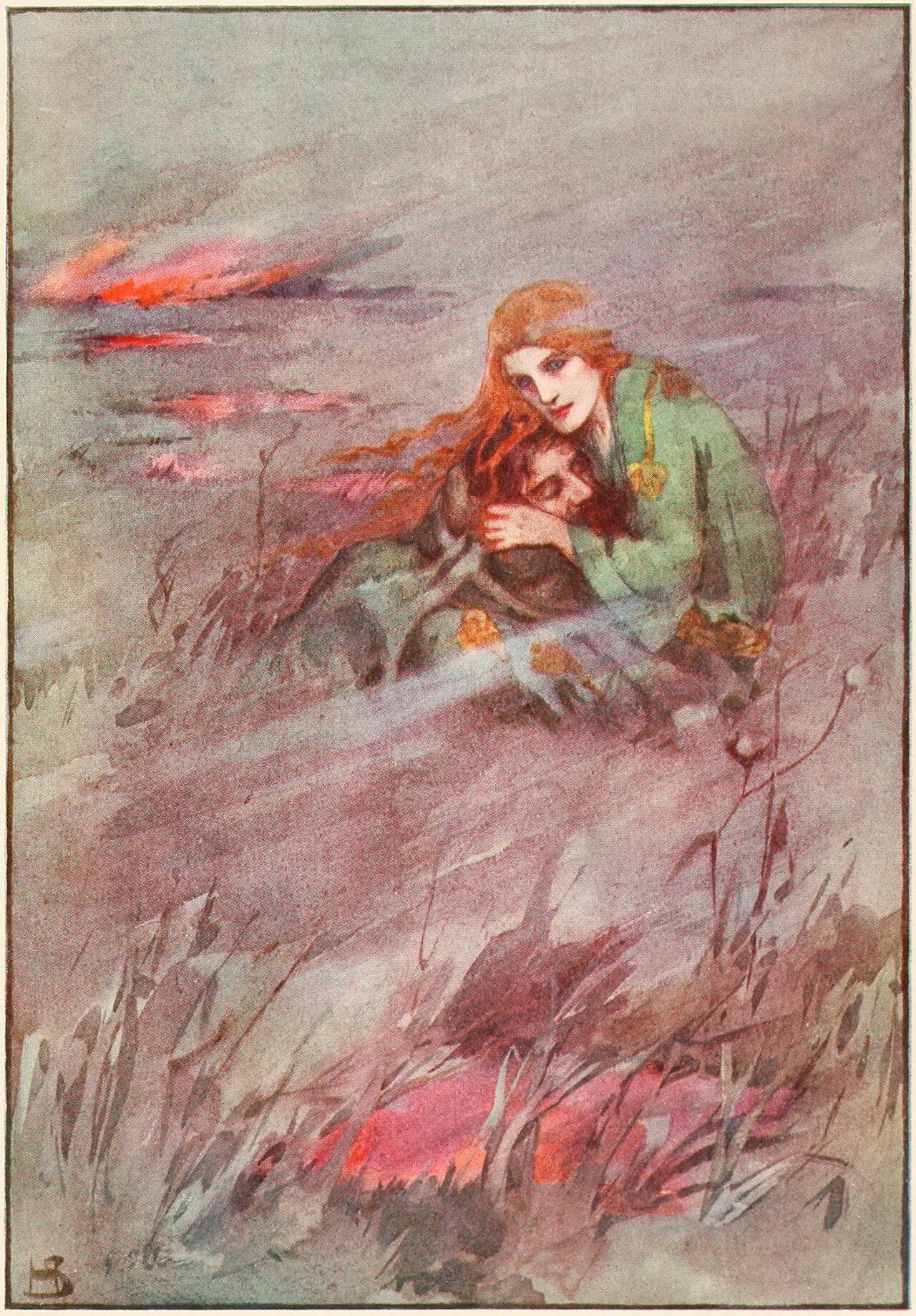
Deirdre was the daughter of the royal storyteller Fedlimid mac Daill. Before she was born, Cathbad, the chief druid at the court of Conchobar mac Nessa, king of Ulster, prophesied that Fedlimid's daughter would grow up to be very beautiful, but that kings and lords would go to war over her, much blood would be shed because of her, and Ulster's three greatest warriors would be forced into exile for her sake. Hearing this, many urged Fedlimid to kill the baby at birth, but Conchobar, aroused by the description of her future beauty, decided to keep the child for himself. He took Deirdre away from her family and had her brought up in seclusion by Leabharcham, a poet and wise woman, and planned to marry Deirdre when she was old enough. As a young girl, living isolated in the woodlands, Deirdre told Leabharcham one snowy day that she would love a man with the colours she had seen when a raven landed in the snow with its prey: hair the color of the raven, skin as white as snow, and cheeks as red as blood. Leabharcham told her she was describing Naoise mac Uisneach, a handsome young warrior, hunter and singer at Conchobar's court. With the collusion of Leabharcham, Deirdre met Naoise and they fell in love. Accompanied by his brothers Ardan and Ainnle (the other two sons of Uisneach), Naoise and Deirdre fled to Scotland. They lived a happy life there, hunting and fishing and living in beautiful places; one place associated with them is Loch Etive. Some versions of the story mention that Deirdre and Naoise had children, a son, Gaiar, and a daughter, Aebgreine, who were fostered by Manannan Mac Lir. 1
However, the furious, humiliated Conchobar tracked them down. He sent Fergus mac Róich to them with an invitation to return and Fergus's own promise of safe conduct home. 1
Cultural references
There are many plays and other stage productions based on Deirdre's story, including: 1
Herbert Trench's Deirdre Wed (1901) George William Russell's Deirdre (1902) William Butler Yeats's Deirdre (1907) J. M. Synge's Deirdre of the Sorrows (1910). Synge's play enjoyed a vogue amongst composers in the earlier part of the 20th century and many of them set it to music, including Fritz Hart, Cecil Gray, Havergal Brian, Healey Wlllan and Karl Rankl. Vincent Woods's A Cry from Heaven (2005). John Coulter's Deirdre of the Sorrows (An Ancient and Noble Tale Retold by John Coulter for Music by Healey Willian) (1944), operetta Adriaan Roland Holst's Deirdre en de zonen van Usnach (1916) Fire Emblem: Genealogy of the Holy War: a character named Deirdre was featured with her story based on the mythological counterpart (1996) Novels about her include Deirdre (1923) by James Stephens, The Celts (1988) by Elona Malterre, On Raven's Wing (1990) by Morgan Llywelyn and The Swan Maiden by Jules Watson. Music about her includes the album A Celtic Tale: The Legend Of Deirdre (1996) by Mychael Danna & Jeff Danna. and the song Of The Sorrows from the album The Wanderlings Volume Two by Leslie Hudson. LÉ Deirdre, a ship in the Irish Naval Service from 1972 to 2001, was named after her. A version of Deirdre appears in the show Mystic Knights of Tir Na Nog as the main character (played by Lisa Dwan), and she is the daughter of King Conchobar and an unknown woman (believed to be a Goddess). 1
Texts
University of Cork, Ireland : CELT (Corpus of Electronic Texts) : Longes mac nUislenn University of Cork, Ireland : CELT (Corpus of Electronic Texts) : Longes mac nUislenn (translation by Douglas Hyde) A Scoto-Irish Romance of the first century A.D., compiled from various sources by William Graham, 1908 The Exile of the Sons of Usnech Deirdre of the Sorrows by J. M. Synge Archived 9 May 2012 at the Wayback Machine The Lament of Deirdre John Coulter Finding Aid McMaster University Libraries "Deirdrê" A detailed retelling of the story for children, by Jeanie Lang (1914) 1
The text above is adapted from the Wikipedia article “Deirdre”, available under the Creative Commons Attribution-ShareAlike 4.0 licence. 1
Deirdre is heroine in Irish mythology, according to the structured record cited below. This entry was generated automatically from that record and has not yet been reviewed by a person familiar with the tradition. 2
The source record links this tradition to 12 external registers, which can be verified through the citation. 2