The tradition & historical record
5 min read · 2 sourcesDelftware or Delft pottery, also known as Delft Blue (Dutch: Delfts blauw) or as delf, is a general term now used for Dutch tin-glazed earthenware, a form of faience. Most of it is blue and white pottery, and the city of Delft in the Netherlands was the major centre of production, but the term covers wares with other colours, and made elsewhere. It is also used for similar pottery, English delftware. Delftware belongs to the global family of blue and white pottery, featuring variations of plant-based decorations that originated in Abbasid Iraq and were later popularised in Europe via Chinese adaptations. Delftware is one of the types of tin-glazed pottery in which a white glaze is applied and usually decorated with metal oxides. In particular, the cobalt oxide is used for its ability to withstand high firing temperatures, allowing it to be applied under this glaze. Cobalt oxide is also what gives Delftware its trademark blue designs. Delftware includes pottery objects of all descriptions, such as plates, vases, figurines and other ornamental forms, and tiles. The style originated around 1600, and the most highly regarded period of production is about 1640–1740, but Delftware continues to be produced. In the 17th and 18th centuries the manufacture of Delftware was a major industry, with product exported all over Europe. 1
History
The earliest tin-glazed pottery in the Netherlands was made in Antwerp where the Italian potter Guido da Savino settled in 1500, and in the 16th century Italian maiolica was the main influence on decorative styles. The manufacture of painted pottery spread from Antwerp to the northern Netherlands, in particular after the Fall of Antwerp in 1585 when a large part of the protestant population fled to the north. Production developed in Middelburg and Haarlem in the 1570s, and in Amsterdam in the 1580s. Much of the finer work was produced in Delft, but simple everyday tin-glazed pottery was made in places such as Gouda, Rotterdam, Haarlem, Amsterdam and Dordrecht. 1
The main period of tin-glaze pottery in the Netherlands was 1640–1740. From about 1640 Delft potters began using personal monograms and distinctive factory marks. The Guild of St Luke, to which painters in all media had to belong, admitted ten master potters in the thirty years between 1610 and 1640, and twenty in the nine years 1651 to 1660. In 1654 a gunpowder explosion in Delft destroyed many breweries and as the brewing industry was in decline, they became available to pottery makers looking for larger premises; some retained the old brewery names, e.g. The Double Tankard, The Young Moors' Head, and The Three Bells. From about 1615, the potters began to coat their pots completely in white tin glaze instead of covering only the painting surface and coating the rest with clear ceramic glaze. 1
Guilds and factories
Some Dutch potters belonged to the artisan Guild of Saint Luke during the 1600s. Of thirty factories, one or two remain: the Royal Tichelaar (Koninklijke Tichelaar Makkum) factory in Makkum, Friesland, founded in 1594, and De Koninklijke Porceleyne Fles ("The Royal Porcelain Bottle") factory in Delft founded in 1653, the latter of which is credited with reviving the Delftware industry. The Royal Tichelaar factory in Makkum continues the production of tin-glazed earthenware. Another notable factory was De Grieksche A (The Greek A), founded in 1658 by Wouter van Eenhorn. Today, Delfts Blauw (Delft Blue) is the brand name hand painted on the bottom of ceramic pieces identifying them as authentic and collectible. 1
Materials and methods
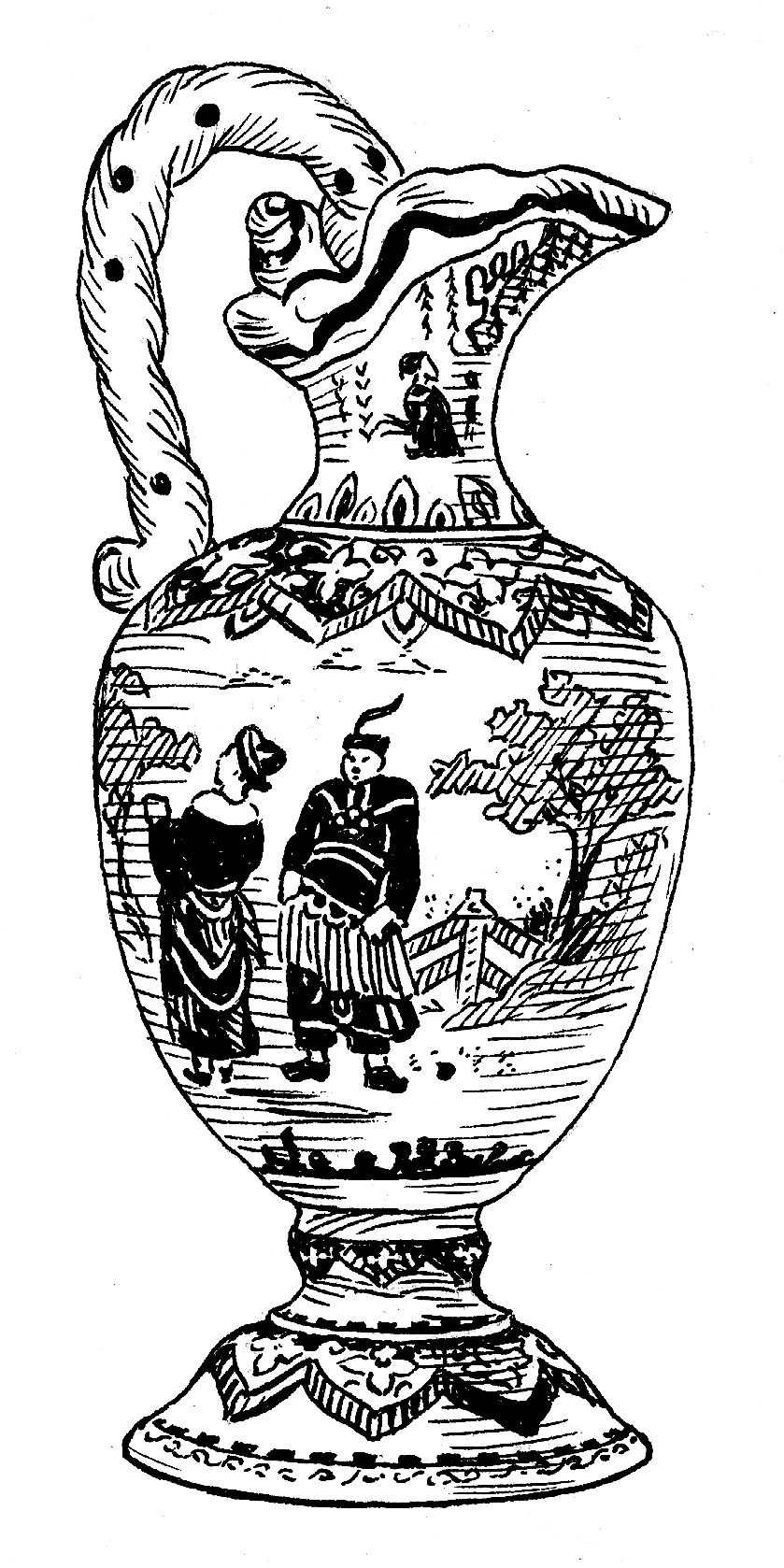
Although most Delft Blue borrows from the tin-glaze tradition, it is nearly all decorated in underglaze blue on a white clay body and very little uses tin glaze, a more expensive product. The use of marl, a type of clay rich in calcium compounds, allowed the Dutch potters to refine their technique and to make finer items. The usual clay body of Delftware was a blend of three clays, one local, one from Tournai and one from the Rhineland. Around 1700 several factories were using enamel colours and gilding over the tin-glaze, requiring a third kiln firing at a lower temperature. Some potters, namely Samuel van Eenhoorn, began to use manganese violet to emphasise their designs—a technique unprecedented by Chinese porcelain. Delftware ranged from simple household items – plain white earthenware with little or no decoration – to fancy artwork. Most of the Delft factories made sets of jars, the kast-stel set. Pictorial plates were made in abundance, illustrated with religious motifs, native Dutch scenes with windmills and fishing boats, hunting scenes, landscapes and seascapes. Sets of plates were made with the words and music of songs; dessert was served on them and when the plates were clear the company started singing. The Delft potters also made tiles in vast numbers (estimated at eight hundred million) over a period of two hundred years; many Dutch houses still have tiles that were fixed in the 17th and 18th centuries. Delftware became popular and was widely exported in Europe and even reached China and Japan. Chinese and Japanese potters made porcelain versions of Delftware for export to Europe. Early on, Dutch tiles took specific design and colour inspiration from Hispano-Mauresque as well as Italian ceramics. 1
The text above is adapted from the Wikipedia article “Delftware”, available under the Creative Commons Attribution-ShareAlike 4.0 licence. 1
delftware is type of glazed pottery, originating from the Low Countries, according to the structured record cited below. This entry was generated automatically from that record and has not yet been reviewed by a person familiar with the tradition. 2
The source record links this tradition to 14 external registers, which can be verified through the citation. 2