The tradition & historical record
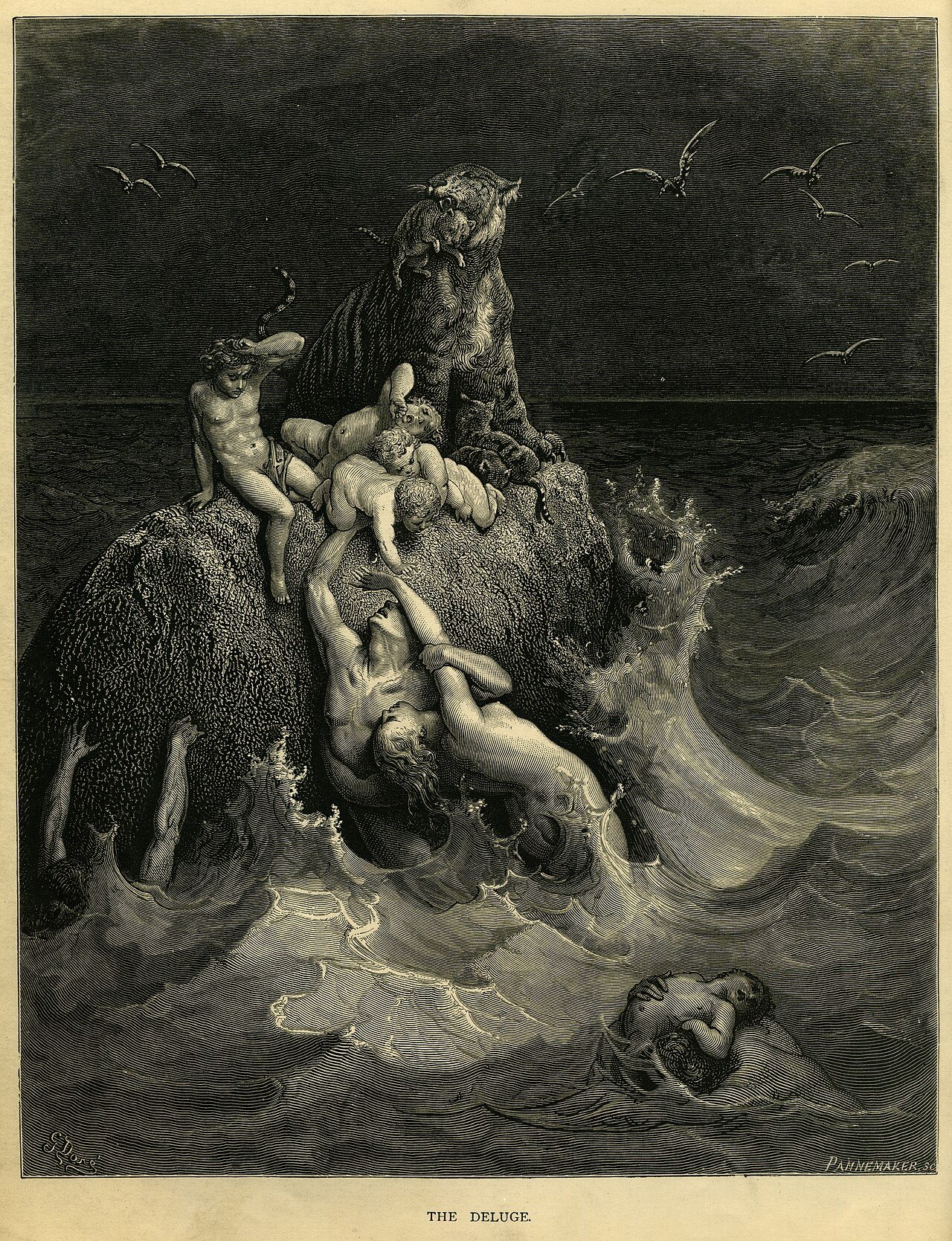
6 min read · 2 sourcesA flood myth or a deluge myth is a narrative in which a great flood—usually sent by one or more deities—destroys civilization, typically as an act of divine retribution. Parallels are often drawn between the floodwaters of these myths and the primordial cosmic ocean that appears in certain creation myths, because the floodwaters are described as a means of social cleansing or purifying humanity of its corruption, for example, in preparation for rebirth. Most flood myths also feature a culture hero who "represents the human craving for life". The oldest known narrative of a divinely initiated flood originates from the Sumerian culture in Mesopotamia, among others expressed in the Akkadian Atra-Hasis epic, which dates to the 18th century BCE. Comparable flood narratives appear in many other cultures, including the biblical Genesis flood narrative, manvantara-sandhya in Hinduism, Deucalion in Greek mythology, and in Indigenous North American cultures. 1
Ancient Near East
The Epic of Gilgamesh (c. 2100–1800 BCE) tells the story of a massive flood from which only a single human family survives – a narrative that, according to current research, was largely borrowed from the Atra-Hasis epic. In it, a cross-group organisation of Sumerian gods begins to transform Mesopotamian's steppe 'Eden' into a fertile garden landscape, introducing agriculture on Earth, which is one of the hallmarks of the Neolithic Revolution. The hard labour provokes a revolt among the 'lower' gods. To end this strife, first humans were created in pairs to do the work in place of the gods and to reproduce themself. After a few thousand years, however, humans have multiplied to such an extent that they disturb the 'upper gods' with their noise, so Enlil, the highest of all gods, decides to unleash a mighty flood to wipe out humanity. The rebellious god Enki secretly warns his priest Atrahasis of the impending catastrophe. Giving him detailed instructions for building a boat, the Atrahasis-family survive, ensuring the continued existence of humanity. 1
The similar Eridu Genesis (c. 1600 BCE), known from tablets found in the ruins of Nippur in the late 1890s, was translated by assyriologist Arno Poebel. Academic Yi Samuel Chen analyzed various texts from the Early Dynastic III Period through to the Old Babylonian Period, and argues that the flood narrative was only added in texts written during the Old Babylonian Period. With regard to the Sumerian King List, expert observations have consistently indicated that the portion of the Sumerian King List discussing events before the flood differs stylistically from the King List Proper. 1
India and Iran
In Hinduism, texts such as the Shatapatha Brahmana (c. 6th century BCE) and the Puranas contain the story of a great flood, manvantara-sandhya, wherein the Matsya avatar of Vishnu warns the first man, Manu, of the impending flood, and also advises him to build a giant boat. In Zoroastrianism, Ahriman tries to destroy the world with a drought that Mithra ends by shooting an arrow into a rock from which a flood springs; one man survives in an ark with his cattle. German academic Norbert Oettinger argues that the story of Yima and the Vara was originally a flood myth, and the harsh winter was added in due to the dry nature of Eastern Iran, as flood myths did not have as much of an effect as harsh winters. He has argued that the mention of melted water flowing in Videvdad 2.24 is a remnant of the flood myth, and notes that Indian flood myths originally had Yama as the protagonist, but this was later changed to Manu. 1
Ancient Greece
In Plato's Timaeus, written c. 360 BCE, Timaeus describes a flood myth similar to the earlier versions. In it, the Bronze race of humans angers the high god Zeus with their constant warring. Zeus decides to punish humanity with a flood. The Titan Prometheus, who had created humans from clay, tells the secret plan to his son Deucalion, advising him to build an ark in order to be saved. After nine nights and days, the water starts receding, and the ark lands on a mountain. 1
North America
The Cheyenne, a North American Great Plains tribe, has a tradition where a flood altered the course of their history, perhaps occurring in the Missouri River Valley. The Blackfeet, another Great Plains tribe, have a story called "Language on a Mountain". In this story, the deity Napi, referred to as Old Man, recounts a great flood that swept through the land. After the flood, Old Man made the water different colours. He gathered the people on top of a large mountain, where he gave them water of different colours. Old Man then told the people to drink the water, then speak, and so they did. Everyone was speaking a different language except those who received the black water; they were speaking the same language, and they consisted of the bands of the Blackfoot, the Piegan (Apatohsipikuni and Amskapipikuni), the Siksika, and the Blood (Kainai). This was said to have taken place in the highest mountain in the Montana reservation. The Hopi, southwestern United States, have a tradition of a flood that nearly reached the tops of the mountains, and other Puebloans have similar legends. 1
Mesopotamia
Mesopotamia, like other early sites of river valley civilizations, was flood-prone; and for those experiencing valley-wide inundations, flooding could destroy the whole of their known world. According to the report of the 1930s excavation at Shuruppak (modern Tell Fara, Iraq), the Jemdet Nasr and Early Dynastic layers at the site were separated by a 60 cm (24 in) yellow layer of alluvial sand and clay, indicating a flood, like that created by river avulsion, a process common in the Tigris–Euphrates river system. Similar layers have been recorded at other sites as well, all dating to different periods, which would be consistent with the nature of river avulsions. Shuruppak in Mesopotamian legend was the city of Uta-napishtim, the king who built a boat to survive the coming flood. The alluvial layer dates from around 2900 BCE. 1
The geography of the Mesopotamian area changed considerably with the filling of the Persian Gulf as sea waters rose following the last glacial period. Global sea levels were about 120 m (390 ft) lower around 18,000 BP and rose until 8,000 BP when they reached current levels, an average of 40 m (130 ft) above the floor of the Gulf. At that time it was a huge (800 km × 200 km, 500 mi × 120 mi) low-lying and fertile region in Mesopotamia, where human habitation is thought to have been strong around the ancient Ur Schatt river for 100,000 years. A sudden increase in settlements above the present-day water level is recorded at around 7,500 BP. 1
The text above is adapted from the Wikipedia article “Flood myth”, available under the Creative Commons Attribution-ShareAlike 4.0 licence. 1
deluge myth is narrative in which a great flood destroys a civilization, commonly as divine retribution, according to the structured record cited below. This entry was generated automatically from that record and has not yet been reviewed by a person familiar with the tradition. 2
The source record links this tradition to 30 external registers, which can be verified through the citation. 2