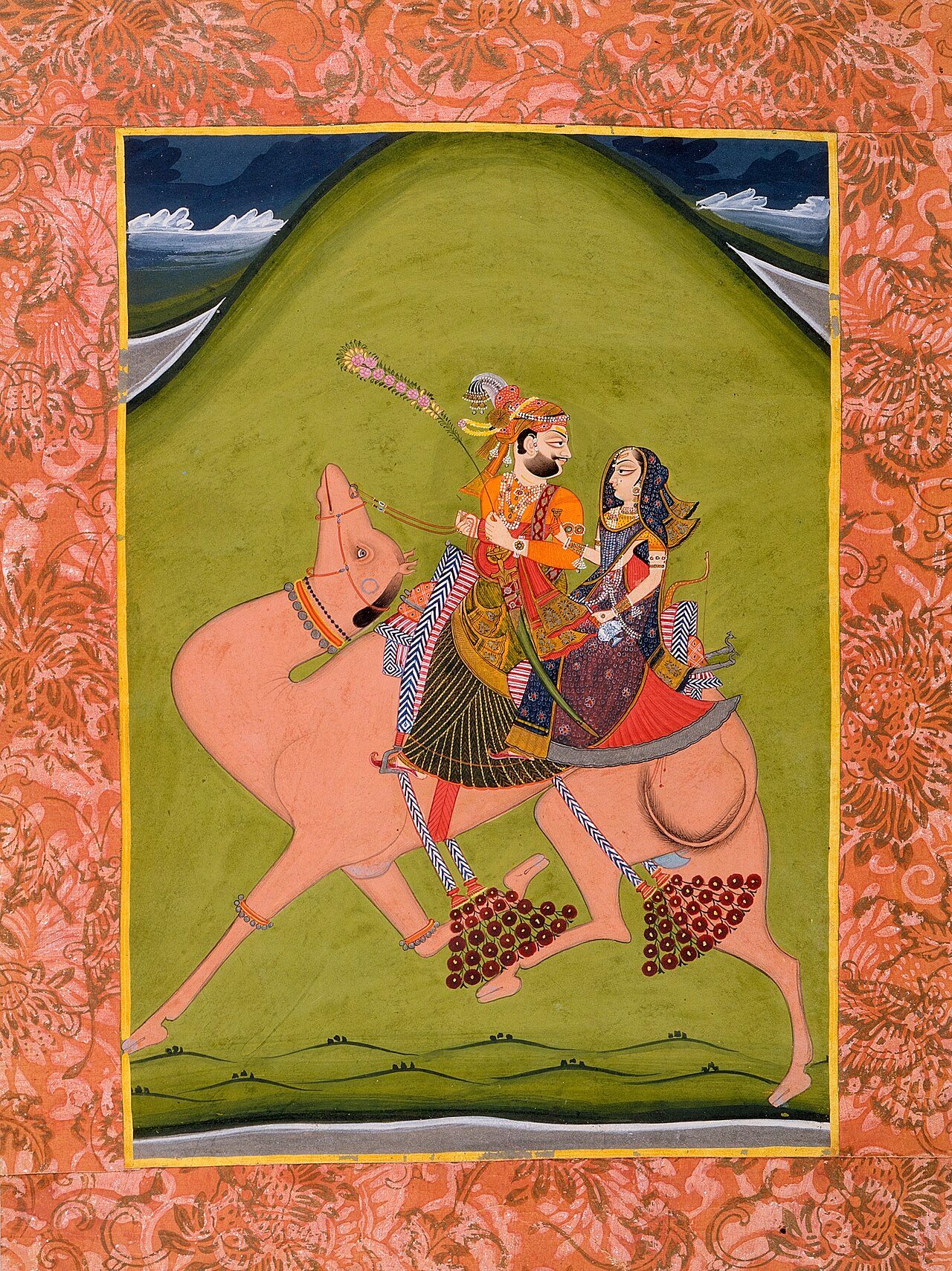
The tradition & historical record
5 min read · 2 sourcesThe Dhola Maru, also known as Dhola Marvani, is the romantic tale of Dhola and Maru in Rajasthan. The Rajasthani version is entirely different from a version found in Chhattisgarh. The folktale can also be found in Punjab. 1
Literature
The Dhola Maru story is deeply rooted in folklore and oral traditions, and it is well-known across Northwestern India: besides Rajasthan, the story is also found in Punjab, Bundelkhand, Uttar Pradesh and Chhattisgarh. The work is available in both prose and poetry form, as well as a mixed form (prose and verse). The tale depicts one of the most mesmerizing chapters of Rajput and Rajasthani history. 1
Editions
Scholarship locates at least three recensions of the story: the oldest to date, titled "recension A", from Bikâner; a second one, called "recension B", from author Kuśallābh, from Jodhpur, and a third one, titled "recension C", from a manuscript found in Bikaner, which contains the story in prose and verse form. Dhola Maru ri chaupai is a book composed by Jain monk Kushallabh in 1617, in which he writes that the story is an old one. Some manuscripts of 1473 also describe the story. Dhola Maru ra doha is the edited text by Kashi Nagari Pracharini Sabha. A version titled Dhola Marva-ni chaupahi is ascribed to Hararaj and dated to circa 1560. A Hindi version named Dhole’maru-ra duha is also reported to exist. 1
Rajasthani version
This is a love story of Kachhwaha prince Dhola of Narwar and Poogal princess Maru. King Pingal lived in a small kingdom, Poogal. One day he decided to have his infant daughter Maru married off to Dhola, the son of Nal, the king of Narwar and his good friend. So Dhola and Maru got married at childhood (now illegal) but before they attained adulthood Nal died, and Dhola forgot the marriage vows he had exchanged with Maru at birth. So Dhola got married again to Malwani, while Maru pined away for him as her father king Pingal sent umpteen messages to Dhola which he never received as his wife Malwani had all the messengers either arrested or bumped off. But Maru got through to Dhola finally through a group of folk singers, and Dhola on learning about his first wife started off for Poogal immediately. However the cunning Malwani was not going to let both lovers meet if she could help it. As Dhola set off she sent word through a messenger that she had died and Dhola ought to hurry back. Dhola, not oblivious of the ways of Malwani, saw the lie for what it was and carried on. His journey to Poogal was uneventful apart from an inopportune encounter with Umar Sumar, the leader of a band of robbers who tried to persuade him that his wife Maru had been married off to somebody else. Umar Sumar was himself very keen on Maru, but Dhola was having none of it. He arrived at Poogal to a tumultuous welcome and Dhola Maru were united at last. Troubles were not over yet. 1
On the way back to Narwar, Maru was stung by a desert snake and died. Overwhelmed with grief Dhola decide to become the first ‘male sati’ in Rajput history by ascending the funeral pyre of his wife. But was saved in the nick of time by a yogi and yogini who claimed that they could bring Maru back to life. 1
Chhattisgarhi version
In the Chhattisgarhi version, Dhola is the son of king Nal and mother Damyanti. In his past life Dhola was a handsome young man who was catching fish in the village pond through angle called 'gari' in Chhattisgarhi. Rewa, an exceptionally beautiful woman, who was daughter-in-law of some family in the village in her past life, came to fetch water seven times, expecting Dhola at least to say a word to her. However, when getting no response from Dhola, she broke her silence by reciting following verse which rhymes: 1
Dhola replied: 1
This reply pierced Rewa's heart like an arrow and filled it with ocean of remorse. Struck by heart-pinching reply, and rejection, she returned to her home and committed suicide by jumping into the well in her family garden called kola in Chhattisgarhi. When her soul reaches heaven, she is confronted by God there as to how come she returned to heaven before completing her actual duration of life-span. She narrates her story of being rejected by Dhola. So God asked her what she wanted. Rewa replied that she wanted Dhola to be her husband. In reply to her request, God said that Dhola is already destined to be husband of Maaru, and thus Rewa cannot have Dhola as her husband for the life-time but only for 12 years. And the story turns to after-birth of Dhola, Maaru and Rewa, where Dhola and Maaru are married in the childhood. Mother Damyanti keeps warning her son Dhola that he can go to roam around every para (caste-based locality) of the village except Malhin para (Malhin is the caste which sell flower and their main profession is gardening). 1
Folk theatre
The Dhola Maru tradition is also a popular subject matter for the Rajasthani folk theatre (or Khyal), one of the least researched areas of the arts in this region. 1
The text above is adapted from the Wikipedia article “Dhola Maru”, available under the Creative Commons Attribution-ShareAlike 4.0 licence. 1
Dhola Maru is romantic tale, according to the structured record cited below. This entry was generated automatically from that record and has not yet been reviewed by a person familiar with the tradition. 2
The source record links this tradition to 1 external register, which can be verified through the citation. 2