The tradition & historical record
5 min read · 2 sourcesDick Whittington and His Cat is the English folklore surrounding the real-life Richard Whittington (c. 1354 – 1423), wealthy merchant and later Lord Mayor of London. The legend describes his rise from poverty-stricken childhood with the fortune he made through the sale of his cat to a rat-infested country. Although the real Whittington was actually of high birth and likely did not own a cat, he did become a merchant and politician and was remembered for his public projects and charitable investments. Another element in the legend is that Dick attempted to flee his service as a scullion one night, heading towards home (or reached Highgate Hill in later tradition), but was dissuaded by the sound of Bow bells, which promised he would be lord mayor of London one day. Since the pre-Victorian era, the story has been a favourite subject of British pantomime, especially during Christmas season. 1
Overview
Written forms date from the early 1600s, over 150 years after the death of the historical Whittington. A drama play (1604–05) and ballad (1605) are known only by name; Richard Johnson's ballad of 1612 is the earliest-surviving piece that refers to Whittington making his fortune with his cat. This early ballad already contains the tradition that Whittington fled his scullion's service and travelled towards home, but was beckoned back by the London bells which predicted his future of becoming mayor. The earliest known prose rendition is The Famous and Remarkable History of Sir Richard Whittington by "T. H." (Thomas Heywood), published 1656 in chapbook form, which specified that the bells were those of Bow Church (St Mary-le-Bow), and that the boy heard them at Bunhill. Common chapbooks of a later period wrote that the boy reached as far as Holloway on the night he fled. Links to this village have not been corroborated in early folklore or literature, and it is thought to be an 18th-century invention. But based on this tradition, the landmark Whittington Stone at the foot of Highgate Hill is commonly perceived to be the place where Dick Whittington stopped and heard the famous bells. The story was adapted into puppet play by Martin Powell in the early 18th century. Later, it has been performed as stage pantomimes and children's plays. It has also been retold as a children's story by a number of printers and authors to this day. A number of foreign and medieval analogues exist that exhibit the motif ("Whittington's cat" motif, N411.2), where the hero obtains wealth by selling a cat, typically in a rodent-infested place direly in need of one. The tale is catalogued Aarne–Thompson (AT) tale type 1651, "Whittington's Cat". 1
Synopsis
The following summary gives a comparison of three textual sources. B = Johnson's ballad, H = prose by Heywood, signed T. H. (Wheatley ed.); C = Late chapbook (18th to 19th-century printing by J. Cheney): 1
To London
Dick Whittington was a poor orphan boy, languishing in Lancashire (B), or some unnamed place in the country (H, C). He set off to seek his fortune in London (B, H, C), enticed by the rumour that its streets were paved with gold (C). But he soon found himself cold and hungry, and fell asleep at the gate of the home of a wealthy merchant named Fitzwarren (H, C). Fitzwarren gave him lodging and hired him to be the scullion in the kitchen (B, H, C). 1
Dick and his cat
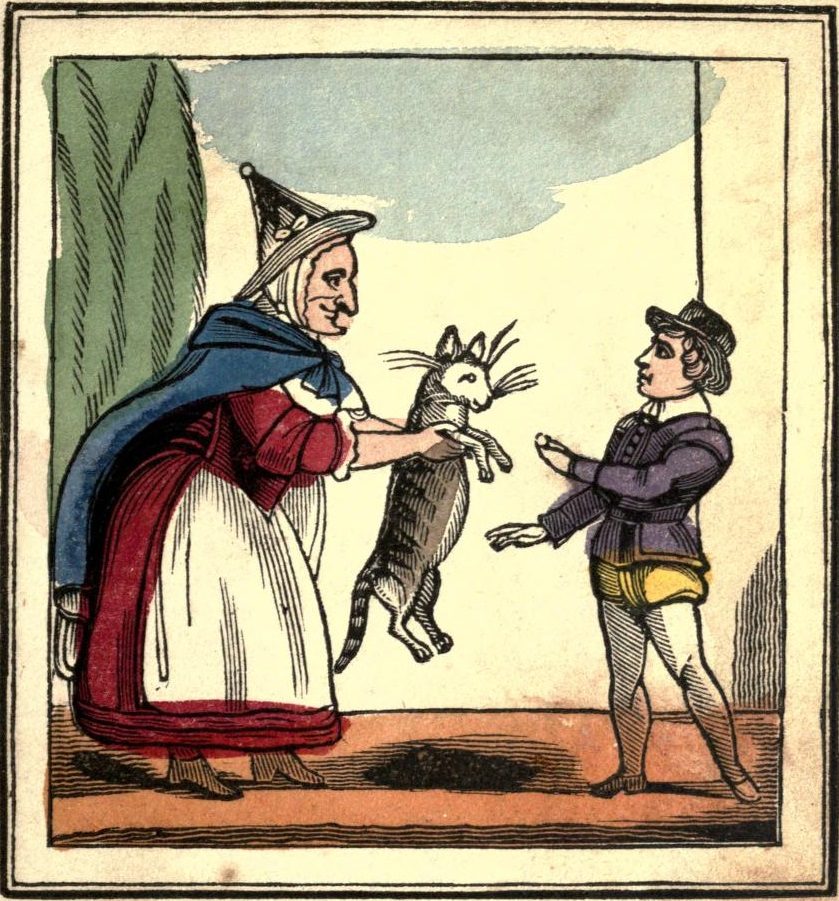
In the prose versions, an account of Dick Whittington's cat subsequently follows, but in the ballad, it is preceded by Dick's flight and church bells episode. In the prose legend, Dick is provided quarter at the Fitzwarrens' garret (room in the attic) (H, C), which was infested with rats and mice (H, C). But Dick owned a cat (B, H, C) that the prose versions say he had bought for a penny he earned by shining shoes (H, C). The cat controlled his rodent problem, which made her an indispensable companion. When Fitzwarren organized a trade expedition sending the merchant ship Unicorn (H), Dick's cat was "ventured" to this mission to be sold for profit abroad (B, H, C). The versions also differ regarding the circumstances: either Dick relinquished the cat of his own volition, hoping its sale in a foreign land might reap a "store of gold" towards the fulfillment of the omen of the bells (B), or, Dick was compelled to do so by Fitzwarren, who maintained a steadfast rule that everyone in his household should have some article of worth riding on the venture, with due dividends forthcoming from the proceeds (H, C). 1
Flight, and the bells tolling
Dick became disenchanted with the scullion's lot and attempted to flee, either because he received only room and board for his labours but was denied monetary wages (B), or because the kitchen maid (H) or female cook named Mrs. Cicely (C) abused and physically beat him beyond his tolerance. He ran as far away as Bunhill (H) or Holloway (C), where he heard "London Bells" (B), Bow bells (C), or the bells of "Bow Church" (H), which seemed to be telling him, 1
and persuaded him to retrace his steps. (The wording of the bells' message differs slightly according to the textual source.) 1
The text above is adapted from the Wikipedia article “Dick Whittington and His Cat”, available under the Creative Commons Attribution-ShareAlike 4.0 licence. 1
Dick Whittington and His Cat is English folklore concerning the rise of Richard Whittington in 14th-century London, according to the structured record cited below. This entry was generated automatically from that record and has not yet been reviewed by a person familiar with the tradition. 2
The source record links this tradition to 4 external registers, which can be verified through the citation. 2