The tradition & historical record
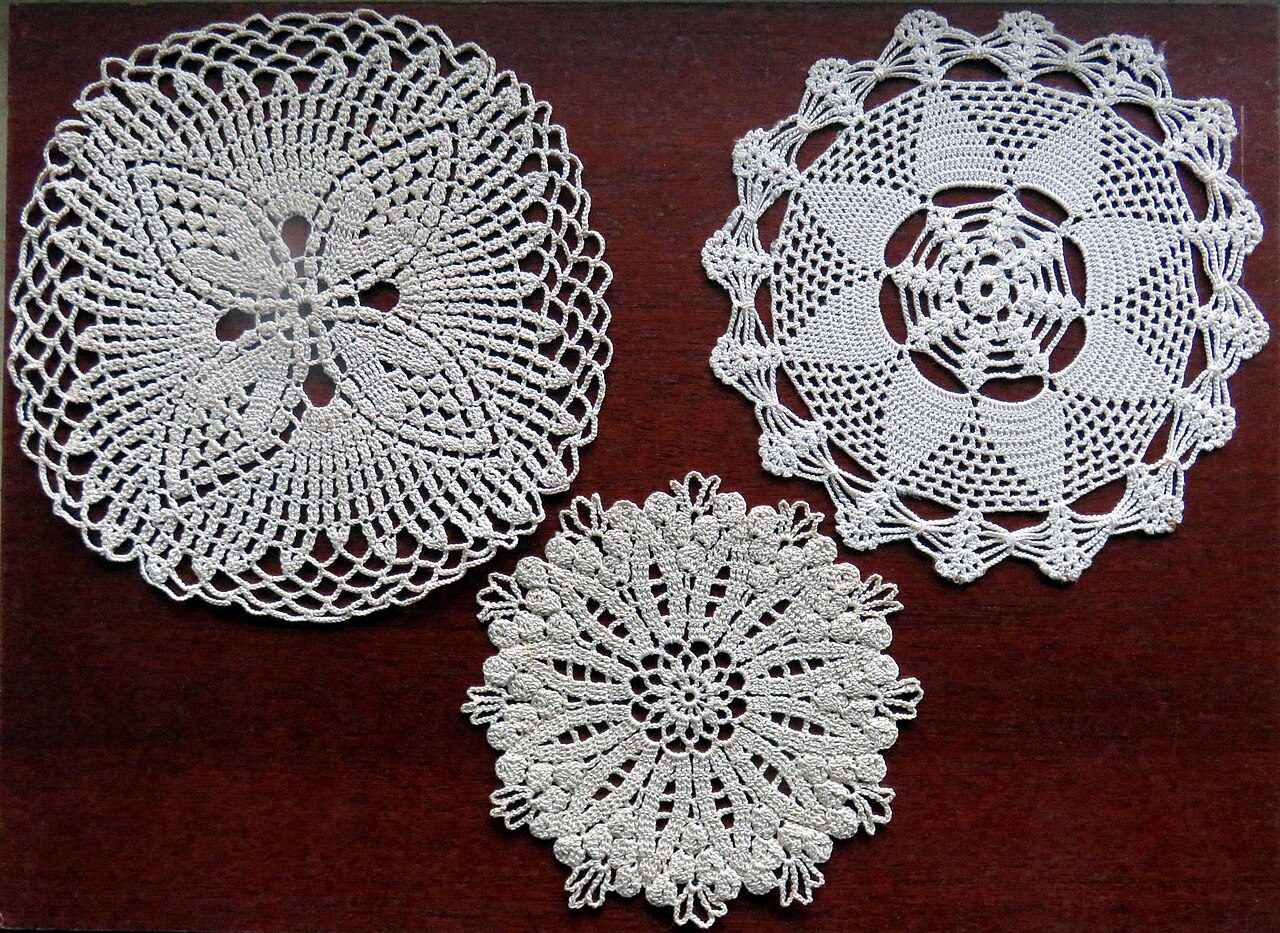
3 min read · 2 sourcesA doily (also doiley, doilie, doyly, or doyley) is an ornamental mat, typically made of paper or fabric, and variously used for protecting surfaces or binding flowers, in food service presentation, or as a clothing ornamentation, as well as a head covering for Christian women. It is characterized by openwork, which allows the surface of the underlying object to show through. Doilies can be constructed in a variety of techniques, and the doily motif can also be represented in atypical non-textile formats. 1
Etymology
Doiley was a 17th-century London draper, who made popular "a woolen stuff, 'at once cheap and genteel', introduced for summer wear in the latter part of the 17th c." At the time, it was used as an adjective, as in "doily stuffs" or "doily suit". Later, usage shifted to refer to "a small ornamental napkin used at dessert", known as a "doily-napkin". 1
Headcovering
The doily is worn as a headcovering for Jewish women as an alternative to the traditional tichel (headscarf). The doily is used as a headcovering by many Christian women who wear them in obedience to 1 Corinthians 11:1–13, especially by Conservative Anabaptist Christian women, including certain Conservative Mennonite fellowships such as the Biblical Mennonite Alliance. 1
Furniture protection
In addition to their decorative function doilies have the practical role of protecting fine-wood furniture from the scratches caused by crockery or decorative objects such as nativity scenes, or from spilled tea when used on tea trays or with cups and saucers. When used to protect the backs and arms of chairs, they are serving as antimacassars. 1
Flower arrangement
Doilies are traditionally used to bind the stems in posies (formal flower arrangements called tussie-mussies in the Victorian Era). 1
Food service and etiquette
Doilies figure prominently in the custom of finger bowls, once common in formal, multi-course dinners. The linen doily (never paper) separates the dessert plate from the finger bowl. The custom requires that both doily and finger bowl are removed to the upper left of the place setting before briefly dipping fingertips into the water and drying them on the napkin. Failing to move both together is considered a faux pas. Disposable paper doilies "were designed as a cheaper but respectable alternative to crocheted linen doilies" and are commonly used to decorate plates, placed under the food for ornamentation. 1
The text above is adapted from the Wikipedia article “Doily”, available under the Creative Commons Attribution-ShareAlike 4.0 licence. 1
doily is small mat, usually of crochet-work, laid on furniture for decoration and protection, according to the structured record cited below. This entry was generated automatically from that record and has not yet been reviewed by a person familiar with the tradition. 2
The source record links this tradition to 7 external registers, which can be verified through the citation. 2