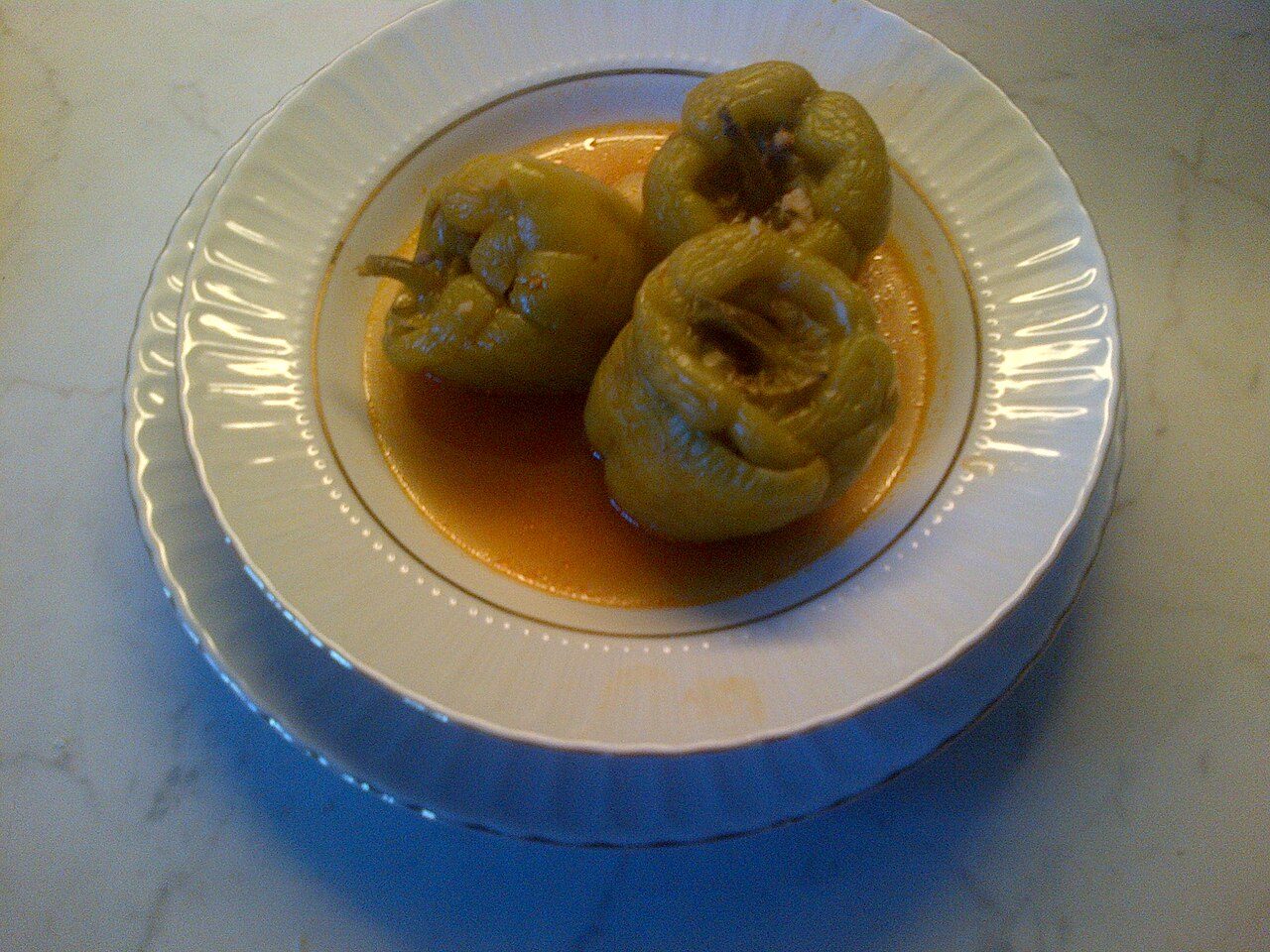
The tradition & historical record
6 min read · 2 sourcesDolma (US: , Turkish: [doɫˈma] ) is a family of stuffed dishes largely associated with Ottoman cuisine. It mainly includes vegetables and leaves, and occasionally seafood, offal, fruits, and meats, that are hollowed out or wrapped, then filled with a mixture of rice, minced meat, herbs, and spices. The leaf-wrapped type can be specifically known as sarma, but colloquially dolma is used for both. Dolma has spread during the Ottoman Empire, becoming a staple food across the modern cuisines of post-Ottoman regions and nations. In 2017, the dolma-making tradition of Azerbaijan was inscribed on the UNESCO Intangible Cultural Heritage Lists. Armenia officially recognizes the preparation and consumption of tolma on its own intangible cultural heritage list. 1
Etymology and terminology
The word dolma is of Turkish origin and means "something stuffed" or "filled". It derives from the verb dolmak ("to get filled or stuffed"), which itself ultimately derives from the Old Turkic tolmak. Gerard Clauson identifies the verbal root tol- ("to be filled, or full") as widely attested in early Turkic texts and as surviving across the modern Turkic languages with similar meanings. One of the earliest attestations of the word dolma appears in Thesaurus Linguarum Orientalium, Turcicæ, Arabicæ, Persicæ (1680) by Franciscus a Mesgnien Meninski, where the Ottoman Turkish word طولمه (dolma) is recorded with the Latin definition ripieno ("stuffed" or "filled"). The earliest written mention of dolma in English dates to the late 19th century, appearing in James William Redhouse’s A Turkish and English Lexicon (1890), which defines it as "an act of filling" and "a dish of meat, fruit, or vegetable, filled with rice, forcemeat, etc." In addition to modern Turkish, dolma is the standard spelling in Azerbaijani and the romanization of the Western Armenian spelling դոլմա, which in Eastern Armenian is տոլմա (tolma). It is also called derevapatat in Western Armenian, which literally means rolled leaves. Name forms related to dolma in other languages include Greek: ντολμάς (ntolmás), Arabic: ضُلْمَة (ḍulma), Persian dolmeh, Georgian: ტოლმა (ṭolma), Tatar: тулма (tulma), Turkmen dolâma, and Swedish dolme. In Turkey, a distinction is made between dolma ("stuffed thing"), referring to hollowed vegetables filled with a stuffing, and sarma ("rolled/wrapped thing"), in which the filling is wrapped in edible leaves such as vine or cabbage leaves. 1
Origin
Although its exact origin is disputed, dolma is mainly associated with an array of stuffed vegetables that originated in Turkey during the Ottoman Empire. The concept is believed to have been invented in the Ottoman palace kitchens during the 15th century, where Ottoman chefs perfected the stuffing of vegetables. Dolma has changed little since Ottoman times, during which recipes for both meat-and-rice fillings, meatless and olive oil-based varieties first appeared. According to Gil Marks, many credit the Ottoman Turks for the innovation of the dish, who have developed diverse versions and spread the concept. Marks notes that they may have been inspired by manti, a type of dumpling found in many Central Asian cuisines. The Oxford Companion to Food argues that the distribution and the name of the dish indicates that dolma belongs to the court cuisine of the Ottoman Empire, where stuffed vegetables were first treated as a regular culinary genre in Istanbul. The book points out that the Ottoman origin of the dish is obscured to an extent by the fact that it may be referred to by a native name is some countries. Claudia Roden has suggested that the dish may have been adopted from the Greeks, though she also observes that "stuffed vegetables were obviously developed as a 'court cuisine', invented and prepared for a rich and powerful leisured class to excite their curiosity and titillate their palates, as well as to satisfy their desire for ostentation." William Pokhlebkin, a culinary historian specialist, contends that the dish's inception traces back to Armenian culinary heritage. 1
Early stuffed dishes
According to Charles Perry, it was relatively recently that stuffed vegetables became a characteristic food of the Eastern Mediterranean, when the Ottoman Turks made them a regular culinary category 500 years ago. He observes that medieval Arabic cookbooks contained many recipes for stuffed dishes, but rarely stuffed vegetables. Claudia Roden argues that stuffed vegetables do not appear in the early Arabic and Persian cookbooks, but seem to have been known during the Ottoman Empire, where they were possibly developed in this period. The Oxford Companion to Food also notes that vegetables were stuffed in pre-Ottoman times, but only sporadically. The earliest recorded use of stuffing as a cooking technique appears in the Roman cookbook Apicius from late antiquity. The recipes involve stuffing a variety of animals, including chickens, pigs, boars, sheep, hares, and dormouses, as well as fish, such as calamari, cuttlefish, and sardines, and even pumpkins. The fillings generally consisted of forcemeat. The cookbook also provides the earliest recipe for stuffed vegetables, which involves cucumbers stuffed with forcemeat, then cooked in broth or wine sauce. The practice of stuffing was also known in Central Asia, where fillings (usually meat) were enclosed in thin dough to form dumplings such as manti. Several kinds of stuffed and wrapped intestine dishes are mentioned in the 11th-century dictionary of Turkic languages Dīwān Lughāt al-Turk, with the fillings containing meat, spices, and sometimes liver. One variety called sogut is stuffed with rice in addition to meat and spices, providing the first written information about stuffed dishes containing rice. 1
Ottoman period
During the Ottoman Empire, vegetables became one of the hallmarks of the Ottoman cuisine, especially eggplants. They were so numerous and highly regarded that one observer commented in the 19th century that it was "on the preparation of vegetables that the Turkish cook expends all his art". Most Ottoman families had gardens where they grew their own vegetables and fruits, and in season, market prices were low. Stuffed vegetables, collectively known as dolma, became one of the most loved and diverse categories of the empire's cuisine. They evolved from just onions and apples in the 15th century to a wide range of vegetables and leaves over the following centuries, with meatless and dairyless varieties becoming mainstream by the late 18th century. By the 17th century, Istanbul had 50 cookshops known as dolmacı that specialized in several stuffed vegetables. Priscilla Mary Işın argues that the innovation of dolma recipes was driven by the imperial court. The establishment of the Ottoman palace kitchen, known as Matbah-ı Âmire, created a competitive environment where cooks constantly experimented with flavors and techniques to impress the Sultan and his council. 1
Historical variations
Under centuries of Ottoman rule, dolma spread across territories in the Middle East, the Mediterranean, the Caucasus, and the Bal… 1
The text above is adapted from the Wikipedia article “Dolma”, available under the Creative Commons Attribution-ShareAlike 4.0 licence. 1
dolma is category of dishes of stuffed vegetables, fruits, seafood and flowers, according to the structured record cited below. This entry was generated automatically from that record and has not yet been reviewed by a person familiar with the tradition. 2
The source record links this tradition to 9 external registers, which can be verified through the citation. 2