The tradition & historical record
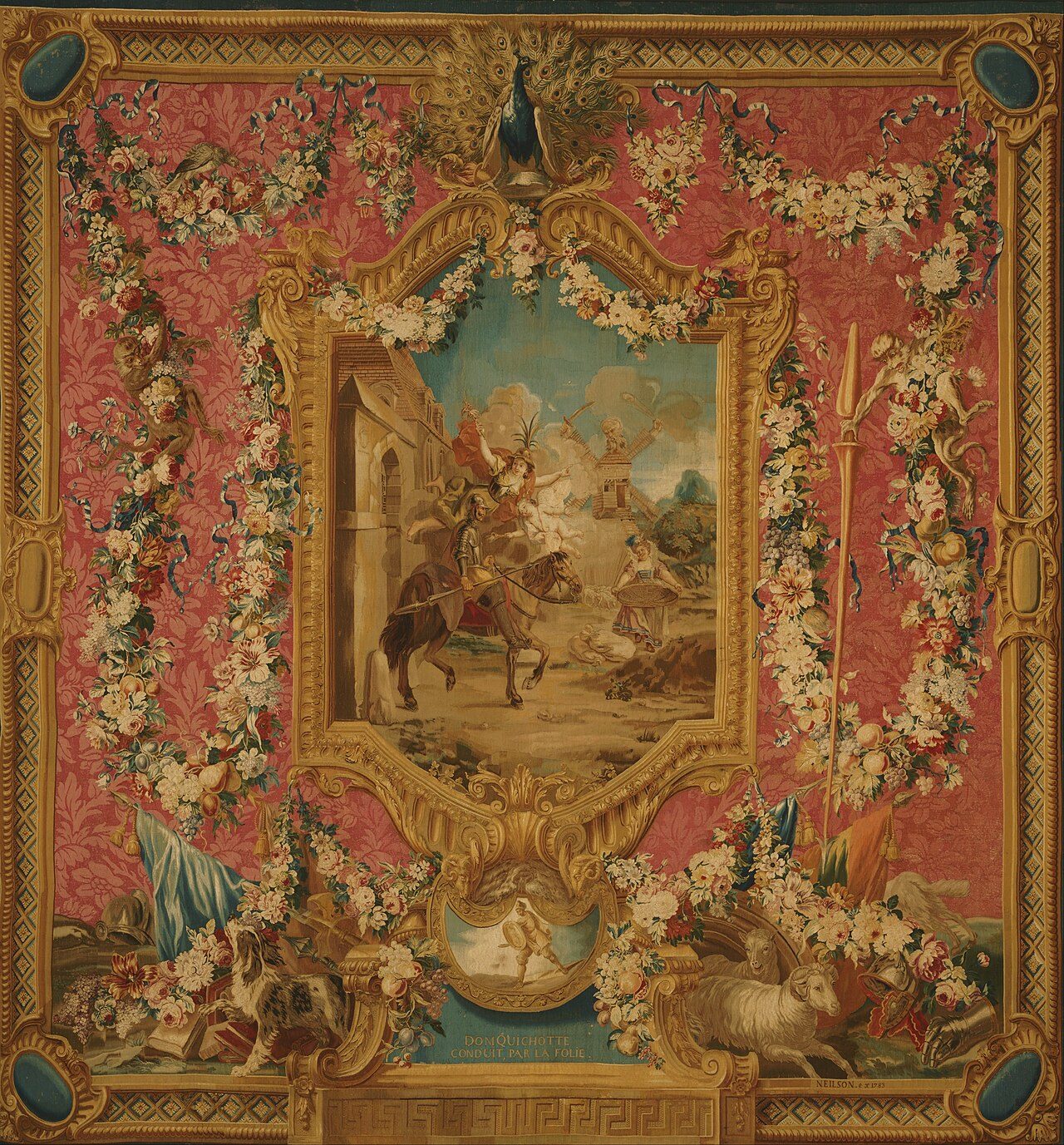
6 min read · 2 sourcesThe Don Quixote tapestry series is a popular series of 18th century mural-scale tapestries illustrating scenes from the Miguel de Cervantes novel, Don Quixote. The series was woven at the Gobelins Manufactory in Paris from 1714 to 1794, during which they were the most frequently reproduced series in the manufactory with over 200 panels woven. Their design marked the emergence of elaborate alentour borders in tapestries. In total, the series contains 28 scenes from the novel. The cartoons (full-scale paintings to copy for the weaving) for each scene were painted by Charles Antoine Coypel, who also arranged the design for the large, surrounding decorative alentour border. The Don Quixote scenes take up comparatively little space in the total surface area, as a small scene in a gilt, flower-bedecked frame hung on a backdrop of elaborate decoration. This large decorative space known as the alentour border has the designs of other famous designers and painters at the Gobelins Manufactory, including Claude Audran III and Jean-Baptiste Belin de Fontenay the Elder. The series was woven nine times, beginning in 1714 during the period of Philippe II, Duke of Orléans, Regent of the Kingdom from 1715 to 1723. Later weavings took place under the reign of Louis XVI until the fall of the French monarchy after the French Revolution (1789–1794). 1
Gobelins Manufactory
In the 1660s the center of tapestry production moved to France when Louis XIV’s financial minister Jean Baptiste Colbert established three manufactories of tapestry production: Gobelins, Beauvais, and Aubusson. Gobelins in Paris would supply tapestries and other furnishings for the king’s palaces and Versailles in particular, while Beauvais and Aubusson produced for the wealthy public. The Gobelins manufactory would close in 1694 due to bankruptcy of the state treasury but reopened in 1699 and resumed production of its tapestries, which it has continued up to present day. The Gobelins manufactory was the dyeworks of the Gobelin family and had been established in the mid-15th century. Colbert hoped to surpass rival European tapestry production centers by bringing the manufactory under the crown’s control and centralizing production of royal furnishings and diplomatic gifts. All of the products of the Gobelins Manufactory were at the disposal of the king. The royal tapestry manufacture was first directed by Charles Le Brun, who designed many of the most famous tapestries of the period. 1
Commission and production
The court first commissioned the cartoons for the series from Coypel in 1714. Over the next 80 years the series would be woven nine times. The first set of weavings showed 15 scenes, depicting Don Quixote from leaving his home to his recovery from madness. These paintings were incorporated into the new design formula of a small scene framed in the center of an elaborately designed expanse of decoration and design motifs related to the central narrative. The backdrop imitated a wall covered in lavish fabric. The background on the first weaving was a rich yellow color composed of shaded squares in a design known as mosaique simple. The second to sixth weavings had a more elaborately patterned yellow background known as mosaique d’ornements. The Duc d’Antin ordered a set for himself in 1721 or 1722 – he wanted a series with modified dimensions to function as wide wall hangings. The second weaving of 12 pieces was given to the Spanish ambassador in 1745. The third weaving was made in 1733 and a fourth from 1746 to 1749 (12 pieces) that was sold to Philip, Duke of Parma. Following this, the series was in constant production in the Gobelins Manufactory until 1794. The fifth weaving had 30 pieces, the sixth had 23, the seventh had 14, and the eighth had 67. Of the later weavings, the seventh, eighth, and ninth had a brilliant crimson background imitating damask silk, using a dye discovered by Gobelin workshop master Jacques Neilson. The alentours were redesigned six times over the course of the series production. Because of the flexibility of background and border and the popularity of the series, the series was a natural choice for developing a stock from which the king could select gifts for all occasions and purposes. 1
Don Quixote in popular culture
Originally published in 1605, Miguel de Cervantes’s Don Quixote is considered the first modern novel and one of the most popular books of all time. It was extremely popular in France and across Europe during the 18th century, frequented transformed into art and theater. Coypel himself wrote two plays based on the novel, illustrating the significance of the work for the artist. Coypel's Don Quixote paintings became very popular and came to dominate 18th-century illustrations of the novel. They gained renown through a series of black and white engravings he personally had made of them in collaboration with distinguished print makers of the time. Though the weavings themselves were not accessible to the public, the prints of the paintings were widely reproduced and came to illustrate French, English and Dutch translations of the work. They were also reproduced in a book of prints in 1746 by Pierre de Hondt and inspired later weavings by the Brussels workshop of Peter van den Hecke. 1
Jacques Neilson workshop
One of the workshops at the Gobelins Manufactory during the 18th century was the low-warp loom (basse-lisse) workshop run by Jacques (James) Neilson, a Scotsman credited with many innovations of the Gobelins Manufactory. Neilson directed the low-warp loom workshop from 1749 to 1788 and was considered the most prominent of workshop directors (entrepreneurs) at the time. Many technical improvements in the manufactory can be attributed to Neilson. In addition to the workshop, he also directed the dyehouse, bringing an industry expertise that contributed to the exceptional quality of workmanship and color of the Gobelins tapestries at the time. Under his direction, the dyehouse produced more consistent dyes with richer, more varied ranges of tone, thus allowing for a more painterly final product. More available dyes meant more subtle gradations of color and more painterly results overall. Ranges of shade were requiring for modeling, and consistency across the year-long projects was also essential. Research to combat issues of color stability and adequate supply was commonplace across the industry. In 1760 Neilson discovered the formula for the crimson color derived from cochineal red used in the later weavings of the Don Quixote tapestries. These brilliant crimson works would become the most popular of the series. The success of this new crimson led the other ateliers of the manufactory, those of Cozette and Audran, to work in collaboration on another weaving replicating Neilson's crimson version of Don Quixote. Similar examples of the exceptional quality of work produced in the Neilson workshop include the Tapestry Room at Croome Court in England commissioned by George Coventry, 6th Earl of Coventry. 1
18th-century tapestry design
The Don Quixote series bridges a transitional period between the French Baroque of Louis… 1
The text above is adapted from the Wikipedia article “Don Quixote tapestry series”, available under the Creative Commons Attribution-ShareAlike 4.0 licence. 1
Don Quixote tapestry series is recorded in open cultural data. The structured record cited below does not describe the practice, and this entry has not yet been reviewed by a person familiar with the tradition. 2