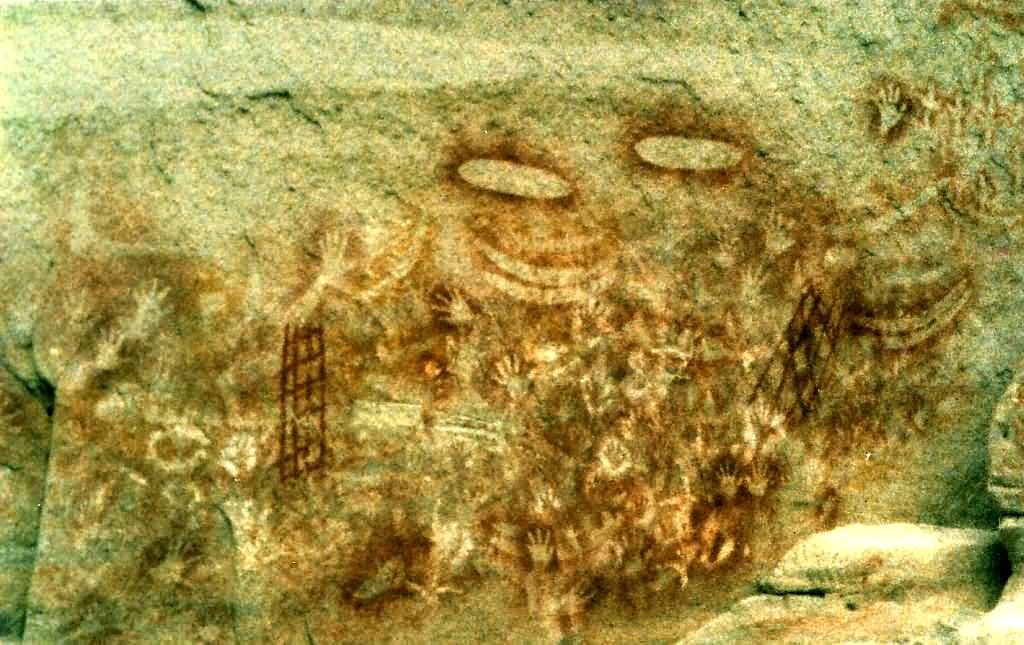
The tradition & historical record
6 min read · 2 sourcesThe Dreaming (also The Dreamtime or Dreamtime) is a term devised by early anthropologists to refer to a religio-cultural worldview attributed to Australian Aboriginal mythology. It was originally used by Francis Gillen, adopted by his colleague Walter Baldwin Spencer, and thereafter popularised by A. P. Elkin, who later revised his views. The Dreaming is used to represent Aboriginal concepts of what anthropologist W.E.H. Stanner called "everywhen", during which the land was inhabited and created by ancestral figures, often of heroic proportions or with supernatural abilities. The meaning and significance of specific places and creatures are wedded to their origin in the Dreaming, and certain locations have a distinct potency, such as Uluru (Ayers Rock), Kata Tjuta (Mt. Olga), Wollumbin, and Baiame Cave. The Dreaming is also used as a term for a system of totemic symbols, so that an Aboriginal person may own a specific Dreaming such as a kangaroo Dreaming, a honey ant Dreaming, or any combination of Dreamings pertinent to their country. This is because in the Dreaming an individual's entire ancestry exists as one single continuing cycle, culminating in the idea that all worldly knowledge is accumulated through one's ancestors. As such, The Dreaming lays down the patterns of life for Aboriginal people. 1
Early challenges to the "Dreamtime"
Early doubts about the precision of Spencer and Gillen's English gloss were expressed by the German Lutheran pastor and missionary Carl Strehlow in his 1908 book Die Aranda (The Arrernte). He noted that his Arrernte contacts explained altjira (also spelled alchera), whose etymology was unknown, as an eternal being who had no beginning. In the Upper Arrernte language the proper verb for "to dream" was altjirerama, literally "to see God". Strehlow theorised that the noun is the somewhat rare word altjirrinja, to which Spencer and Gillen gave a corrupted transcription and a false etymology. "The native," Strehlow concluded, "knows nothing of 'dreamtime' as a designation of a certain period of their history." Strehlow gives Altjira or Altjira mara (mara meaning "good") as the Arrernte word for the eternal creator of the world and humankind. Strehlow describes him as a tall, strong man with red skin, long fair hair, and emu legs, with many red-skinned wives (with dog legs) and children. In Strehlow's account, Altjira lives in the sky (which is a body of land through which runs the Milky Way, a river). 1
Missionary influence and the concept of God
However, by the time Strehlow was writing the majority of his Aboriginal contacts had been converts to Christianity for decades. Critics such as Sam Gill suggested that Altjira had been used by missionaries from the Hermannsburg Institute as a word for the Christian God in order to fill in a lexical gap in Arrernte language. This process is said to have shifted the original traditional meaning of the word so as to fit Christian theology, implying that Strehlow's usage may be unsuited for sourcing. 1
Spencer's rebuttal and modern academic views
In 1926 Spencer conducted a field study to challenge Strehlow's conclusion about Altjira and the implied criticism of Gillen and Spencer's original work. Spencer found attestations of altjira from the 1890s that used the word to mean "associated with past times" or "eternal", not "god". Academic Sam Gill finds Strehlow's use of Altjira ambiguous, sometimes describing a supreme being and sometimes describing a totem being, but not necessarily a supreme one. He attributes the clash partly to Spencer's cultural evolutionist beliefs that Aboriginal people were at a pre-religion "stage of development (and thus could not believe in a supreme being)", while Strehlow as a Christian missionary found presence of belief in the divine a useful entry point for proselytising. Linguist David Campbell Moore is critical of Spencer and Gillen's "Dreamtime" translation, concluding: 1
"Dreamtime" was a mistranslation based on an etymological connection between "a dream" and "Altjira", which held only over a limited geographical domain. There was some semantic relationship between "Altjira" and "a dream", but to imagine that the latter captures the essence of "Altjira" is an illusion. 1
Other terms among Aboriginal groups
The complex of religious beliefs encapsulated by the Dreaming is also called: 1
Ngarrankarni or Ngarrarngkarni by the Gija people Jukurrpa or Tjukurpa/Tjukurrpa by the Warlpiri people and in the Pitjantjatjara dialect Ungud or Wungud by the Ngarinyin people Manguny in the language Martu Wangka Wongar in North-East Arnhem Land Daramoolen in Ngunnawal language and Ngarigo language Nura in the Dharug language Nyitting in the Noongar language Many Aboriginal Australians also refer to the world-creation time as "The Dreamtime", or just "Dreamtime" 1
Translation debates and meaning
Dreamtime and similar terms are based on a rendition of the Arandic word alcheringa, used by the Arrernte (Aranda, Arunta) people of Central Australia. However, there are also arguments these English-language terms are based on a misunderstanding or mistranslation. Some scholars suggest that the word's meaning is closer to "eternal, uncreated". Anthropologist William Stanner said the concept was "best" understood by non-Aboriginal people as "a complex of meanings". Stanner famously termed this "Everywhen", representing the Aboriginal concept that the Dreaming is not a "far distant past", but a timeless reality where the past, present, and future coexist in an omnipotently simultaneous manner. Some Aboriginal groups find the word "Dreaming" inappropriate because it implies something non-real, whereas the concept is a lived daily reality. By the 1990s, Dreaming had entered popular culture, based on idealized or highly fictionalized conceptions of Australian mythology. Since the 1970s, Dreaming has also returned from academic usage via popular culture and tourism and is now ubiquitous in the English vocabulary of Aboriginal Australians in a kind of "self-fulfilling academic prophecy". The station-master, magistrate, and amateur ethnographer Francis Gillen first used the terms in an ethnographical report in 1896. Along with Walter Baldwin Spencer, Gillen published a major work, Native Tribes of Central Australia, in 1899. In that work, they spoke of the Alcheringa as "the name applied to the far distant past with which the earliest traditions of the tribe deal". 1
The text above is adapted from the Wikipedia article “The Dreaming”, available under the Creative Commons Attribution-ShareAlike 4.0 licence. 1
Dreamtime is sacred era in Australian Aboriginal mythology, according to the structured record cited below. This entry was generated automatically from that record and has not yet been reviewed by a person familiar with the tradition. 2
The source record links this tradition to 12 external registers, which can be verified through the citation. 2