The tradition & historical record
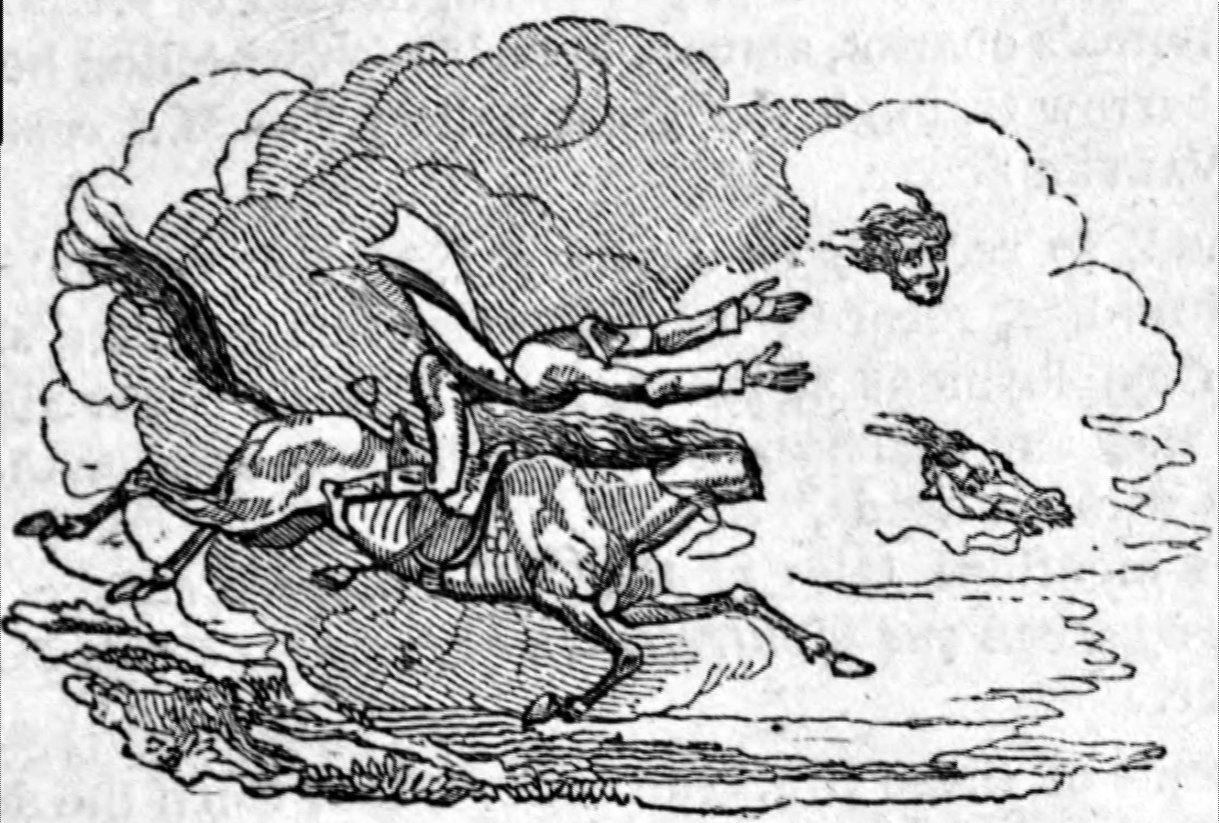
5 min read · 2 sourcesThe Dullahan (Irish: Dubhlachan; dúlachán, ) is a type of legendary creature in Irish folklore. He is depicted as a headless rider on a black horse, or as a coachman, who carries his own head. As it is not widely attested in native sources, including no references to it on the Irish Folklore Commission's website, there is doubt as to whether the Dullahan was originally a part of the Irish oral tradition. 1
Etymology
Dullahan or Dulachan (Irish: Dubhlachan [Duḃlaċan]) referring to "hobgoblin" (generic term; cf. Dullahan described as "unseelie (wicked) fairy"), literally "signifies dark, sullen person", according to the lexicographer Edward O'Reilly. Dulachan and Durrachan are alternative words for this "hobgoblin", and these forms suggest etymological descent from dorr/durr "anger" or durrach "malicious" or "fierce". The original Irish term contains the stem dubh, meaning "black" in Irish. Dullahan was later glossed as "dark, angry, sullen, fierce or malicious being", encompassing both etymologies, though Thomas Crofton Croker considered the alternative etymology more dubious than the dubh "black" ("dark") etymology. The Dullahan is also called Colainn Gan Cheann, meaning "without a head" in Irish. "Headless Coach" (Irish: Cóiste Gan Cheann) or the "Soundless Coach" (literally "deaf coach", Irish: cóiste bodhar; Hiberno-English: Coshta Bower, corrupted to "coach-a-bower") is the name given to the vehicle driven by the Dullahan. 1
Description
He is depicted as a headless horseman, typically on a black horse, who may carry his own head in his hand or under his arm. The severed head has a revolting appearance, as in Croker's tale "The Headless Horseman": 1
...such a head no mortal ever saw before. It looked like a large cream cheese hung round with black puddings: no speck of colour enlivened the ashy paleness of the depressed features; the skin lay stretched over the unearthly surface almost like the parchment head of a drum. Two fiery eyes of prodigious circumference, with a strange and irregular motion, flashed like meteors. According to the modern storyteller Tony Locke of County Mayo, the Dullahan's mouth, full of razor-sharp teeth, forms a grin reaching the sides of the head, its "massive" eyes "constantly dart about like flies", and the flesh has acquired the "smell, colour and consistency of mouldy cheese". There are also legends and tales mentioning the "Headless Coach" (also called "Coach-a-bower"; Irish: cóiste bodhar), with the Dullahan as its presumed driver. Cóiste Bodhar was referred to as "Soundless Coach" by Robert Lynd, who gave an account of a "silent shadow" of a coach passing by, provided by an avowed witness from Connemara. However, William Butler Yeats explained that "the 'deaf coach' was so called because of its rumbling sound". According to one witness, only the silent shadow of the horse-drawn hearse, i.e., the "Soundless Coach" was seen passing by. In Croker's poem "The Death Coach", the carriage axle is made of a human spine and the wheel-spokes are constructed from thigh bones. 1
Behaviour
A Dullahan appears as a mounted horseman or a coachman driving a horse-drawn carriage out of graveyards. The rumour of a Dullahan's appearance often develops near a graveyard or a charnel vault where a wicked aristocrat is reputed to be buried. He arrives, driving the death coach, at the doorstep of a person whose death is approaching. According to Croker, the appearance of the "Headless Coach" foreshadows imminent death or misfortune. In "Hanlon's Mill", Michael (Mick) Noonan is returning from his trip to a shoemaker at Ballyduff, Co. Cork, and during his journey, he sees a black coach drawn by six headless black horses, driven by a headless coachman clad in black. The next morning, Mick receives news from the huntsman that Master Wrixon of Ballygibblin had a fit and died. Croker reports that in one legend, a Headless Coach would run back and forth from Castle Hyde to a glen/valley beyond the village of Ballyhooly, in County Cork. Nearby in the town of Doneraile, it was said that the coach would visit the houses in succession, and whichever occupant dared to open the door would be splashed with a basin of blood by the coachman. There are rumours that golden objects can force the Dullahan to disappear. 1
Sight
A modern commentator stated that the Dullahan has the ability to see with the severed head and can "use it to scan the countryside for mortals about to die". In contrast, the headless coach in the tale "The Harvest Dinner" is described as a "blind (thief)", and Croker assumed he lacks sight. 1
Whip
The Dullahan allegedly uses a human spine as a whip according to a number of 21st century commentators. The headless coachman merely bears a "long whip" in Croker's tale "The Harvest Dinner", with which he lashes the horses so furiously, he almost strikes a witness blind in an eye (the would-be-victim regarded it as deliberate assault). Croker deduced that the headless creature, as a way of habit, attempts to destroy his witness's eye or eyes with his whip, reasoning that the coachman's wrath turns to the onlooker because he lacks the ability to look due to his headlessness. 1
The text above is adapted from the Wikipedia article “Dullahan”, available under the Creative Commons Attribution-ShareAlike 4.0 licence. 1
Dullahan is headless rider on a black horse in Irish folklore, according to the structured record cited below. This entry was generated automatically from that record and has not yet been reviewed by a person familiar with the tradition. 2
The source record links this tradition to 2 external registers, which can be verified through the citation. 2