The tradition & historical record
3 min read · 2 sourcesDwarf Nose is a fairy tale by Wilhelm Hauff, which was published in a collection of fairytales in 1826. The story has been adopted by Andrew Lang in the Violet Fairy Book. 1
Summary
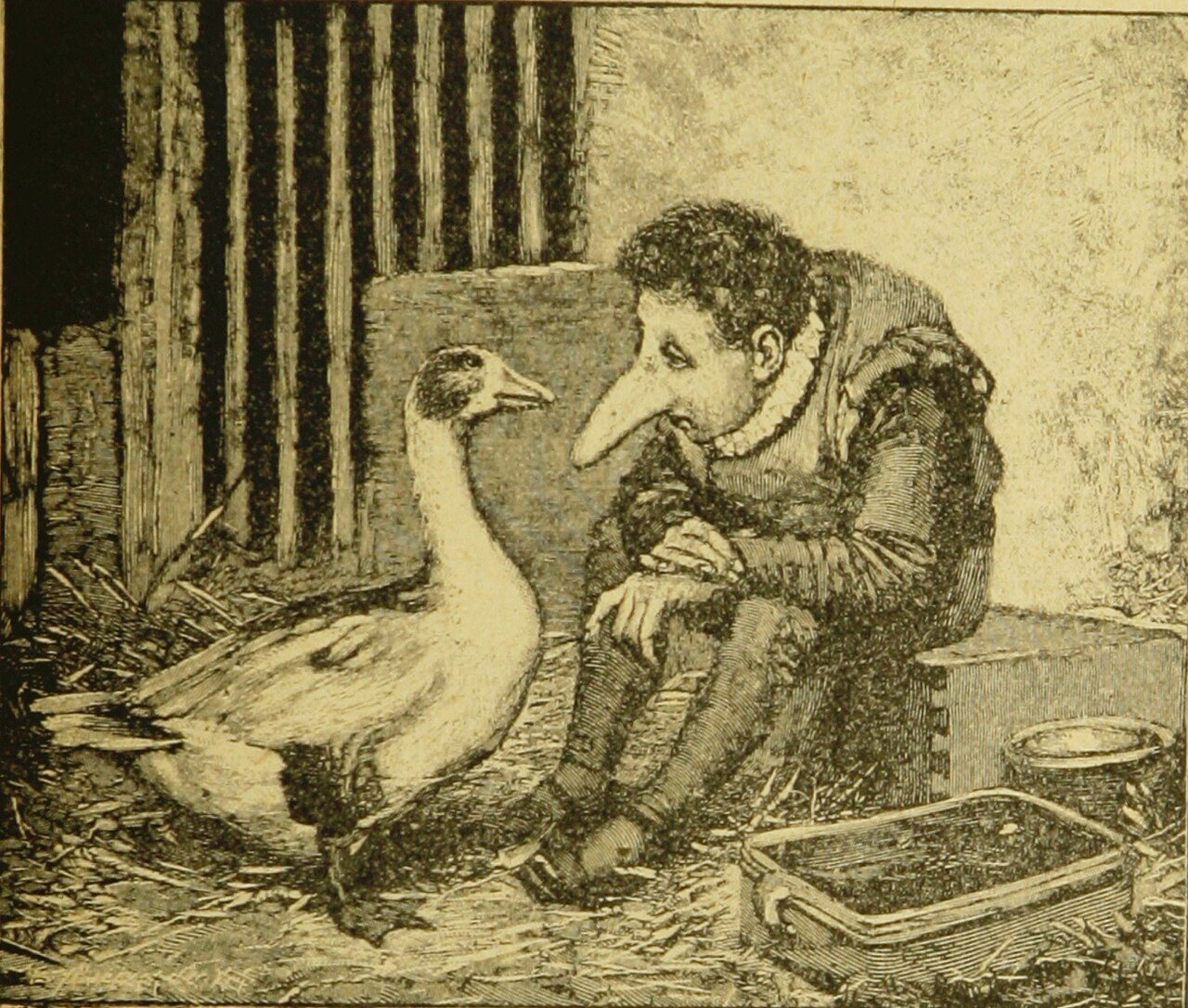
The tale is about Jacob, the son of a cobbler, who lives in a small German town. When he was twelve years old, he is said to have had a beautiful face and figure. His mother, Hanne, sells vegetables and fruit at the market and Jacob helps her by carrying home the bags for the customers. One day, an ugly old woman, who has a long, crooked nose and a thin neck, comes to his mother's stand to buy some herbs. It is later revealed that she is the fairy Wise-herb. She throws everything into disarray and makes a mess of the herbs on display so that nobody wants to buy them anymore. In reaction to this, Jacob insults her and makes fun of her looks. In response, she wishes him a long nose as well, and no neck. In the end, she does buy a few cabbages and lets Jacob carry them home for her. Arriving at the house of the woman, the cabbages turn into human heads. Guinea pigs and squirrels, which behave like humans and serve the old woman, are living here. She offers Jacob some soup while she is talking about a herb that he will never find. After he eats the soup, Jacob feels like he is falling asleep and is dreaming about living and working as a squirrel in the woman's house. He stays for seven years and learns, among other things, how to cook. By doing that he discovers a herb, smells it and wakes up. However, when he returns to his family, nobody recognizes him and everyone, including his own mother and father, call him a hideous dwarf and chase him away. 1
Interpretation
In his works, Wilhelm Hauff often comments on the political situation of his time. In the pre-March era, Germany was torn into several different small countries, which were governed by their arbitrary king, duke or earl. Hauff dreamt of witnessing these injustices being persecuted. He also believed that a righteous and strong king could provide the people with fortune and wealth. In Dwarf Nose his criticism also becomes obvious through the names of the dishes, which the bewitched boy has to prepare for his nobleman: the Danish soup, red hamburger dumplings and – upon a special request of the earl – “the queen of all dishes, the pâté Souzeraine”, a clear allusion to the political expression suzerainty. It is consequently no accident, that Hauff ends his story with a “pâté peace”. The art of cooking becomes Jacob's purpose in life, which thereby compensates for the rejection from his family. It is typical for a family tale by Hauff that Jacob marries no utopian princess, but Mimi, an ordinary woman (daughter of the wizard). 1
The text above is adapted from the Wikipedia article “Dwarf Nose”, available under the Creative Commons Attribution-ShareAlike 4.0 licence. 1
Dwarf Nose is 1826 literary fairy tale by Wilhelm Hauff, according to the structured record cited below. This entry was generated automatically from that record and has not yet been reviewed by a person familiar with the tradition. 2
The source record links this tradition to 2 external registers, which can be verified through the citation. 2