The tradition & historical record
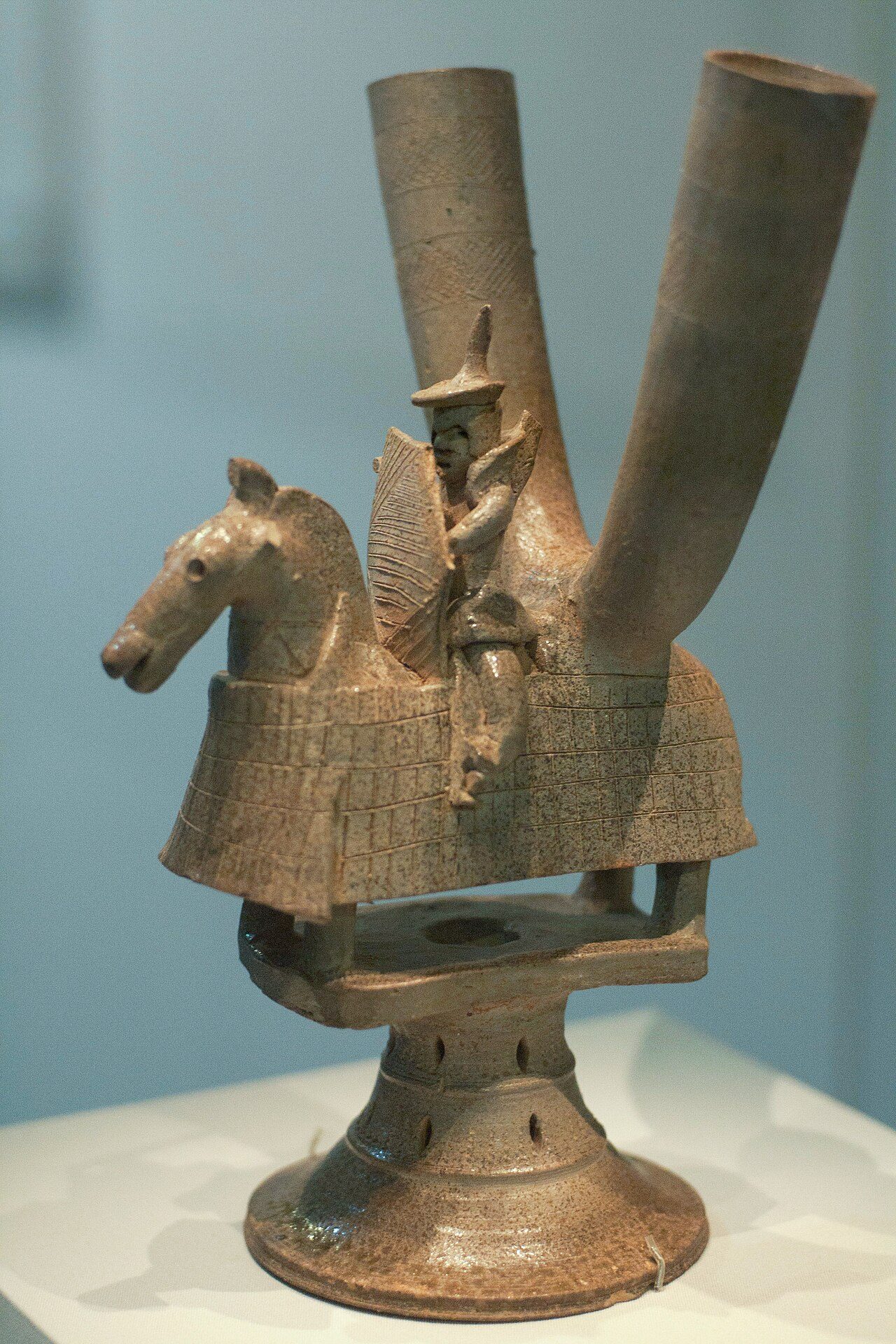
3 min read · 2 sourcesThe earthenware horn cup in the shape of a warrior on horseback (Korean: 도기 기마인물형 뿔잔) is widely regarded as one of the most significant surviving examples of figurative pottery from the Kaya Confederacy (ca. first century BCE–562 CE). The vessel is currently preserved in the Gyeongju National Museum and is recognized as an invaluable source for understanding the political, military, and ritual culture of ancient Kaya. 1
Historical background
The Kaya Confederacy consisted of a group of independent yet closely connected polities that occupied the Nakdong River basin in southern Korea between approximately the first century BCE and 562 CE. Unlike the centralized monarchies of Goguryeo, Baekje, and Silla, Kaya developed as a decentralized confederation composed of multiple regional chiefdom, including Geumgwan Gaya, Daegaya, Ara Gaya, and Sogaya. These polities shared similar cultural traditions while maintaining considerable political autonomy. Their strategic location enabled them to control inland transportation routes and maritime trade connecting the Korean Peninsula with the Japanese Archipelago and the Chinese mainland. The prosperity of Kaya was largely due to abundant iron resources, which became the basis of its political and economic independence. Archaeological excavations have revealed extensive evidence of iron smelting, forging, and export, demonstrating that Kaya functioned as one of East Asia's principal centers of iron production during the late third and fifth centuries. Relations between Kaya and Silla during the fifth century were characterized by both cooperation and competition. The two neighboring powers exchanged technologies, artistic styles, and diplomatic missions while competing for influence over southeastern Korea. For instance, Daegaya made a marriage alliance with Silla in 522. The eventual annexation of Daegaya by Silla in 562 CE brought an end to Kaya's political independence. However, its technological innovations, ceramic traditions, and equestrian culture continued to influence Silla society. 1
Provenance
According to the Korea Heritage Service, the vessel preserves exceptionally detailed representations of armor, horse harnesses, and riding equipment, making it one of the most informative ceramic artifacts for the study of Kaya military culture and elite society. Excavations at major Kaya sites—including Daeseong-dong (Gimhae), Jisan-dong (Goryeong), and Marisan (Haman)—have produced elaborate stoneware vessels, iron armor, horse trappings, and prestige goods deposited in high-status tombs. Within this archaeological context, the mounted horn cup functioned as both a ceremonial vessel and a symbolic object expressing the social rank, military authority, and religious beliefs of the deceased. 1
Characteristics
During the 5th century, heavy cavalry played a decisive role in the geopolitical struggles of the Korean Peninsula. The detailed depiction of heavy armaments on this vessel provides direct archaeological evidence for horse armor (gabal) and warrior body armor used in southern Korean kingdoms during this era. The artifact is constructed from high-fired unglazed stoneware (earthenware) at temperatures exceeding 1100 ~ 1200 ℃ producing a dark grayish-blue body. The drinking horn forms the principal container, while the rider and horse serve simultaneously as structural supports and symbolic imagery. The vessel exhibits thin walls, carefully controlled firing, and balanced proportions despite its complex sculptural composition. Individual components—including the rider, horse, pedestal, and horn-shaped cup—were modeled separately and skillfully joined before firing. 1
The text above is adapted from the Wikipedia article “Earthenware Horn Cup in the Shape of a Warrior on Horseback”, available under the Creative Commons Attribution-ShareAlike 4.0 licence. 1
Earthenware Horn Cup in the Shape of a Warrior on Horseback is Korean cultural heritage item, according to the structured record cited below. This entry was generated automatically from that record and has not yet been reviewed by a person familiar with the tradition. 2
The source record links this tradition to 2 external registers, which can be verified through the citation. 2