The tradition & historical record
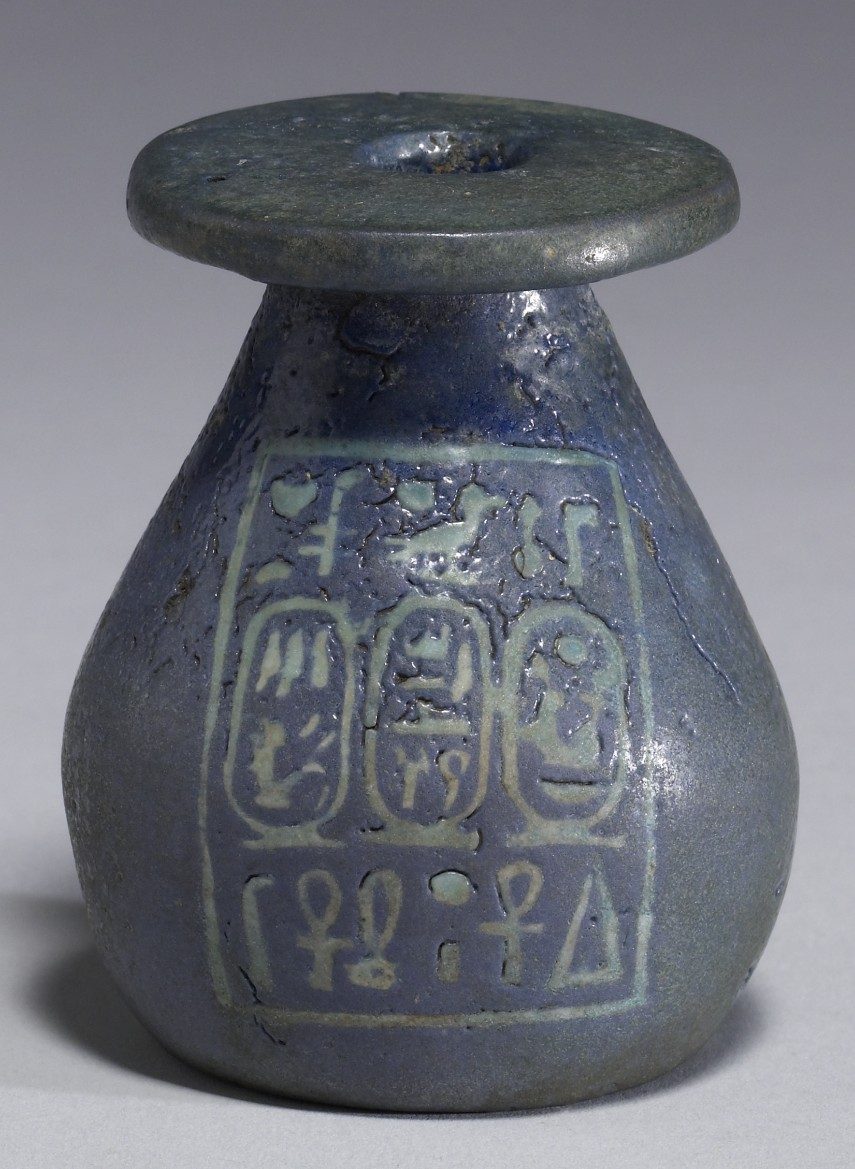
6 min read · 2 sourcesEgyptian faience is a sintered-quartz ceramic material from Ancient Egypt. The sintering process covered the material with a true vitreous coating as the quartz underwent vitrification, creating a bright lustre of various colours usually in a transparent blue or green isotropic glass. Its name in the Ancient Egyptian language was tjehenet, literally "the gleaming" or "the dazzling", and modern archeological terms for it include sintered quartz, glazed frit, and glazed composition. Tjehenet is distinct from the crystalline pigment Egyptian blue, for which it has sometimes incorrectly been used as a synonym. It is not faience in the usual sense of tin-glazed pottery, and is different from the enormous range of clay-based Ancient Egyptian pottery, from which utilitarian vessels were made. It is similar to later Islamic stonepaste (or "fritware") from the Middle East, although that generally includes more clay. Egyptian faience is considerably more porous than glass proper. It can be cast in molds to create small vessels, jewelry and decorative objects. Although it contains the major constituents of glass (silica, lime) and no clay until late periods, Egyptian faience is frequently discussed in surveys of ancient pottery, as in stylistic and art-historical terms, objects made of it are closer to pottery styles than ancient Egyptian glass. 1
Egyptian faience was very widely used for small objects, from beads to small statues, and is found in both elite and popular contexts. 1
Scope of the term
It is called "Egyptian faience" to distinguish it from faience, the tin-glazed pottery whose name came from Faenza in northern Italy, a center of maiolica (one type of faience) production in the late Middle Ages. Egyptian faience was both exported widely in the ancient world and made locally in many places, and is found in Mesopotamia, around the Mediterranean and in northern Europe as far away as Scotland. The term is used for the material wherever it was made and modern scientific analyses are often the only way of establishing the provenance of simple objects such as the very common beads. 1
The term is therefore unsatisfactory in several respects, although clear in an Ancient Egyptian context, and is increasingly rejected in museum and archaeological usage. The British Museum now calls this material "glazed composition", with the following note in their online collection database: The term is used for objects with a body made of finely powdered quartz grains fused together with small amounts of alkali and/or lime through partial heating. The bodies are usually colourless but natural impurities give them a brown or greyish tint. Colourants can also be added to give it an artificial colour. It can be modelled by hand, thrown or moulded, and hardens with firing. This material is used in the context of Islamic ceramics where it is described as stonepaste (or fritware). Glazed composition is related to glass, but glass is formed by completely fusing the ingredients in a liquid melted at high temperature. This material is also popularly called faience in the contexts of Ancient Egypt and Ancient Near East. However, this is a misnomer as these objects have no relationship to the glazed pottery vessels made in Faenza, from which the faience term derives. 1
Glazes
From the inception of faience in the archaeological record of Ancient Egypt, the elected colors of the glazes varied within an array of blue-green hues. Glazed in these colours, faience was perceived as substitute for blue-green materials such as turquoise, found in the Sinai Peninsula, and lapis lazuli from Afghanistan. According to the archaeologist David Frederick Grose, the quest to imitate precious stones "explains why most all early glasses are opaque and brilliantly colored" and that the deepest blue color imitating lapis lazuli was likely the most sought after. As early as the Predynastic graves at Naqada, Badar, el-Amrah, Matmar, Harageh, Avadiyedh and El-Gerzeh, glazed steatite and faience beads are found associated with these semi-precious stones. The association of faience with turquoise and lapis lazuli becomes even more conspicuous in Quennou's funerary papyrus, giving his title as the director of overseer of faience-making, using the word which strictly means lapis lazuli, which by the New Kingdom had also come to refer to the 'substitute', faience. The symbolism embedded in blue glazing could recall both the Nile, the waters of heaven and the home of the gods, whereas green could possibly evoke images of regeneration, rebirth and vegetation. 1
Relationship with Egyptian copper industry
The discovery of faience glazing has tentatively been associated with the copper industry: bronze scale and corrosion products of leaded copper objects are found in the manufacture of faience pigments. However, although the likelihood of glazed quartz pebbles developing accidentally in traces in copper smelting furnaces from the copper and wood ash is high, the regions in which these processes originate do not coincide. 1
Relationship with Egyptian glass industry
Although it appears that no glass was intentionally produced in Egypt before the Eighteenth Dynasty (as the establishment of glass manufacture is generally attributed to the reign of Thutmose III), it is likely that faience, frit and glass were all made in close proximity or in the same workshop complex, since developments in one industry are reflected in others. Such close relationship is reflected in the prominent similarity of the formulations of faience glaze and contemporary glass compositions. Despite the differences in the pyrotechnology of glass and faience, faience being worked cold, archaeological evidence suggests that New Kingdom glass and faience production was undertaken in the same workshops. 1
Typical composition and access to raw materials
Faience has been defined as the first high technology ceramic, to emphasize its status as an artificial medium, rendering it effectively a precious stone. Egyptian faience is a non-clay based ceramic composed of crushed quartz or sand, with small amounts of calcite lime and a mixture of alkalis, displaying surface vitrification due to the soda lime silica glaze often containing copper pigments to create a bright blue-green luster. While in most instances domestic ores seem to have provided the bulk of the mineral pigments, evidence suggests that during periods of prosperity, raw materials not available locally, such as lead and copper, were imported. Plant ash, from "halophyte" (salt-tolerant) plants typical of dry and sea areas, was the major source of alkali until the Ptolemaic Period, when natron-based alkalis almost completely replaced the previous source. Although the chemical composition of faience materials varies over time and according to the status of the workshop, also as a cause of change of accessibility of raw materials, the material constitution of the glaze is at all times consistent with the generally accepted version of faience glazing. 1
The text above is adapted from the Wikipedia article “Egyptian faience”, available under the Creative Commons Attribution-ShareAlike 4.0 licence. 1
Egyptian faience is type of Ancient Egyptian sintered-quartz ceramic, according to the structured record cited below. This entry was generated automatically from that record and has not yet been reviewed by a person familiar with the tradition. 2
The source record links this tradition to 6 external registers, which can be verified through the citation. 2