The tradition & historical record
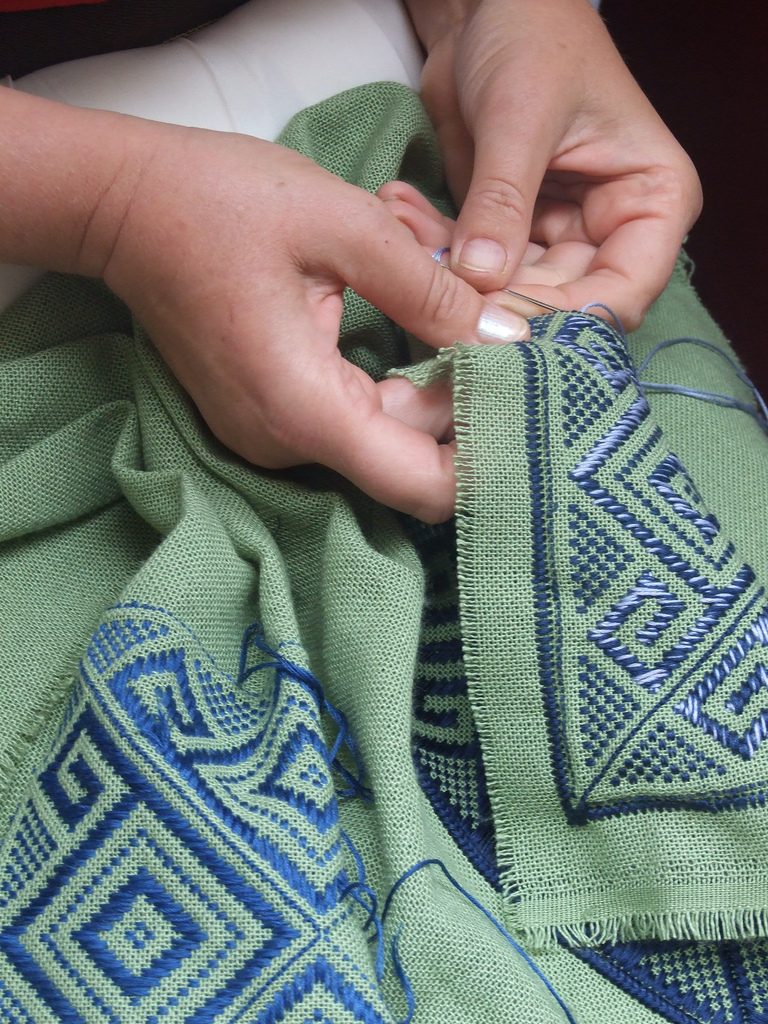
6 min read · 2 sourcesEmbroidery is the art of decorating fabric or other materials using a needle to stitch thread or yarn. It is one of the oldest forms of needlework, a type of textile art, with origins dating back thousands of years across various cultures. Common stitches found in early embroidery include the chain stitch, buttonhole or blanket stitch, running stitch, satin stitch, and cross stitch. Modern embroidery continues to utilize traditional techniques, though many contemporary stitches are exclusive to machine embroidery. Embroidery is commonly used to embellish accessories and garments and is usually seen on quilts, clothing, and accessories. In addition to thread, embroidery may incorporate materials such as pearls, beads, quills, and sequins to highlight texture and design. Today, embroidery serves both decorative and functional purposes and is utilized in fashion expression, cultural identity, and custom-made gifts. A person who is doing embroidery is called an embroiderer. An archaic term is broderer, derived from French broderie for 'embroidery'. 1
Classification
Embroidery can be classified according to what degree the design takes into account the nature of the base material and by the relationship of stitch placement to the fabric. The main categories are free or surface embroidery, counted-thread embroidery, and needlepoint or canvas work. In free or surface embroidery, designs are applied without regard to the weave of the underlying fabric. Examples include crewel and traditional Chinese and Japanese embroidery. Counted-thread embroidery patterns are created by making stitches over a predetermined number of threads in the foundation fabric. Counted-thread embroidery is more easily worked on an even-weave foundation fabric such as embroidery canvas, aida cloth, or specially woven cotton and linen fabrics. Examples include cross-stitch and some forms of blackwork embroidery. While similar to counted thread in regards to technique, in canvas work or needlepoint, threads are stitched through a fabric mesh to create a dense pattern that completely covers the foundation fabric. Examples of canvas work include bargello and Berlin wool work. Embroidery can also be classified by the similarity of its appearance. In drawn thread work and cutwork, the foundation fabric is deformed or cut away to create holes that are then embellished with embroidery, often with thread in the same color as the foundation fabric. When created with white thread on white linen or cotton, this work is collectively referred to as whitework. However, whitework can either be counted or free. Hardanger embroidery is a counted embroidery and the designs are often geometric. Conversely, styles such as Broderie anglaise are similar to free embroidery, with floral or abstract designs that are not dependent on the weave of the fabric. 1
Origins
The process used to tailor, patch, mend and reinforce cloth fostered the development of sewing techniques, and the decorative possibilities of sewing led to the art of embroidery. Indeed, the remarkable stability of basic embroidery stitches has been noted: 1
It is a striking fact that in the development of embroidery ... there are no changes of materials or techniques which can be felt or interpreted as advances from a primitive to a later, more refined stage. On the other hand, we often find in early works a technical accomplishment and high standard of craftsmanship rarely attained in later times. The art of embroidery has been found worldwide and several early examples have been found. The earliest surviving embroidered cloth comes from Egypt. The Egyptians were skilled at embroidery, using appliqué decorations with leather and beads. Works in China have been dated to the Warring States period (5th–3rd century BC). and continued to develop over subsequent dynasties, flourishing during the Song, Yuan, Ming, and Qing periods, when it became an established artistic and cultural practice. Related but distinct embroidery traditions also developed in region of Southeast Asia, such as Nonya beadwork associated with Peranakan communities. While influenced by Chinese techniques, this form reflected a unique cultural synthesis by incorporating local materials and traditions. In a garment from Migration period Sweden, roughly 300–700 AD, the edges of bands of trimming are reinforced with running stitch, back stitch, stem stitch, tailor's buttonhole stitch, and Whip stitch, but it is uncertain whether this work simply reinforced the seams or should be interpreted as decorative embroidery. 1
Historical applications and techniques
Depending on time, location and materials available, embroidery could be the domain of a few experts or a widespread, popular technique. This flexibility led to a variety of works, from the royal to the mundane. Examples of high status items include elaborately embroidered clothing, religious objects, and household items often were seen as a mark of wealth and status. In medieval England, Opus Anglicanum, a technique used by professional workshops and guilds in medieval England, was used to embellish textiles used in church rituals. In 16th century England, some books, usually bibles or other religious texts, had embroidered bindings. The Bodleian Library in Oxford contains one presented to Queen Elizabeth I in 1583. It also owns a copy of The Epistles of Saint Paul, whose cover was reputedly embroidered by the Queen. One of the oldest complete embroidered works still in existence is the Bayeux Tapestry, an embroidered cloth nearly 70 metres (230 feet) long and 50 centimetres (20 inches) tall that depicts the events leading up to the Norman Conquest of England in 1066, led by William, Duke of Normandy, challenging Harold II, King of England, and culminating in the Battle of Hastings. It is thought to date to the 11th century, within a few years of the battle. In 18th-century England and its colonies, with the rise of the merchant class and the wider availability of luxury materials, rich embroideries began to appear in a secular context. These embroideries took the form of items displayed in private homes of well-to-do citizens, as opposed to a church or royal setting. Even so, the embroideries themselves may still have had religious themes. Samplers employing fine silks were produced by the daughters of wealthy families. 1
21st century
Since the late 2010s, there has been a growth in the popularity of embroidering by hand. As a result of visual social media such as Pinterest and Instagram, artists can share their work more extensively, which has inspired younger generations to pick up needlework. Contemporary embroidery artists believe hand embroidery has grown in popularity as a result of an increasing need for relaxation and digitally disconnecting practices. 1
In literature
Embroidery portrays a large function of representation in many literary works. Hobbies in regards to stitching, dressmaking, or quilting have learned to be acquainted with women through the 18th to 19th century. 1
The text above is adapted from the Wikipedia article “Embroidery”, available under the Creative Commons Attribution-ShareAlike 4.0 licence. 1
embroidery is art or handicraft of decorating fabric or other materials with needle and thread or yarn, according to the structured record cited below. This entry was generated automatically from that record and has not yet been reviewed by a person familiar with the tradition. 2
The source record links this tradition to 54 external registers, which can be verified through the citation. 2