The tradition & historical record
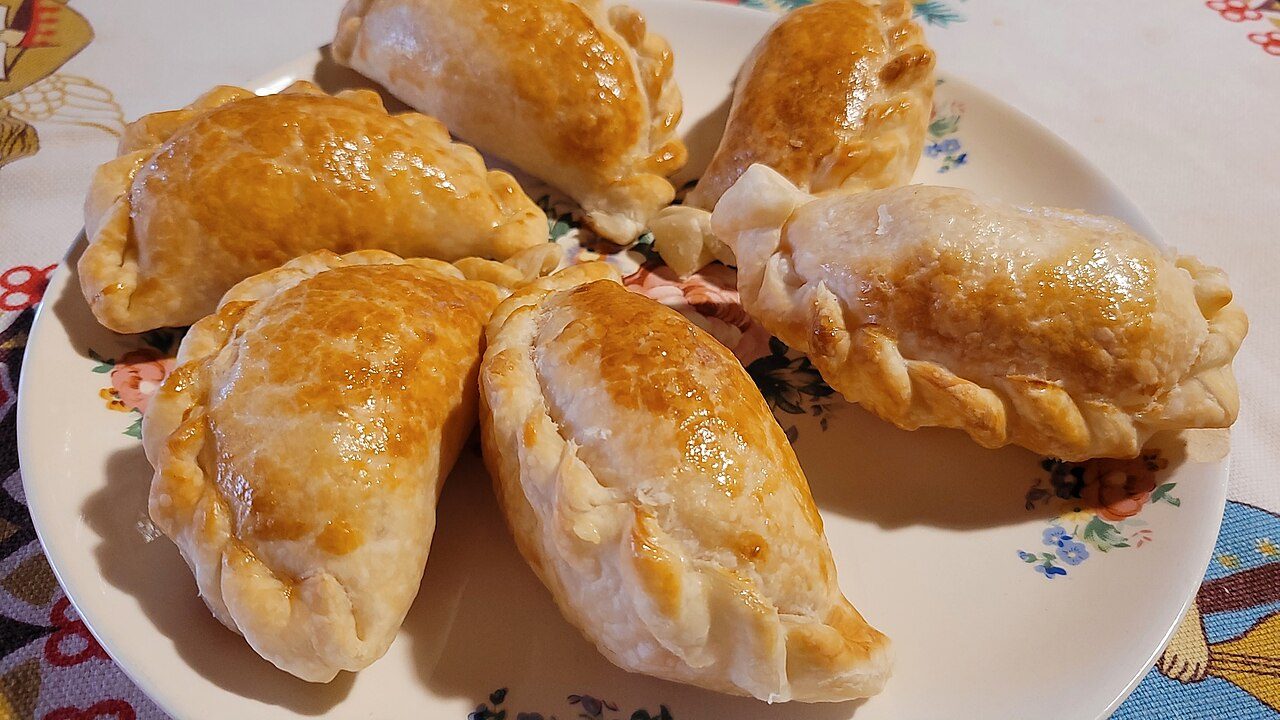
5 min read · 2 sourcesAn empanada is a type of baked or fried turnover consisting of pastry and filling, common in Spain, Portugal, other Southern European countries, North African countries, West African countries (where they are known as meat pies in Ghana and Nigeria), South Asian countries, Latin American countries, and the Philippines. The name comes from the Spanish empanar (to bread, i.e., to coat with bread), and translates as 'breaded', that is, wrapped or coated in bread. They are made by folding dough over a filling, which may consist of meat, cheese, tomato, corn, or other ingredients, and then cooking the resulting turnover, either by baking or frying. 1
Origins
The origin of empanadas not currently known, but they are thought to have originated in 7th century Galicia, a region in northwest Spain. An empanada (empãada) is mentioned in the Cantigas de Santa Maria 57:VI (c. 1282): 1
Entr' esses roubadores / viu jazer um vilão / desses mais malfeitores, / ũa perna na mão / de galinha, freame / que sacara com fame / entom dũ' empãada | que so um seu çurame/ comer quisera, / mais nom podera, / ca Deus nom queria. 1
In the midst of these robbers he saw lying there one of the most vicious of the rascals with a chicken leg in his hand. He had taken the cold morsel out of a pasty and was about to eat it under the cover of his cape. However, he could not, for God prevented it. 1
Rabbinic Jewish books from the same period, including the Novellae of Asher ben Jehiel (1250–1327), the Novellae of Yom Tov of Seville (c. 1260–1320), the Orchot Chayyim of Aaron ben Jacob (c. 1250–1325) and the Arba'ah Turim of Jacob ben Asher (c. 1270–1340) mention "inpanada" and "panada" as bread products containing fat, meat or fish on the inside. A cookbook published in Catalan in 1520, Llibre del Coch by Robert de Nola, mentions empanadas filled with seafood in the recipes for Catalan, Italian, French, and Arabian food. 1
Argentina
Argentine empanadas are often served during parties and festivals as a starter or main course. Shops specialize in freshly made empanadas, with many flavors and fillings. Every region of Argentina has its own characteristic variant. Those of Salta (salteñas) are small, juicy and spicy, and contain potatoes, peppers and ground chili. These are also popular in neighbouring Bolivia. The Jujuy variant adds peas and garlic. Its filling is called recado and the repulgue (method of closing the empanada) simbado. The La Rioja variant includes hard-boiled egg, red bell pepper, olives, and raisins. In Jujuy, there are two variants: criollas and arabes. Those of Santiago are considered especially juicy. Those of Catamarca are similar but smaller. Tucumán is known for the empanada creole; an annual National Empanada festival is held in Famaillá. Those of Famaillá are made with matambre and fried in good fat, competing with the entreveradas (mixed-grated), in which the matambre is mixed with chicken breast, garlic, ground chili, hard-boiled egg and cumin. Those of Mendoza are large and include olives and garlic. Those of San Juan have a higher proportion of onion, making them juicier and slightly sweet. Olives are also common and sometimes fat is also added to the recado or the dough. In San Luis they are big, seasoned with oregano and hot pepper, and kneaded with pork fat. In Córdoba, there is a version "Pastel Federal" "federal cake" or empanadas de Misia Manuelita. These are famous because pears boiled in wine with cloves were added to their filling. Today they are not so sweet but it is tradition to sprinkle them with sugar. In Traslasierra they add carrots and potatoes. 1
Belize
In Belize, empanadas are known as panades. They are made with masa (corn dough) and typically stuffed with fish, chicken, or beans. They are usually deep-fried and served with a cabbage or salsa topping. Panades are frequently sold as street food. 1
Brazil
In Brazil, a pastel (pl.: pastéis) consists of half-circle or rectangle-shaped thin-crust pies with assorted fillings, fried in vegetable oil. The result is a crispy, brownish fried pie. The most common fillings are ground meat, mozzarella, Catupiry, heart of palm, codfish, cream cheese, chicken and small shrimp. Pastéis with sweet fillings such as guava paste with Minas cheese, banana and chocolate also exist. 1
Chile
Traditional Chilean styles include empanada de pino "fritas"(fried) or de horno(baked), filled with seasoned ground beef, onions, olives, raisins, and hard-boiled eggs and cooked in an oven, and cheese-filled empanadas with crimped edges which are deep-fried. There are several other flavors and fillings, like shrimps and cheese, crab and cheese, neopolitan, spider crab and cheese, seafood, etc 1
The text above is adapted from the Wikipedia article “Empanada”, available under the Creative Commons Attribution-ShareAlike 4.0 licence. 1
empanada is baked or fried turnover consisting of pastry and filling, according to the structured record cited below. This entry was generated automatically from that record and has not yet been reviewed by a person familiar with the tradition. 2
The source record links this tradition to 14 external registers, which can be verified through the citation. 2