The tradition & historical record
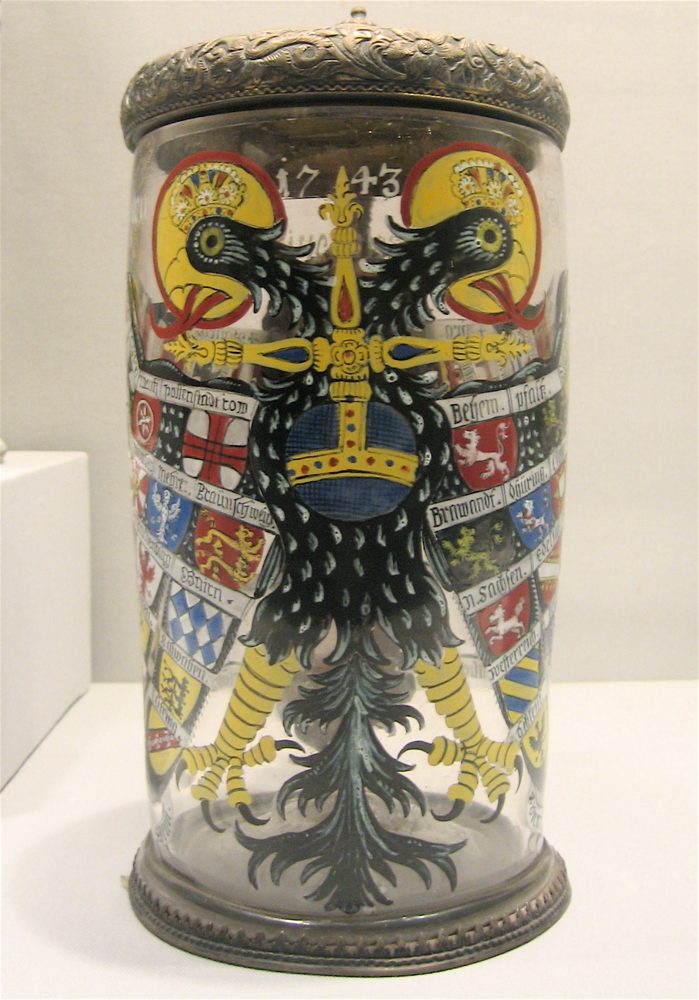
7 min read · 2 sourcesEnamelled glass or painted glass is glass which has been decorated with vitreous enamel (powdered glass, usually mixed with a binder) and then fired to fuse the glasses. It can produce brilliant and long-lasting colours, and be translucent or opaque. Unlike most methods of decorating glass, it allows painting using several colours, and along with glass engraving, has historically been the main technique used to create the full range of image types on glass. All proper uses of the term "enamel" refer to glass made into some flexible form, put into place on an object in another material, and then melted by heat to fuse them with the object. It is called vitreous enamel or just "enamel" when used on metal surfaces, and "enamelled" overglaze decoration when on pottery, especially on porcelain. Here the supporting surface is glass. All three versions of the technique have been used to make brush-painted images, which on glass and pottery are the normal use of the technique. Enamelled glass is only one of the techniques used in luxury glass, and at least until the Early Modern period it appears in each of the leading centres of this extravagant branch of the decorative arts, although it has tended to fall from fashion after two centuries or so. 1
Techniques
Glass is enamelled by mixing powdered glass, either already coloured (more usual) or clear glass mixed with the pigments, with a binder such as gum arabic that gives a thick liquid texture allowing it to be painted with brushes. Generally the desired colours only appear when the piece is fired, adding to the artist's difficulties. As with enamel on metal, gum tragacanth may be used to make sharp boundaries to the painted areas. The paint is applied to the vessel, which has already been fully formed; this is called the "blank" . Once painted, the enamelled glass vessel needs to be fired at a temperature high enough to melt the applied powder, but low enough that the vessel itself is only "softened" sufficiently to fuse the enamel with the glass surface, but not enough to deform or melt the original shape (unless this is desired, as it may be). The binding and demarcating substances burn away. Until recent centuries the enamel firing was done holding the vessel in a furnace on a pontil (long iron rod), with the glassmaker paying careful attention to any changes in the shape. Many pieces show two pontil marks on the base, where the pontil intruded on the glass, showing it had been on the furnace twice, before and after the enamels were applied. Modern techniques, in use since the 19th century, use enamels with a lower melting point, enabling the second firing to be done more conveniently in a kiln. 1
In fact some glassmakers allowed for a deforming effect in the second firing, which lowered and widened the shape of the vessel, sometimes very greatly, by making blanks that were taller and narrower than the shape they actually wanted. 1
Ancient
The history of enamelled glass begins in ancient Egypt not long after the start of making glass vessels (as opposed to objects such as beads) around 1500 BC, and some 1400 years before the invention of glassblowing. A vase or jug, probably for perfumed oil, found in the tomb of the pharaoh Tutmose III and now in the British Museum dates to about 1425 BC. The base glass is blue, and it has geometrical decoration in yellow and white enamels; it is 8.7 cm high. However, and rather "incredibly", this is the only known enamelled glass piece from before (about) the first century AD. Enamel was used to decorate glass vessels during the Roman period, and there is evidence of this as early as the late Republican and early Imperial periods in the Levant, Egypt, Britain and around the Black Sea. Designs were either painted freehand or over the top of outline incisions, and the technique probably originated in metalworking. Production is thought to have come to a peak in the Claudian period and persisted for some three hundred years, though archaeological evidence for this technique is limited to some forty vessels or vessel fragments. Among a variety of pieces, many perhaps fall into two broad groups: tall, clear drinking glasses painted with scenes of sex (from mythology) or violence (hunting, gladiators), and then low bowls, some of coloured glass, painted with birds and flowers. This latter group appear to date to about 20–70 AD, and findspots are widely distributed across the empire, indeed many are found beyond its borders; they may have been made in north Italy or Syria. The largest group of survivals comes from the Begram Hoard, found in Afghanistan, a deposit of various luxury items in storerooms, probably dating to the 1st century AD, or perhaps later. 1
Byzantine
After about the 3rd century Greco-Roman enamelled glass disappears, and there is another long gap in the history of the technique. This is ended in spectacular fashion by a 10th or 11th-century Byzantine bowl in the Treasury of Saint Mark's, Venice. This is of very high quality and shows great confidence in using the technique, which had no doubt been reborrowed from enamel on metal, although Byzantine enamel uses brush painting very little. Some other, technically similar works, one possibly from the same workshop, are also extant. 1
Islamic
There is little surviving Byzantine enamelled glass, but enamel was much used for jewellery and religious objects, and appears again on Islamic glass of the Mamluk Empire from the 13th century onwards, used for mosque lamps in particular, but also various types of bowls and drinking glasses. Gilding is often combined with enamels. The painted decoration was generally abstract, or inscriptions, but sometimes included figures. The places of manufacture are generally assumed to have been in Egypt or Syria, with any more precise locating tentative and somewhat controversial. Enamels used oil-based medium and a brush or reed pen, and the physical properties of the medium encouraged inscriptions, which are useful for determining dates and authorship. According to Carl Johan Lamm, whose two-volume book on Islamic glass (Mittelalterliche Glaser und Steinschnittarbeiten aus dem Nahen Osten, Berlin, 1929/30) has long been the standard work, the main centres, each with its own style, were in turn Raqqa (1170–1270), Aleppo (13th century), Damascus (1250–1310) and Fustat (Cairo, 1270–1340). However this chronology has been disputed in recent years, tending to push dates later, and rearranging the locations. In particular there is disagreement as to whether elaborate pieces with figural decoration are early or late, effectively 13th or 14th century, with Rachel Ward arguing for the later dates. The shape of mosque lamps in this period is very standard; despite being suspended in the air through their lugs when in use, they have a broad foot, a rounded central body, and a wide flaring mouth. Filled with oil, they lit not only mosques, but also similar spaces such as madrassas and mausoleums. 1
Western Europe
It is now known that the technique was b… 1
The text above is adapted from the Wikipedia article “Enamelled glass”, available under the Creative Commons Attribution-ShareAlike 4.0 licence. 1
enamelled glass is glass which has been decorated with vitreous enamel, according to the structured record cited below. This entry was generated automatically from that record and has not yet been reviewed by a person familiar with the tradition. 2
The source record links this tradition to 2 external registers, which can be verified through the citation. 2