The tradition & historical record
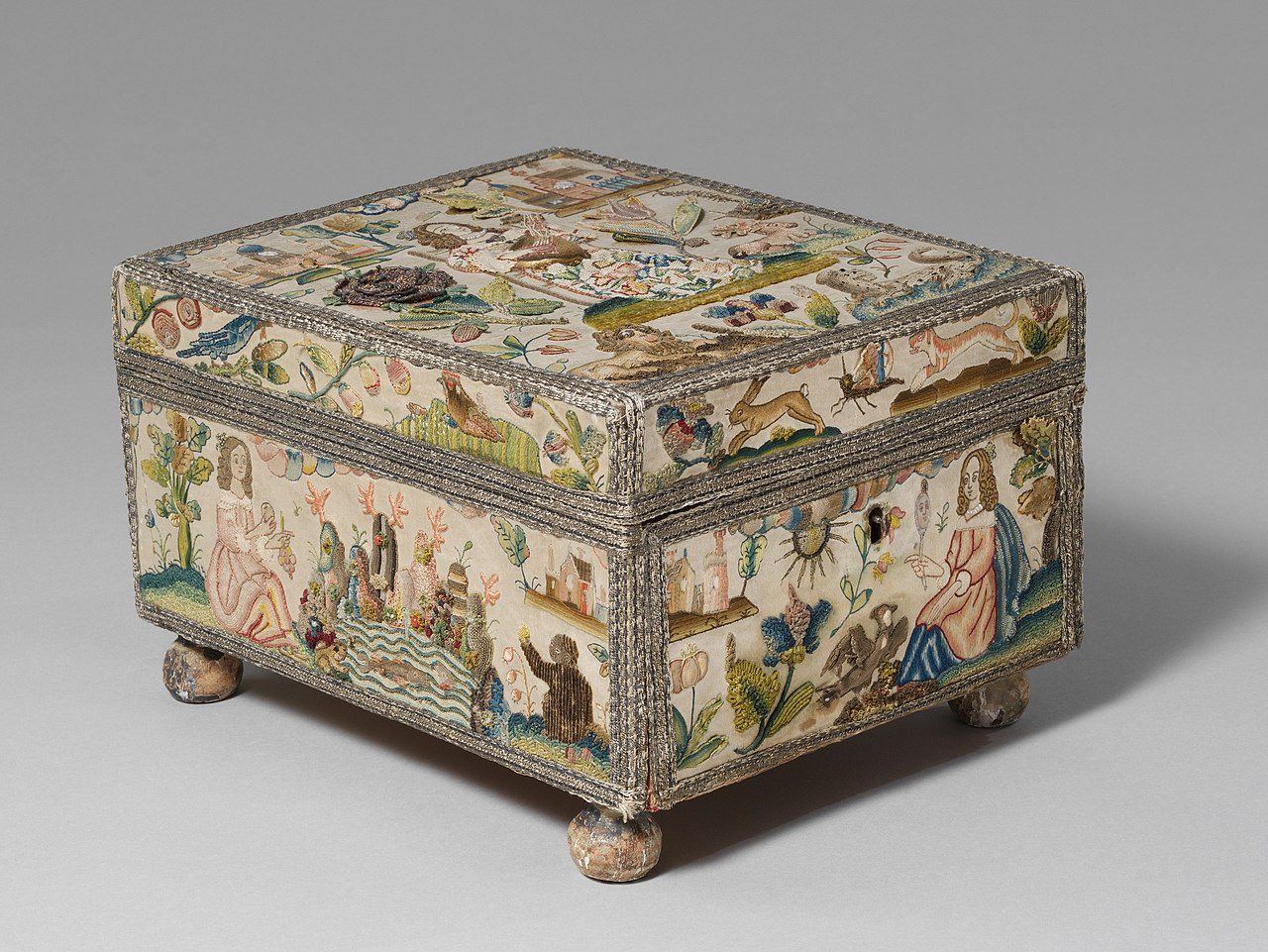
6 min read · 2 sourcesEnglish embroidery includes embroidery worked in England or by English people abroad from Anglo-Saxon times to the present day. The oldest surviving English embroideries include items from the early 10th century preserved in Durham Cathedral and the 11th century Bayeux Tapestry, if it was worked in England. The professional workshops of Medieval England created rich embroidery in metal thread and silk for ecclesiastical and secular uses. This style was called Opus Anglicanum or "English work", and was famous throughout Europe. With the Protestant Reformation of the 16th century, the focus of English embroidery increasingly turned to clothing and household furnishings, leading to another great flowering of English domestic embroidery in the Elizabethan and Jacobean eras. The end of this period saw the rise of the formal sampler as a record of the amateur stitcher's skills. Curious fashions of the mid-17th century were raised work or stumpwork, a pictorial style featuring detached and padded elements, and crewel work, featuring exotic leaf motifs worked in wool yarn. Canvaswork, in which thread is stitched through a foundation fabric, and surface embroidery, in which the majority of the thread sits on top of the fabric, exist side-by-side in the English tradition, coming in and out of fashion over the years. 1
Anglo-Saxon
Little physical evidence survives to reconstruct the early development of English embroidery before the Norman Conquest of 1066. Stitches reinforcing the seams of a garment in the Sutton Hoo ship burial may have been intended as decoration, and so be classed as embroidery, and fragments of a scrolling border worked in stem stitch were recovered from a grave in Kempston, Bedfordshire. Some embroidered pieces of about 850 preserved in Maaseik, Belgium, are generally assumed to be Anglo-Saxon work based on their similarity to contemporary manuscript illustrations and sculptures of animals and interlace. The documentary evidence is rather richer than the physical remains. Part of the reason for both these facts is the taste among the late Anglo-Saxon elite for embroidering using lavish amounts of precious metal thread, especially gold, which both gave items a magnificence and expense worth recording, and meant that they were well worth burning to recover the bullion. Three old vestments, almost certainly Anglo-Saxon, recycled in this way at Canterbury Cathedral in the 1370s, produced over £250 of gold – a huge amount. Richly embroidered hangings were used in both churches and the houses of the rich, but vestments were the most richly embellished of all, of a "particularly English" richness. Most of these were sent back to Normandy or burnt for their metal after the Norman Conquest. An image of part of a huge gold acanthus flower on the back of a gold-bordered chasuble, almost certainly depicting a specific real vestment, can be seen in the Benedictional of St. Æthelwold (fol. 1
Opus Anglicanum
The Anglo-Saxon embroidery style combining split stitch and couching with silk and goldwork in gold or silver-gilt thread of the Durham examples flowered from the 12th to the 14th centuries into a style known to contemporaries as Opus Anglicanum or "English work". Opus Anglicanum was made for both ecclesiastical and secular use on clothing, hangings, and other textiles. It was usually worked on linen or dark silks, or later, worked as individual motifs on linen and applied to velvet. Throughout this period, the designs of embroidery paralleled fashions in manuscript illumination and architecture. Work of this period often featured continuous light scrolls and spirals with or without foliations, in addition to figures of kings and saints in geometrical frames or Gothic arches. Opus Anglicanum was famous throughout Europe. A "Gregory of London" was working in Rome as a gold-embroiderer to Pope Alexander IV in 1263, and the Vatican inventory in Rome of 1295 records well over 100 pieces of English work. Notable surviving examples of Opus Anglicanum are two copes in the Victoria and Albert Museum: the Syon Cope of 1310-1320, and the Butler-Bowdon Cope of 1330–50, embroidered with silver and silver-gilt thread and coloured silks on silk velvet. 1
Professional embroiderers
By the 13th century, most English goldwork was made in London workshops, which produced ecclesiastical work, clothing and furnishings for royalty and the nobility, heraldic banners and horse-trappings, and the ceremonial regalia for the great livery companies of the City of London and for the court. The founding of the embroiderer's guild in London is attributed to the 14th century or earlier, but its early documents were lost in the Great Fire of London in the 17th century. An indenture of 23 March 1515 records the establishment of Broderers' Hall in Cutter Lane in that year, and the guild was officially incorporated (or reincorporated) by royal charter under Elizabeth I in 1561 as the Worshipful Company of Broderers. Professional embroiderers were also attached to the great households of England, but it is unlikely that those working far from London were members of the Company. From the middle of the 14th century, money that had previously been spent on luxury goods like lavish embroidery was redirected to military expenditure, and imported Italian figured silks competed with native embroidery traditions. Varieties of design in textiles succeeded each other very rapidly, and they were more readily available than the more leisurely produced needlework. The work produced by the London workshops was simplified to meet the demands of this deteriorating market. The new techniques required less work and smaller quantities of expensive materials. Surface couching replaced underside couching, and allover embroidery was replaced by individual motifs worked on linen and then applied to figured silks or silk velvets. 1
Renaissance to Restoration
The second great flowering of English embroidery, after Opus Anglicanum, took place in the reign of Elizabeth I. Although the majority of surviving English embroidery from the medieval period was intended for church use, this demand decreased radically with the Protestant Reformation. In contrast, the bulk of the surviving embroidery of the Tudor, Elizabethan, and Jacobean eras is for domestic use, whether for clothing or household decoration. The stable society that existed between the accession of Elizabeth in 1558 and the English Civil War encouraged the building and furnishing of new houses, in which rich textiles played a part. Some embroidery was imported in this period, including the canvas work bed valances once thought to be English but now attributed to France, but the majority of work was made in England—and increasingly, by skilled amateurs, mostly women, working domestically, to designs by professional men and women, and later to published pattern books. 1
Tudor and Jacobean styles
A general taste for abundant surface ornamentation is reflected in both household furnishings and in fashionable court clothing from the mid-16th century through the reign of Ja… 1
The text above is adapted from the Wikipedia article “English embroidery”, available under the Creative Commons Attribution-ShareAlike 4.0 licence. 1
English embroidery is embroidery worked in England or by English people abroad, according to the structured record cited below. This entry was generated automatically from that record and has not yet been reviewed by a person familiar with the tradition. 2
The source record links this tradition to 2 external registers, which can be verified through the citation. 2