The tradition & historical record
6 min read · 2 sourcesThe Epic of Gilgamesh () is an epic from ancient Mesopotamia that is the world's oldest surviving example of narrative literature. The literary history of Gilgamesh begins with five Sumerian poems about Gilgamesh, king of Uruk, some of which may date to the Third Dynasty of Ur (c. 2100 BCE). These independent stories were later used as source material for a combined epic in Akkadian. The first surviving version of this combined epic, known as the "Old Babylonian" version, dates to the 18th century BCE and is titled after its incipit, Shūtur eli sharrī ("Surpassing All Other Kings"). Only a few tablets of it have survived. The later Standard Babylonian version compiled by Sîn-lēqi-unninni dates to somewhere between the 13th and 10th centuries BCE and bears the incipit Sha naqba īmuru ("He Who Saw the Deep(s)", lit. "He Who Sees the Unknown"). About two-thirds of this longer, 12-tablet version have been recovered. Some of the best copies were discovered in the library ruins of the 7th-century BCE Assyrian King Ashurbanipal. The first part of the story discusses Gilgamesh, king of Uruk, and Enkidu, a wild man created by the gods to stop Gilgamesh from oppressing his people. After Enkidu becomes civilized through sexual initiation with Shamhat, he travels to Uruk, where he challenges Gilgamesh to a test of strength. Gilgamesh wins the contest; nonetheless, the two become friends. 1
Discovery
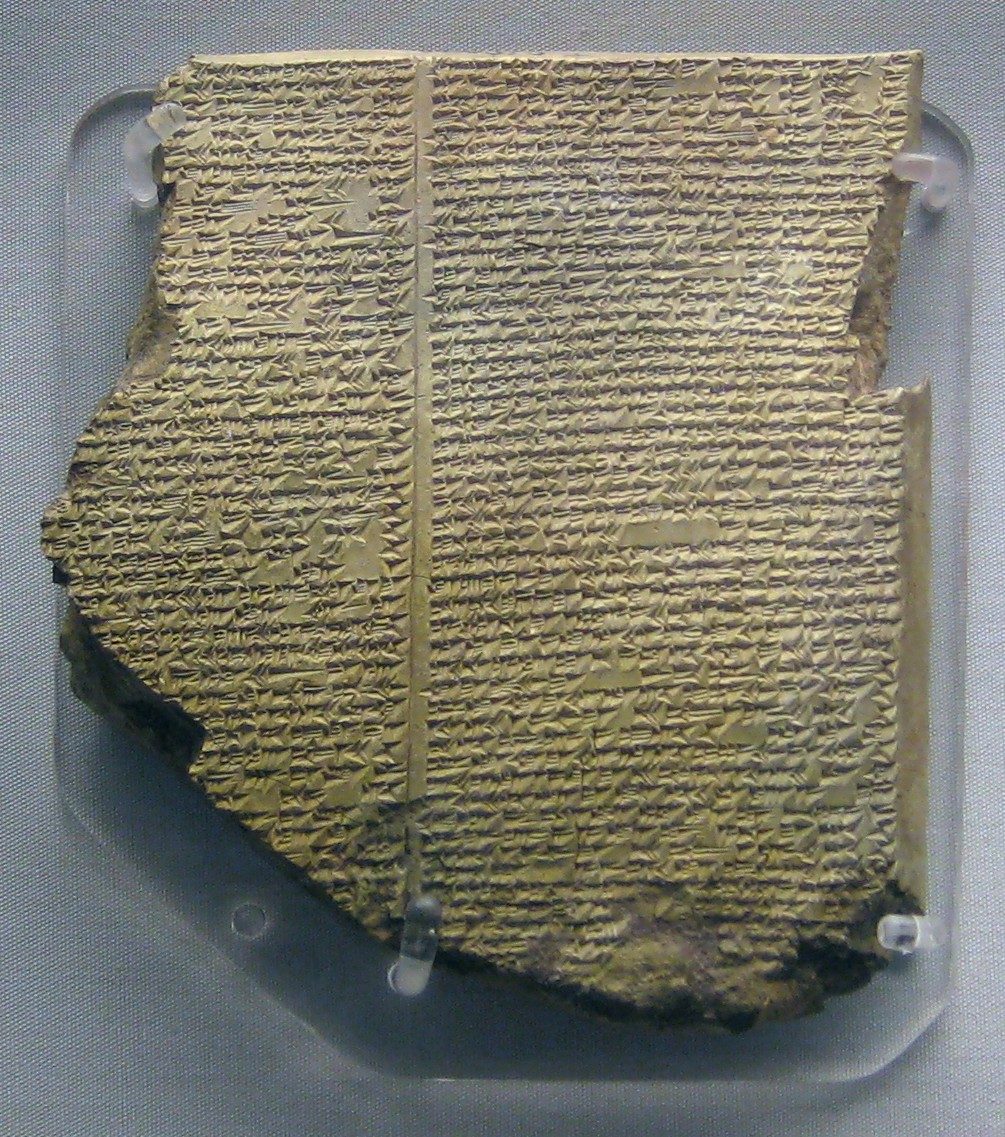
About 15,000 fragments of Assyrian cuneiform tablets were discovered in the Library of Ashurbanipal in Nineveh by Austen Henry Layard, his assistant Hormuzd Rassam, and W. K. Loftus in the early 1850s. Late in the following decade, the British Museum hired George Smith to study them. In 1872, Smith read translated fragments before the Society of Biblical Archaeology, and in 1875 and 1876 he published fuller translations, the latter of which was published as The Chaldaean Account of Genesis. The central character of Gilgamesh was initially reintroduced to the world as "Izdubar", before the cuneiform logographs in his name could be pronounced accurately. In 1891, Paul Haupt collected the cuneiform text, and nine years later, orientalist Peter Jensen provided a comprehensive edition; R. Campbell Thompson updated both of their work in 1930. Over the next two decades, Samuel Noah Kramer reassembled the Sumerian poems. In 1998, American Assyriologist Theodore Kwasman discovered a piece believed to have contained the first lines of the epic in the storeroom of the British Museum. The fragment, found in 1878 and dated to between 600 BCE and 100 BCE, had remained unexamined by experts for more than a century since its recovery. The fragment read "He who saw all, who was the foundation of the land, who knew (everything), was wise in all matters: Gilgamesh." The discovery of artifacts (c. 2600 BCE) associated with Enmebaragesi of Kish, mentioned in the legends as the father of one of Gilgamesh's adversaries, has lent credibility to the historical existence of Gilgamesh. In the early 2000s, the Gilgamesh Dream Tablet was imported illegally into the United States. 1
Versions
Distinct sources exist from over a 2,000-year timeframe. The earliest Sumerian poems are now generally considered to be distinct stories, rather than parts of a single epic. Some of these may date back to as early as the Third Dynasty of Ur (c. 2100 BCE). The Old Babylonian tablets (c. 1800 BCE) are the earliest surviving tablets for a single Epic of Gilgamesh narrative. The older Old Babylonian tablets and later Akkadian version are important sources for modern translations, with the earlier texts mainly used to fill in gaps (lacunae) in the later texts. Although several revised versions based on new discoveries have been published, the epic remains incomplete. Analysis of the Old Babylonian text has been used to reconstruct possible earlier forms of the epic. The most recent Akkadian version, also referred to as the Standard Babylonian version, consists of twelve tablets and was edited by Sîn-lēqi-unninni, who is thought to have lived sometime between 1300 BCE and 1000 BCE. From the diverse sources found, two main versions of the epic have been partially reconstructed: the Standard Babylonian version, or He who saw the deep, and the Old Babylonian version, or Surpassing all other kings. Five earlier Sumerian poems about Gilgamesh have been partially recovered, some with primitive versions of specific episodes in the Babylonian version, others with unrelated stories. 1
Standard Babylonian version
The Standard Babylonian version was discovered by Hormuzd Rassam in the library of Ashurbanipal in Nineveh in 1853. "Standard Babylonian" refers to a literary style that was used for literary purposes. This version was compiled by Sin-leqi-unninni sometime between 1300 and 1000 BCE from earlier texts. One impact that Sin-leqi-unninni brought to the work was to bring the issue of mortality to the foreground, thus making it possible for the character to move from being an "adventurer to a wise man." The Brazilian scholar Lins Brandão saw the standard version can be seen in this sense as "sapiential literature," ("wisdom literature"), which is common in the Middle East, but this idea has not been widely accepted. 1
The Standard Babylonian version has different opening words, or incipit, from the older version. The older version begins with the words "Surpassing all other kings", while the Standard Babylonian version has "He who saw the deep" (ša naqba īmuru), "deep" referring to the mysteries of the information brought back by Gilgamesh from his meeting with Uta-Napishti (Utnapishtim) about Ea, the fountain of wisdom. Gilgamesh was given knowledge of how to worship the gods, why death was ordained for human beings, what makes a good king, and how to live a good life. The story of Utnapishtim, the hero of the flood myth, can also be found in the Babylonian epic of Atra-Hasis. The Standard version is also known as iškar Gilgāmeš, "Series of Gilgamesh". The 12th tablet is a sequel to the original 11, and was probably appended at a later date. It bears little relation to the well-crafted 11-tablet epic; the lines at the beginning of the first tablet are quoted at the end of the 11th tablet, giving it circularity and finality. 1
Genre
When it was discovered in the 19th century, the story of Gilgamesh was classified as a Greek epic, a genre known in Europe, even though it predates the Greek culture that spawned epics, specifically, when Herodotus referred to the works of Homer in this way. When Alfred Jeremias translated the text, he insisted on the relationship to Genesis by giving the title "Izdubar-Nimrod" and by recognizing the genre as that of Greek heroic poetry. Although the relationship to Nimrod was dropped, the view of "Greek epic" was retained. 1
Content of the Standard Babylonian version tablets
This summary is based on Andrew George's translation. 1
The text above is adapted from the Wikipedia article “Epic of Gilgamesh”, available under the Creative Commons Attribution-ShareAlike 4.0 licence. 1
Epic of Gilgamesh is epic poem from Mesopotamia, is amongst the earliest surviving works of literature, according to the structured record cited below. This entry was generated automatically from that record and has not yet been reviewed by a person familiar with the tradition. 2
The source record links this tradition to 41 external registers, which can be verified through the citation. 2