The tradition & historical record
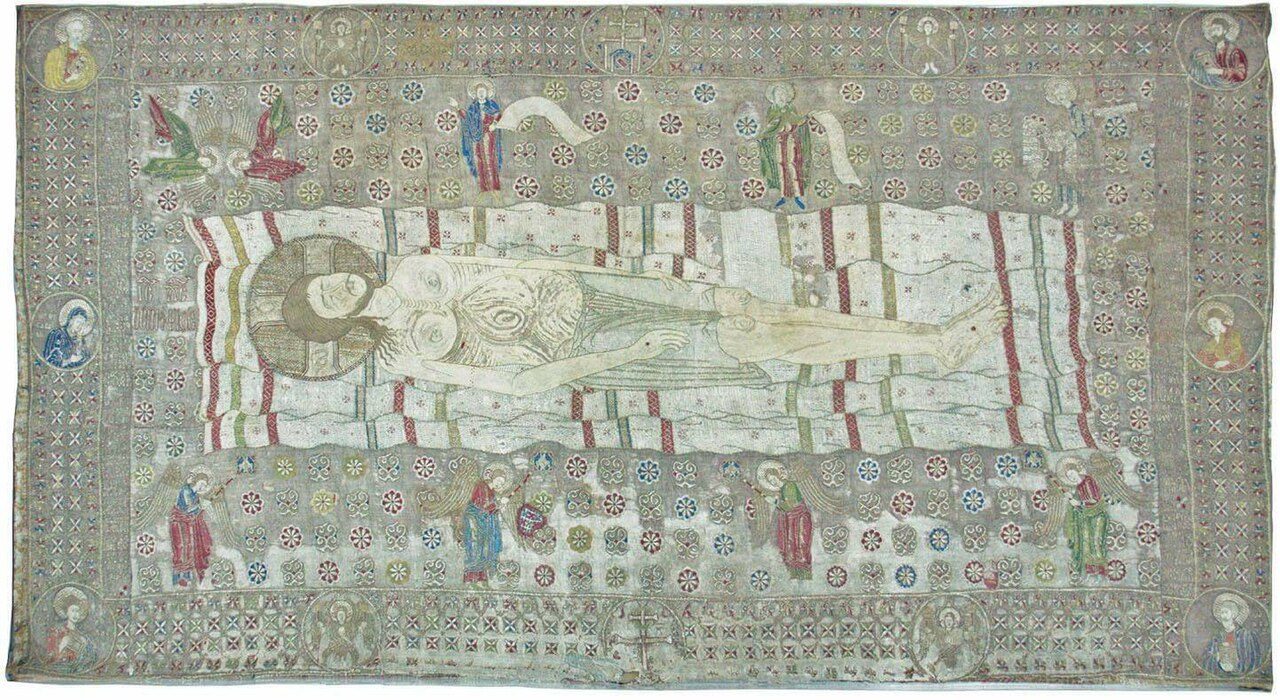
6 min read · 2 sourcesThe Epitaph of Gllavenica (Albanian: Epitafi I Gllavenicës) is a medieval embroidered liturgical cloth, created on March 22, 1373, in the town of Gllavenica (modern Ballsh, Albania). It is a rare and valuable example of Albanian Orthodox religious art from the late Byzantine period. The epitaph depicts Christ lying on a burial shroud, surrounded by mourning figures and biblical prophets, embroidered in silk with silver-gilt threads and vibrant natural dyes. Commissioned by Bishop Kalist and the Albanian noble Gjergj Arianiti, and embroidered by Monk Savia, the epitaph is a prime example of medieval Albanian religious art. It was rediscovered near Ballsh and is now preserved in the National History Museum in Tirana. 1
History
The Epitaph of Gllavenica was created on March 22, 1373, in the town of Gllavenica (modern Ballsh, Albania). It was commissioned by the Albanian noble Gjergj Arianiti and Bishop Kalist of Gllavenica and Berat, and crafted by Monk Savia. The cloth was created as a liturgical textile for Orthodox Good Friday ceremonies, depicting Christ’s burial with rich iconography embroidered in silk and silver-gilt thread. Originally, the epitaph belonged to the church of Gllavenica in Ballsh, a significant medieval ecclesiastical center. According to local oral tradition, supported by scholar Theofan Popa, during the period of Bulgarian occupation of Albania, the bishops of Gllavenica-specifically Gorazhd and Angelar- were active in the area. Their relics, along with the epitaph, were moved from the Church of Gllavenica in Ballsh to the Church of the Dormition of the Virgin located inside Berat Castle for protection. The transfer was motivated by the decline of the church in Ballsh and the need to safeguard sacred objects. In addition to the epitaph and relics, other ecclesiastical items such as liturgical books and parchments were part of this relocation. Initially, monks from the monastery moved these objects to the Monastery of Saint George in the village of Mbreshtan near Berat. However, during the Ottoman period, after the Islamization of Mbreshtan, the holy relics and the epitaph were brought back to the Church of the Dormition in Berat Castle, where they have remained safeguarded. The relics of Gorazhd and Angelar still remain in the Cathedral of Saint Mary in Berat today, accompanied by icons and a Greek-written service honoring the saints. The veneration of these relics was significant for the local faithful, who regarded the saints as protectors of the city. 1
Rediscovery and conservation
The Epitaph of Gllavenica was rediscovered in the mid-20th century in the cellar of a ruined house near Ballsh, where it had been folded and damaged by rodents and environmental factors. The researcher Theofan Popa was instrumental in its early study and gave the artifact its name based on Bishop Kalist’s ecclesiastical title linking it to the church of Gllavenica. Restoration efforts began in 1974 under conservator Frederik Stamati, who treated stains from wax, soot, and damage caused by candles, smoke, and handling. That same year, the epitaph was exhibited internationally at the Petit Palais in Paris, where Byzantinist André Grabar described it as the third of its kind in Europe. In 1980, following the opening of the Museum of Medieval Art in Korçë, concerned citizens of Berat, aware of their own valuable objects, proposed establishing a medieval museum in Berat. During a visit by leader Ramiz Alia, locals revealed that the epitaph was being stored improperly—wrapped and placed inside a chest. Recognizing the poor conditions, Alia ordered the epitaph to be transferred to Tirana for better preservation. In 1981, the Epitaph of Gllavenica underwent a more extensive phase of conservation to prepare it for exhibition at the newly established National Historical Museum in Tirana. Conservators cleaned layers of soot that had built up over centuries and removed old fabric patches that had been added to its surface. The textile was then carefully mounted on a wooden board and sealed beneath a layer of transparent plexiglass. 1
Iconography and inscription
The central image of the Epitaph of Gllavenica depicts Christ laid out in the tomb, measuring approximately 126 by 23 cm. His halo bears Greek letters, which means "He Who Is," symbolizing divinity and eternal existence. The halo’s diameter is about 24.5 cm. The wounds of the Crucifixion are clearly visible on Christ’s hands and feet, along with blood marks on his ribs. Above Christ’s head stands the Virgin Mary, shown mourning her deceased son, with a height of about 13.5 cm. At Christ’s feet is John the Theologian, also depicted as a young man, similarly mourning and leaning on his hand in sorrow. The epitaph is embroidered on a rectangular fabric framed by a 14 cm wide border decorated with parallel rows of crosses arranged in pairs. At each corner of the cloth are the Four Evangelists—Matthew, Luke, Mark, and John-symbolizing the Gospels. Within the frame, alongside the Virgin Mary and John the Theologian, is the emblematic cross of Bishop Kalist of Gllavenica. The upper portion features prominent biblical figures such as the prophets Moses and Isaiah, and Joseph of Arimathea, each with their respective symbolic dimensions. The epitaph features an embroidered inscription in Byzantine Greek, positioned on two vertical columns near Christ’s head and feet. This inscription dates the work precisely to March 22, 1373 (Byzantine year 6881) and credits Bishop Kalist of Gllavenica and Berati for commissioning the piece. 1
Theft and recovery
On February 3, 1994, the Epitaph of Gllavenica was stolen from the National Historical Museum in Tirana during a break-in by four individuals who had secretly remained in the building after hours. Along with the epitaph, several other valuable artifacts were taken, including icons and historical furnishings. The theft was discovered the following day by museum staff, who promptly notified authorities. Months later, on October 10, 1994, police apprehended Aleksandër Soto in connection with the crime. During the arrest, he attempted to discard one of the stolen icons by throwing it out a window, causing irreparable damage. In a court appearance, Soto admitted the group had intended to sell the artifacts and claimed they were unaware of the epitaph’s cultural significance at the time. After a lengthy investigation, the stolen items—including the Epitaph of Gllavenica-were recovered and officially returned to the museum on October 17, 1996, during a public ceremony led by museum officials. 1
The text above is adapted from the Wikipedia article “Epitaph of Gllavenica”, available under the Creative Commons Attribution-ShareAlike 4.0 licence. 1
Epitaph of Gllavenica is 14th-century epitaph, according to the structured record cited below. This entry was generated automatically from that record and has not yet been reviewed by a person familiar with the tradition. 2
The source record links this tradition to 1 external register, which can be verified through the citation. 2