The tradition & historical record
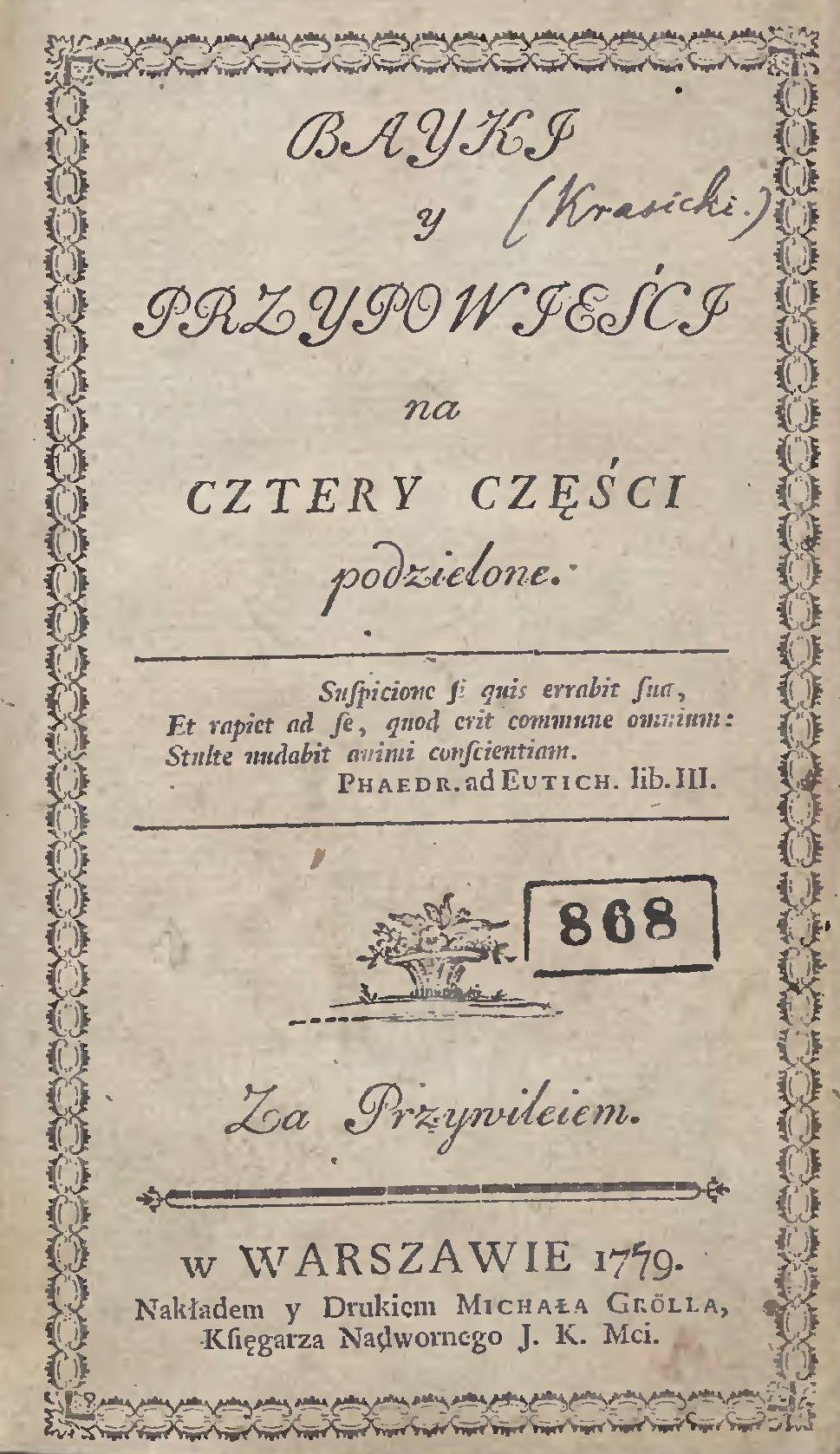
4 min read · 2 sourcesFables and Parables (Bajki i przypowieści, 1779), by Ignacy Krasicki (1735–1801), is a work in a long international tradition of fable-writing that reaches back to antiquity. Krasicki's fables and parables have been described as being, "[l]ike Jean de La Fontaine's [fables],... amongst the best ever written, while in colour they are distinctly original, because Polish." They are, according to Czesław Miłosz, "the most durable among Krasicki's poems." 1
Characteristics
Emulating the fables of the ancient Greek Aesop, the Macedonian-Roman Phaedrus, the Polish Biernat of Lublin, and the Frenchman Jean de La Fontaine, and anticipating Russia's Ivan Krylov, Poland's Krasicki populates his fables with anthropomorphized animals, plants, inanimate objects, and forces of nature, in epigrammatic expressions of a skeptical, ironic view of the world. That view is informed by Krasicki's observations of human nature and of national and international politics in his day—including the predicament of the expiring Polish–Lithuanian Commonwealth. Just seven years earlier (1772), the Commonwealth had experienced the first of three partitions that would, by 1795, totally expunge the Commonwealth from the political map of Europe. The Polish–Lithuanian Commonwealth would fall victim to the aggression of three powerful neighbors much as, in Krasicki's fable of "The Lamb and the Wolves," the lamb falls prey to the two wolves. The First Partition had rendered Krasicki—an intimate of Poland's last king, Stanisław August Poniatowski—involuntarily a subject of that Partition's instigator, Prussia's King Frederick II ("the Great"). Krasicki would, unlike Frederick, survive to witness the final dismemberment of the Commonwealth. Krasicki's parables (e.g., "Abuzei and Tair," "The Blind Man and the Lame," "Son and Father," "The Farmer," "Child and Father," "The Master and His Dog," "The King and the Scribes," and "The Drunkard") do not, by definition, employ the anthropomorphization that characterizes the fables. Instead, his parables point elegant moral lessons drawn from more quotidian human life. Krasicki's, writes Czesław Miłosz, "is a world where the strong win and the weak lose in a sort of immutable order... 1
Samples
Below are 20 samples from Krasicki's Fables and Parables (1779), in English translation by Christopher Kasparek. An additional 42 items may be found at Wikisource. The total of 62 items constitute 52% of the 119 in Krasicki's Fables and Parables. 1
Preface to the Fables
There was once a young man whose temperance never flagged; There was an old man, too, who never scolded or nagged; There was a rich man who shared his wealth with the needy; There flourished an author, for renown never greedy; There was a customs man who did not steal; a cobbler who shunned alcohol; A soldier who did not boast; a rogue who did not brawl; There was a politician who never thought of self; There was a poet who never put lies on his shelf. 1
"Why do you tell me that each of these is a fable?" "I hate to gainsay you, but that's the proper label." 1
Abuzei and Tair
"Congratulate me, father," said Tair, "I prosper. Tomorrow I am to become the Sultan's brother- In-law and hunt with him." Quoth father: "All does alter, Your lord's good graces, women's favor, autumn weather." He had guessed aright, the son's plans did not turn out well: The Sultan withheld his sister, all day the rain fell. 1
The Blind Man and the Lame
A blind man was carrying a lame man on his back, And everything was going well, everything's on track, When the blind man decides to take it into his head That he needn't listen to all that the lame man said. "This stick I have will guide the two of us safe," said he, And though warned by the lame man, he plowed into a tree. On they proceeded; the lame man now warned of a brook; The two survived, but their possessions a soaking took. At last the blind man ignored the warning of a drop, And that was to turn out their final and fatal stop. 1
Which of the two travelers, you may ask, was to blame? Why, 'twas both the heedless blind man and the trusting lame. 1
The text above is adapted from the Wikipedia article “Fables and Parables”, available under the Creative Commons Attribution-ShareAlike 4.0 licence. 1
Fables and Parables is book by Ignacy Krasicki, according to the structured record cited below. This entry was generated automatically from that record and has not yet been reviewed by a person familiar with the tradition. 2
The source record links this tradition to 2 external registers, which can be verified through the citation. 2