The tradition & historical record
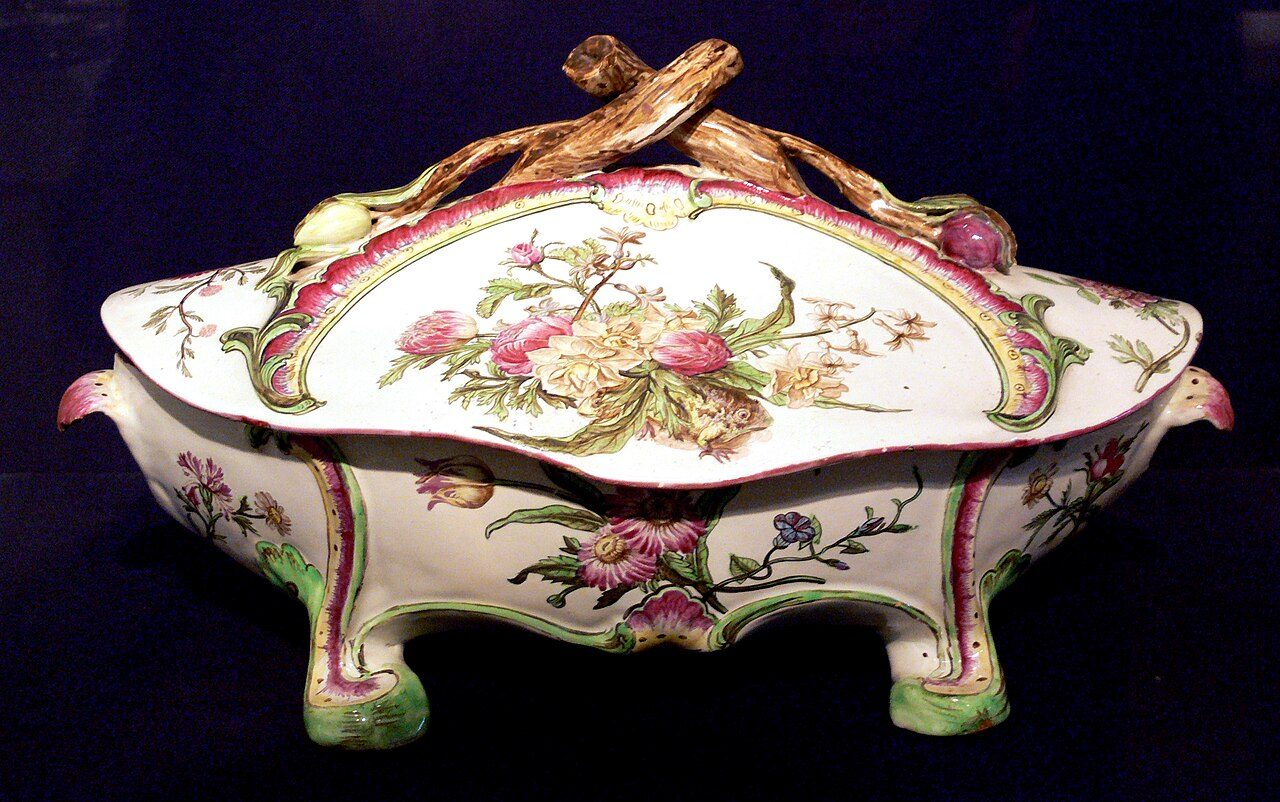
5 min read · 2 sourcesFaience or faïence (, French: [fajɑ̃s] ) is the general English language term for fine tin-glazed pottery. The invention of a white pottery glaze suitable for painted decoration, by the addition of an oxide of tin to the slip of a lead glaze, was a major advance in the history of pottery. The invention seems to have been made in Iran or the Middle East before the ninth century. A kiln capable of producing temperatures exceeding 1,000 °C (1,830 °F) was required to achieve this result, after millennia of refined pottery-making traditions. The term is now used for a wide variety of pottery from several parts of the world, including many types of European painted wares, often produced as cheaper versions of porcelain styles. English generally uses various other terms for well-known sub-types of faience. Italian tin-glazed earthenware, at least the early forms, is called maiolica in English, Dutch wares are called Delftware, and their English equivalents English delftware, leaving "faience" as the normal term in English for French, German, Spanish, Portuguese wares and those of other countries not mentioned (it is also the usual French term, and fayence in German). 1
Western Mediterranean
The Muslims brought the technique of tin-glazed earthenware to Al-Andalus, where the art of lustreware with metallic glazes was perfected. From at least the 14th century, Málaga in Andalusia and later Valencia exported these "Hispano-Moresque wares", either directly or via the Balearic Islands to Italy and the rest of Europe. Later these industries continued under Christian lords. "Majolica" and "maiolica" are garbled versions of "Maiorica", the island of Mallorca, which was a transshipping point for refined tin-glazed earthenwares shipped to Italy from the kingdom of Aragon at the close of the Middle Ages. This type of pottery owed much to its Andalusi inheritance. In Italy, locally produced tin-glazed earthenwares, now called maiolica, initiated in the fourteenth century, reached a peak in the late fifteenth and early sixteenth centuries. After about 1600, these lost their appeal to elite customers, and the quality of painting declined, with geometric designs and simple shapes replacing the complicated and sophisticated scenes of the best period. Production continues to the present day in many centres, and the wares are again called "faience" in English (though usually still maiolica in Italian). At some point "faience" as a term for pottery from Faenza in northern Italy was a general term used in French, and then reached English. 1
French and northern European faïence
The first northerners to imitate the tin-glazed earthenwares being imported from Italy were the Dutch. Delftware is a kind of faience, made at potteries round Delft in the Netherlands, characteristically decorated in blue on white. It began in the early sixteenth century on a relatively small scale, imitating Italian maiolica, but from around 1580 it began to imitate the highly sought-after blue and white Chinese export porcelain that was beginning to reach Europe, soon followed by Japanese export porcelain. From the later half of the century the Dutch were manufacturing and exporting very large quantities, some in its own recognisably Dutch style, as well as copying East Asian porcelain. In France, the first well-known painter of faïence was Masseot Abaquesne, established in Rouen in the 1530s. Nevers faience and Rouen faience were the leading French centres of faience manufacturing in the 17th century, both able to supply wares to the standards required by the court and nobility. Nevers continued the Italian istoriato maiolica style, painted with figurative subjects, until around 1650. Many others centres developed from the early 18th century, led in 1690 by Quimper in Brittany [1], followed by Moustiers, Marseille, Strasbourg and Lunéville and many smaller centres. The cluster of factories in the south were generally the most innovative, while Strasbourg and other centres near the Rhine were much influenced by German porcelain. The products of faience manufactories are identified by the usual methods of ceramic connoisseurship: the character of the clay body, the character and palette of the glaze, and the style of decoration, faïence blanche being left in its undecorated fired white slip. 1
Revival
In the 19th century two glazing techniques revived by Minton were: 1. Tin-glazed pottery in the style of Renaissance Italian maiolica and, 2. The pottery of coloured glazes decoration over unglazed earthenware molded in low relief. At the Great Exhibition of 1851 and at the International Exhibition of 1862 both were exhibited. Both are known today as Victorian majolica. The coloured glazes majolica wares were later also made by Wedgwood and numerous smaller Staffordshire potteries round Burslem and Stoke-on-Trent. At the end of the nineteenth century, William de Morgan re-discovered the technique of lustered faience "to an extraordinarily high standard". 1
Ancient frit wares called "faience"
The term faience broadly encompassed finely glazed ceramic beads, figures and other small objects found in Egypt as early as 4000 BC, as well as in the Ancient Near East, the Indus Valley Civilisation and Europe. However, this material is not pottery at all, containing no clay, but a vitreous frit, either self-glazing or glazed. The Metropolitan Museum of Art displays a piece known as "William the Faience Hippopotamus" from Meir, Egypt, dated to the Twelfth Dynasty of Egypt, c. 1981–1885 BC. Different to those of ancient Egypt in theme and composition, artefacts of the Nubian Kingdom of Kerma are characterized by extensive amounts of blue faience, which was developed by the natives of Kerma independently of Egyptian techniques. Examples of ancient faience are also found in Minoan Crete, which was likely influenced by Egyptian culture. Faience material, for instance, has been recovered from the Knossos archaeological site. 1
Types
Many centres of traditional manufacture are recognized, as well as some individual ateliers. A partial list follows. 1
The text above is adapted from the Wikipedia article “Faience”, available under the Creative Commons Attribution-ShareAlike 4.0 licence. 1
faience is tin-glazed pottery, according to the structured record cited below. This entry was generated automatically from that record and has not yet been reviewed by a person familiar with the tradition. 2
The source record links this tradition to 33 external registers, which can be verified through the citation. 2