The tradition & historical record
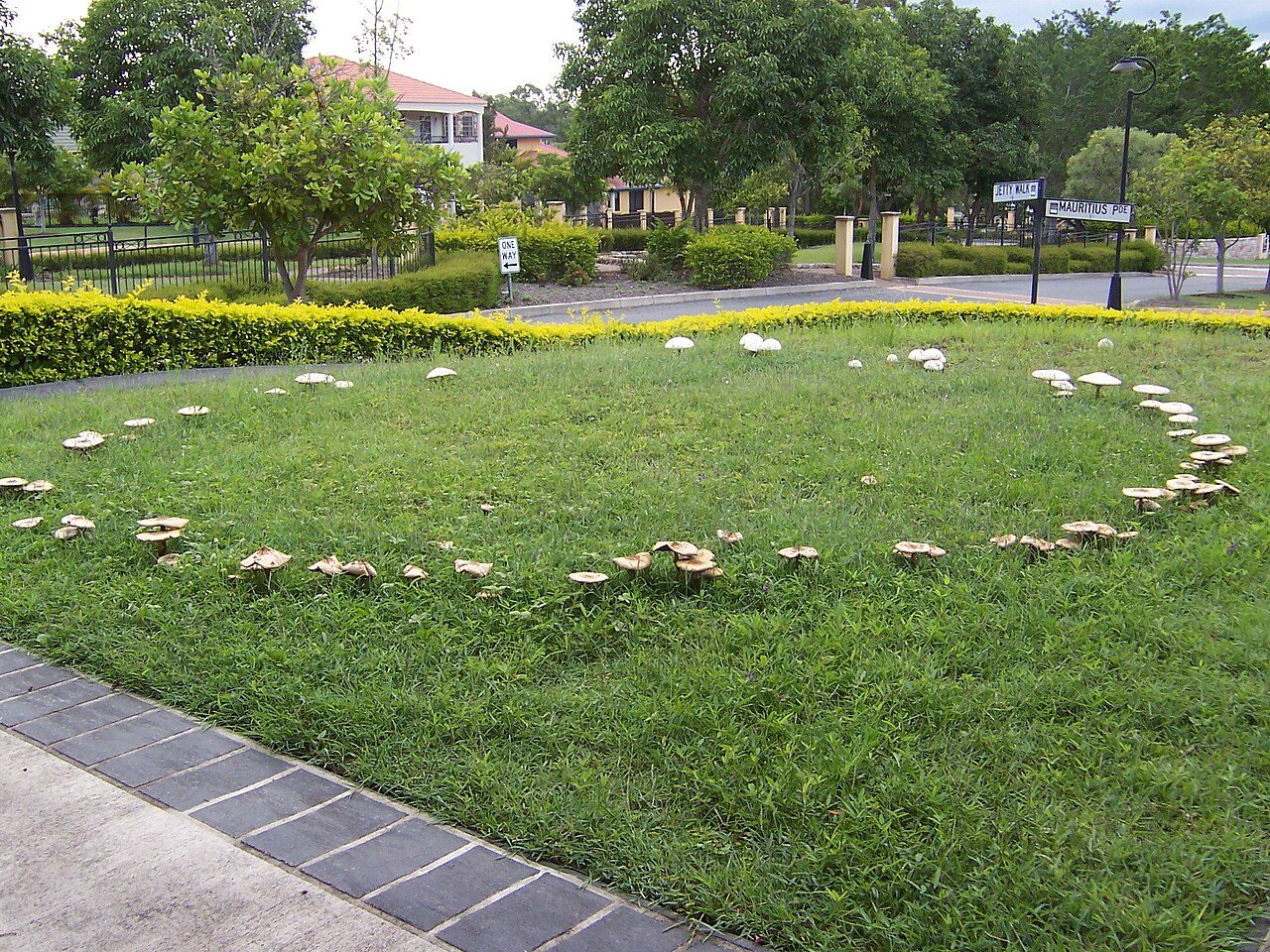
6 min read · 2 sourcesA fairy ring, also known as fairy circle, elf circle, elf ring or pixie ring, is a naturally occurring ring or arc of mushrooms. They are found mainly in forested areas, but also appear in grasslands or rangelands. Fairy rings are detectable by sporocarps (fungal spore pods) in rings or arcs, as well as by a necrotic zone (dead grass), or a ring of dark green grass. Fungus mycelium is present in the ring or arc underneath. The rings may grow to over 10 metres (33 ft) in diameter, and they become stable over time as the fungus grows and seeks food underground. Fairy rings are the subject of much folklore and myth worldwide, particularly in Western Europe. They are alternately seen as hazardous or dangerous places linked with witches or the Devil, or as a sign of good fortune. 1
Genesis
The mycelium of a fungus growing in the ground absorbs nutrients by secretion of enzymes from the tips of the hyphae (thread-like branching filaments making up the mycelium). This breaks down larger molecules in the soil into smaller molecules that are absorbed through the hyphae walls near their growing tips. The mycelium moves outward from the center, and when the nutrients in the center are exhausted, the center dies, forming a living ring, from which the fairy ring arises. There are two theories regarding the process involved in creating fairy rings. One states that the fairy ring is begun by a spore from the sporocarpus. The underground presence of the fungus can also cause withering or varying colour or growth of the grass above. The second theory, which is presented in the investigations of Japanese scientists on the Tricholoma matsutake species, shows that fairy rings could be established by connecting neighbouring oval genets of these mushrooms. If they make an arc or a ring, they continuously grow about the centre of this object. 1
Necrotic or rapid growth zones
One of the manifestations of fairy ring growth is a necrotic zone—an area in which grass or other plant life has withered or died. During a dry year, these zones are caused by the mycelia, which coat the roots of grasses and other herbs in meadows. After some time, they are removed by biotic factors from the ground; at this stage, a zone on the surface soil becomes visible. Patterns other than the basic ring or arc are also possible: circles, doubled arcs, sickle-shaped arcs, and other complicated formations are also formed by this process. Fungi can deplete the soil of readily available nutrients such as nitrogen, causing plants growing within the circle to be stressed, which leads to plant discoloration. Some fungi also produce chemicals that act like hormones called gibberellins, which affect plant growth, causing rapid luxuriant growth. Long-term observations of fairy rings on Shillingstone Hill in Dorset, England, further suggested that the cycle depended on the continuous presence of rabbits. Chalky soils on higher elevations in the counties of Wiltshire and Dorset in southern England used to support many meadow-type fairy rings. Rabbits crop grass short in open areas and produce nitrogen-rich droppings. Mushrooms need more soil nitrogen than grass does. A ring can start from only a few spores from which the mycelium develops; the fruiting bodies of the mushrooms appearing only later when sufficient mycelial mass has been generated to support them. Subsequent generations of fungi grow only outward because the parent generations have depleted their local nitrogen levels. Meanwhile, rabbits keep cropping the grass, but do not eat the fungi, allowing them to grow through their competition to tower, relatively, above the grass. 1
Types
There are two generally recognised types of fairy ring fungus. Those found in the woods are called tethered because they are formed by mycorrhizal fungi living in symbiosis with trees. Meadow fairy rings are called free because they are disconnected from other organisms. These mushrooms are saprotrophic. The effects on the grass depend on the type of fungus that is growing; when Calvatia cyathiformis is growing in the area, grass grows more abundantly; however, Leucopaxillus giganteus causes the grass to wither. 1
Species involved
About 60 mushroom species can grow in the fairy ring pattern. The best known is the edible Scotch bonnet (Marasmius oreades), commonly known as the fairy ring champignon. One of the largest rings ever found is near Belfort in northeastern France. Formed by Infundibulicybe geotropa, it is thought to have a radius of about 300 metres (980 ft) and to be over 700 years old. On the South Downs in southern England, Calocybe gambosa has formed huge fairy rings that also appear to be several hundred years old. 1
Oral tradition and folklore
A great deal of folklore surrounds fairy rings. Their names in European languages often allude to supernatural origins; they are known as ronds de sorcières ("witches' circles") in French, and Hexenringe ("witches' rings") in German. In German tradition, fairy rings were thought to mark the site of witches' dancing on Walpurgis Night, and Dutch superstition claimed that the circles show where the Devil set his milk churn. In Tyrol, folklore attributed fairy rings to the fiery tails of flying dragons; once a dragon had created such a circle, nothing but toadstools could grow there for seven years. European superstitions routinely warned against entering a fairy ring. French tradition reported that fairy rings were guarded by giant bug-eyed toads that cursed those who violated the circles. In other parts of Europe, entering a fairy ring would result in losing an eye. Fairy rings are associated with diminutive spirits in the Philippines. Western European traditions, including English, Scandinavian, and Celtic, claimed that fairy rings are the result of elves or fairies dancing. Such ideas dated to at least the mediæval period; the Middle English term elferingewort ("elf-ring"), meaning "a ring of daisies caused by elves' dancing" dates to the 12th century. In his History of the Goths (1628), Swedish writer Olaus Magnus makes this connection, saying that fairy rings are burned into the ground by the dancing of elves. British folklorist Thomas Keightley noted that in Scandinavia in the early 19th century, beliefs persisted that fairy rings (elfdans) arose from the dancing of elves. 1
The text above is adapted from the Wikipedia article “Fairy ring”, available under the Creative Commons Attribution-ShareAlike 4.0 licence. 1
fairy ring is natural trace of the circular growth front of mushroom mycelium, according to the structured record cited below. This entry was generated automatically from that record and has not yet been reviewed by a person familiar with the tradition. 2
The source record links this tradition to 10 external registers, which can be verified through the citation. 2