The tradition & historical record
6 min read · 2 sourcesA fairy tale (alternative names include fairytale, fairy story, household tale, magic tale, or wonder tale) is a short story that belongs to the folklore genre. Such stories typically feature magic, enchantments, and mythical or fanciful beings. In most cultures, there is no clear line separating myth from folk or fairy tale; all these together form the literature of preliterate societies. Fairy tales may be distinguished from other folk narratives such as legends (which generally involve belief in the veracity of the events described) and explicit moral tales, including beast fables. Prevalent elements include dragons, dwarfs, elves, fairies, giants, gnomes, goblins, griffins, merfolk, monsters, monarchy, pixies, talking animals, trolls, unicorns, witches, wizards, woodwoses, magic, and enchantments. In less technical contexts, the term is also used to describe something blessed with unusual happiness, as in "fairy-tale ending" (a happy ending) or "fairy-tale romance". Colloquially, the term "fairy tale" or "fairy story" can also mean any far-fetched story or tall tale; it is used especially to describe any story that is not only untrue, but also could not possibly be true. Legends are perceived as real within their culture; fairy tales may merge into legends, where the narrative is perceived both by teller and hearers as being grounded in historical truth. 1
Terminology
Some folklorists prefer to use the German term Märchen or "wonder tale" to refer to the genre rather than fairy tale, a practice given weight by the definition of Thompson in his 1977 [1946] edition of The Folktale: 1
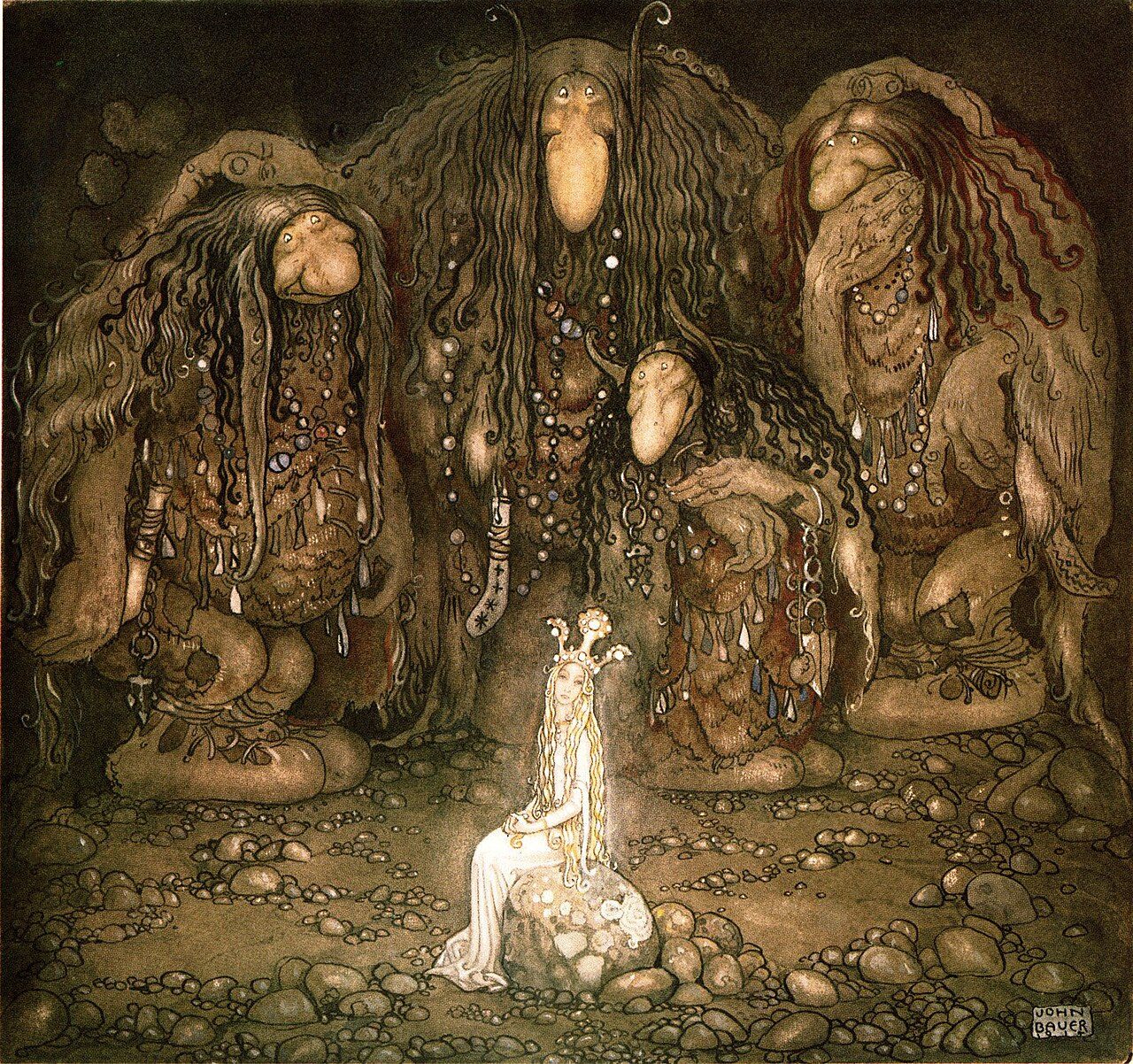
"...a tale of some length involving a succession of motifs or episodes. It moves in an unreal world without definite locality or definite creatures and is filled with the marvellous. In this never-never land, humble heroes kill adversaries, succeed to kingdoms and marry princesses." The characters and motifs of fairy tales are simple and archetypal: princesses and goose-girls; youngest sons and gallant princes; ogres, giants, dragons, and trolls; wicked stepmothers and false heroes; fairy godmothers and other magical helpers, often talking animals; glass mountains; and prohibitions and breaking of prohibitions. 1
Definition
Although the fairy tale is a distinct genre within the larger category of folktale, the definition that marks a work as a fairy tale is a source of considerable dispute. The term itself comes from the translation of Madame D'Aulnoy's Conte de fées, first used in her collection in 1697. Common parlance conflates fairy tales with beast fables and other folktales, and scholars differ on the degree to which the presence of fairies and/or similarly mythical beings (e.g., elves, goblins, trolls, giants, huge monsters, or mermaids) should be taken as a differentiator. Vladimir Propp, in his Morphology of the Folktale, criticized the common distinction between "fairy tales" and "animal tales" on the grounds that many tales contained both fantastic elements and animals. Nevertheless, to select works for his analysis, Propp used all Russian folktales classified as folklore, Aarne–Thompson–Uther Index 300–749,—in a cataloguing system that made such a distinction—to gain a clear set of tales. His own analysis identified fairy tales by their plot elements, but that in itself has been criticized, as the analysis does not lend itself easily to tales that do not involve a quest, and the same plot elements are found in non-fairy tale works. 1
Were I asked, what is a fairytale? I should reply, Read Undine: that is a fairytale ... of all fairytales I know, I think Undine the most beautiful. As Stith Thompson points out, talking animals and the presence of magic seem to be more common to the fairy tale than fairies themselves. However, the mere presence of animals that talk does not make a tale a fairy tale, especially when the animal is clearly a mask on a human face, as in fables. In his essay "On Fairy-Stories", J. R. R. 1
History of the genre
Originally, stories that would contemporarily be considered fairy tales were not marked out as a separate genre. The German term "Märchen" stems from the old German word "Mär", which means news or tale. The word "Märchen" is the diminutive of the word "Mär", therefore it means a "little story". Together with the common beginning "once upon a time", this tells us that a fairy tale or a märchen was originally a little story from a long time ago when the world was still magic. (Indeed, one less regular German opening is "In the old times when wishing was still effective".) The French writers and adaptors of the conte de fées genre often included fairies in their stories; the genre name became "fairy tale" in English translation and "gradually eclipsed the more general term folk tale that covered a wide variety of oral tales". Jack Zipes also attributes this shift to changing sociopolitical conditions in the seventeenth and eighteenth centuries that led to the trivialization of these stories by the upper classes. Roots of the genre come from different oral stories passed down in European cultures. The genre was first marked out by writers of the Renaissance, such as Giovanni Francesco Straparola and Giambattista Basile, and stabilized through the works of later collectors such as Charles Perrault and the Brothers Grimm. In this evolution, the name was coined when the précieuses took up writing literary stories; Madame d'Aulnoy invented the term Conte de fée, or fairy tale, in the late 17th century. Before the definition of the genre of fantasy, many works that would now be classified as fantasy were termed "fairy tales", including Tolkien's The Hobbit, George Orwell's Animal Farm, and L. Frank Baum's The Wonderful Wizard of Oz. 1
Folk and literary
The fairy tale, told orally, is a sub-class of the folktale. Many writers have written in the form of the fairy tale. These are the literary fairy tales, or Kunstmärchen. The oldest forms, from Panchatantra to the Pentamerone, show considerable reworking from the oral form. The Grimm brothers were among the first to try to preserve the features of oral tales. Yet the stories printed under the Grimm name have been considerably reworked to fit the written form. Literary fairy tales and oral fairy tales freely exchanged plots, motifs, and elements with one another and with the tales of foreign lands. The literary fairy tale came into fashion during the 17th century, developed by aristocratic women as a parlour game. This, in turn, helped to maintain the oral tradition. According to Jack Zipes, "The subject matter of the conversations consisted of literature, mores, taste, and etiquette, whereby the speakers all endeavoured to portray ideal situations in the most effective oratorical style that would gradually have a major effect on literary forms." Many 18th-century folklorists attempted to recover the "pure" folktale, uncontaminated by literary versions. 1
History
The oral tradition of the fairy tale came long before the written page. 1
The text above is adapted from the Wikipedia article “Fairy tale”, available under the Creative Commons Attribution-ShareAlike 4.0 licence. 1
fairy tale is fictional story typically featuring folkloric fantasy characters and magic, according to the structured record cited below. This entry was generated automatically from that record and has not yet been reviewed by a person familiar with the tradition. 2
The source record links this tradition to 58 external registers, which can be verified through the citation. 2